Nepal Flood Disaster Enters Third Day: 543 Dead, 1,535 Missing (Comprehensive)
Death Toll Jumps by 180 in a Single Day
Nepal Attempts to Rescue Over 100 Trapped in Hydropower Plant
"No Need for Assistance from Other Countries at This Time"
The death toll from the massive flood that struck the Himalayan mountain region bordering Nepal and China has reached 543. The number of missing persons now exceeds 1,500, and there are still nine Koreans who remain unaccounted for.

A woman is being assisted by others as she arrives at the military training facility, Mytali Barracks, in Trishuli, Nuwakot District, Nepal, on the 28th (local time). Photo by Reuters·Yonhap News
View original imageAccording to CNN and other sources on the 28th (local time), the Nepal Police announced that, as of the 26th, 538 people have died due to flooding in the northern Bagmati province of Nepal.
In neighboring Gyirong County, Rikaze City, in China’s Tibet Autonomous Region, five people died in landslides caused by the floods. The total number of fatalities in the two countries now stands at 543. The death toll, which was 362 the previous day, surged by more than 180 within a single day as more bodies were discovered across Nepal.
The total number of missing persons is 1,535, with 977 in Nepal and 558 in Tibet, China. Among them, more than 500 are foreigners from over 30 countries, including India and the United States.
The whereabouts of the nine Korean nationals also remain unknown. They are employees of Korea South-East Power and Doosan Enerbility, who were working on a hydroelectric power plant in the area affected by the flood.
The Nepalese government has so far declined offers of rescue assistance from other countries. While South Korea, India, China, the United States, the United Kingdom, and Japan have proposed sending rescue teams, Nepal has stated that it is able to manage the efforts with its own capacity for now.
Lok Bahadur Chetri, spokesperson for the Nepal Ministry of Foreign Affairs, said, “Our security agencies are currently conducting search and rescue operations.” He added, “Should we require specialized assistance, we will request it.”

Nepal-China border checkpoint during the Great Flood. Screenshot from social media X.
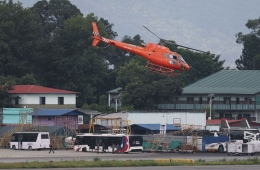
View original imageRescue operations are ongoing. On this day, the Nepal Army deployed two helicopters to rescue more than 100 people trapped inside the flooded UpTrishuli (UT)-1 Hydropower Plant tunnel. This is the facility that the missing Korean workers were building.
According to the Nepal Prime Minister's Office, about 350 workers and residents who were trapped in the tunnel have been rescued. Authorities in Nepal mobilized more than 14,800 security personnel, rescuing 3,742 people from the affected area by the afternoon.
The International Federation of Red Cross and Red Crescent Societies estimates that at least 93,000 people have been affected by this flood. There is growing concern about the possibility of additional floods.
The cause of the disaster is believed to be the collapse of a Himalayan glacier. At an altitude of 5,200 meters on Mount Langtang Lirung (7,234 meters above sea level), a glacier and rocks with a width of about 600 meters collapsed, sending a massive flow of ice and debris approximately 70 kilometers downstream.
Hot Picks Today
!["Sold Already? That Must Sting"... Gold Surges 15% in a Month, U.S. Treasuries Behind the Rally [Weekend Money]](https://cwcontent.asiae.co.kr/asiaresize/93/2026082718281195698_1787822890.png) "Sold Already? That Must Sting"... Gold Surges 15% in a Month, U.S. Treasuries Behind the Rally [Weekend Money]
"Sold Already? That Must Sting"... Gold Surges 15% in a Month, U.S. Treasuries Behind the Rally [Weekend Money]
- "We Can't Live With So Many Tourists"... Japan to Impose Nightly Accommodation Tax as Visitor Numbers Soar
- "Excited for 400,000 Won" Turns to Anger: "It Feels Like an Insult" as Basic Pension Leaves Seniors with No Income Gain
- "Quietly Among Ourselves"... 14,000 Unmanned Mahjong Parlors Open in 3 Years as Millennials and Gen Z Flock in China
- "Who Would Visit Now?" Foot Traffic Plummets... Japan Appeals to Koreans for Help—Here's Why
There have also been suggestions that a “glacial lake outburst flood” may have occurred, where water from a lake formed by melted glacier bursts out all at once. Experts warn that due to climate change, the risk of such large-scale floods in the Himalayas could increase in the future.
© The Asia Business Daily. All rights reserved. Unauthorized AI training and use prohibited.