Korea and Japan Battle for Market Leadership... 'Korean Spicy' as a Double-Edged Sword [The Rise of K-Ramen] ③
Nongshim and Samyang Foods U.S. Subsidiaries Interviewed
Japanese Brands Hold More Shelf Space,
But K-Ramen Is Growing Rapidly
"Fierce Competition in the Premium Ramen Segment
Expanding Lineups Beyond Spicy Flavors"
"The biggest change we are feeling locally is that Korean ramen has moved beyond being a specialty item for a niche group of consumers and is now perceived by major US distributors as an important product category within ramen overall." (Representative from Nongshim America)
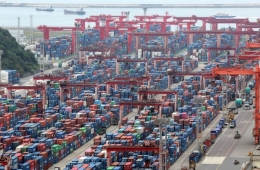
The competition between Korea and Japan over the global instant noodle market—worth as much as 70 trillion KRW—continues to intensify. While Japan still maintains the lead in market share, Korea's growth rate is now superior. In particular, as Korean ramen’s presence in the US, a key hub of the global noodle market, grows stronger, the rivalry between ramen companies from both countries over shelf space has escalated.

A consumer is selecting a K-Ramen product displayed in the Asian food section of a large supermarket in Santa Clara County, California, USA. Photo by Hyunjin Jung
View original imageAccording to Euromonitor, the US instant noodle market was worth $3.2 billion (about 4.4 trillion KRW) as of 2024, ranking fourth globally with a 6.5% market share. China leads with 34.9%, followed by Japan (10.1%) and Indonesia (7.6%). Korea ranks fifth with a 4.3% share.
However, among the top five markets by size, the US shows the highest growth potential. Over the past five years, the US reported the highest average annual growth rate, at 16.1%. Although China (2.0%), Indonesia (6.5%), and Korea (0.4%) all recorded positive growth, their rates were relatively modest, while Japan experienced a 5.3% contraction.


Both Nongshim and Samyang Foods began exporting ramen to the US in the 1970s, pioneering into overseas markets. Nongshim established local manufacturing plants in 2005 and 2022 to develop its production system, while Samyang Foods currently manufactures all products domestically and exports to the US. Both companies compete with Japanese firms such as Nissin Foods and Toyo Suisan for shelf space, having secured placements at key retailers like Walmart, Costco, and Kroger.
Representatives from both Nongshim and Samyang Foods concurred that Japanese ramen brands in the US have not yet lost their competitive edge. Japanese companies have established extensive local distribution networks over many years, leveraging affordable prices and diverse product lines to maintain a strong position. However, they also noted that they have started to sense some changes this year. They explained that K-ramen is no longer confined to the Asian foods section, but is now being relocated to main display areas and given more prominent placement.
A Nongshim representative said, "The range of Korean ramen products and touchpoints with consumers continue to expand across major US retail channels." A Samyang Foods representative added, "While in terms of current shelf space, Japanese brands still dominate, the share of newly allocated retail space—meaning additional space granted by retail channels this year—has been much higher for Korean brands." The representative continued, "Whereas we used to make proposals to distribution channels, there has been a growing trend of retailers approaching us first to discuss how to grow the category together."
Until now, competition in the US instant noodle market had focused on pricing and distribution networks; however, it is now expanding to include taste, quality, branding, and product differentiation. Notably, competition in the US market is shifting from super-cheap noodles to premium ramen. Currently, premium ramen accounts for about 30% of the US instant noodle market, but these higher-priced, higher-margin products are driving the market's growth.
A Samyang Foods representative remarked, "Japanese companies are focusing on strengthening their premium lines, and brands from China and Southeast Asia are also targeting the premium segment. There has been a noticeable increase in launches of new spicy premium products by Japanese brands, and their stances are more defensive during shelf negotiations. In this sense, competition is clearly intensifying."
A Nongshim representative explained, "There used to be a distinction: 'Japan equals low price, Korea equals premium,' but this line is fading. Japanese companies are expanding their premium selections as well, and consumers are now choosing products based on a range of factors, not just price—such as taste, quality, and brand." The representative added, "Ultimately, the key competitive edge in the premium market is offering taste, quality, and differentiated value that live up to the price."
Both companies claim that K-ramen is particularly competitive in the premium market, thanks to distinctive flavor profiles and superior product quality. The fact that packaging now includes phrases like "Korean Style" or "Korean Spicy" or displays Hangul is seen as evidence that K-ramen has become mainstream. They also pointed to the increase in spicy product launches as proof of K-ramen's popularity.
However, K-ramen is not without its weaknesses. The very spiciness that fueled the global K-ramen craze can also be a barrier to expanding the market. For consumers unaccustomed to spicy flavors, the spice level can deter purchase—prompting companies to focus on diversifying their product lines. Korean ramen also faces some disadvantages regarding price competitiveness compared to Japanese brands, and the need to strengthen their relationships with distribution channels. For Samyang Foods in particular, the lack of a local production facility is cited as a drawback.
Hot Picks Today
 He Left It in the Car and Forgot... "I Nearly Collapsed with Joy": Man Wins $1.48 Million Lottery
- "Maybe I'll just go to Japan," they'll say... Why are foreign visitors to Korea "flooding with complaints"? [2026 National Assembly Audit]
- "Everyone else is retiring"... People who say they'll work until 74: What's going on? [Pension Asset Polarization] 1
- "'Nodding Off' on the Subway? Here's Why Koreans Are Getting Even Less Sleep"
- Beachgoer Finds 'Plastic' That Turns Out to Be Perfume Ingredient Worth More Than Twice as Much as Gold
A Nongshim representative said, "We will target the US market by expanding brand experiences, strengthening mainstream distribution, and broadening our product portfolio. Our goal is to make Korean ramen not just a temporary K-food trend, but a staple that American consumers choose as part of their everyday diet." A Samyang Foods representative noted, "We intend to increase our market share through expanding existing distribution channels, diversifying sales formats and portfolios, and attracting a broader range of consumers."
© The Asia Business Daily. All rights reserved. Unauthorized AI training and use prohibited.