Wi Seongrak: "North Korea-U.S. Dialogue Must Lead to Progress on Nuclear Issue... No 'Korea Passing'"
"Actively Utilizing Trump's Moves to Resume Dialogue"
Cooperating with the U.S. to Achieve Substantive Progress on North Korea's Nuclear Issue
Vigilant Against Loosening of Security Posture... "Policy Coordination with the U.S. More Important Than Ever"
Regional Dynamics Including North Korea Discussed with Wang Yi of China
The Blue House has expressed its intention to actively utilize U.S. President Donald Trump's recent moves to resume North Korea-U.S. dialogue. However, it emphasized that even if talks between the leaders of North Korea and the U.S. are resumed, they must lead to substantive progress on North Korea's nuclear issue. The administration also stated that it plans to strengthen South Korea-U.S. cooperation to prevent what is known as "Korea passing," or the sidelining of South Korea, and any loosening of the security posture.

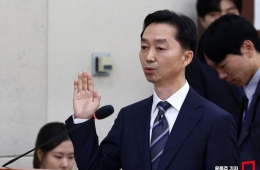
Seongrak Wi, Director of the National Security Office, is conducting a pre-briefing on the upcoming visits to the United States and South America at the Blue House press briefing room on July 22, 2026. Photo by Yonhap News Agency
View original imageOn August 28, Seongrak Wi, Director of the National Security Office, held a press briefing at the Blue House regarding foreign affairs issues and said, "As a party directly concerned with peace on the Korean Peninsula and as a pacemaker, we will support the resumption of North Korea-U.S. dialogue by helping build trust between the two sides and encourage a return to dialogue, in line with President Trump's efforts." The administration has thus officially stated its intention to seize the opportunity to restore North Korea-U.S. dialogue, in light of President Trump's recent move to scale down joint South Korea-U.S. drills and field exercises and his continued willingness to engage with North Korea.
Director Wi also laid out the government's guiding principles during the process of resuming North Korea-U.S. dialogue. He said, "It is important to collaborate with the U.S. so that the reopening of North Korea-U.S. talks in the future will lead not only to the establishment of a peace regime on the Korean Peninsula but also to meaningful progress on the North Korean nuclear issue." He added, "At the same time, it is also critical to ensure that our security posture does not weaken or that Korea is not sidelined during this process." This is interpreted as signaling both a determination to maintain deterrence and a firm security posture during the dialogue phase, while also seeking to preempt concerns in some quarters that Korea's role might diminish when the leaders of North Korea and the U.S. engage in direct talks.
Recently, there have been a series of moves raising expectations for a resumption of dialogue between North Korea and the United States. On July 20, President Trump once again referred to his relationship with North Korean leader Kim Jong Un in front of the press and posted additional photos of the two leaders. In response, Kim Yo Jong, Deputy Director of the Central Committee of North Korea's Workers' Party, released a statement on international affairs on July 19, followed by another statement regarding inter-Korean relations on July 20.
The Blue House is closely monitoring this flow as a signal increasing the possibility of North Korea-U.S. dialogue, while also focusing on coordinating current issues between South Korea and the United States. Director Wi said, "Policy alignment and communication between South Korea and the U.S. are more important now than ever to ensure smooth progress on these matters," adding, "There are currently a range of ongoing issues between the two countries, including investment, Coupang, security cooperation, intelligence sharing, and the transfer of wartime operational control. The government is working diligently to coordinate these issues and strengthen the U.S.-Korea cooperative system."
Meanwhile, Director Wi also stated that he held a meeting and luncheon lasting about two hours with Director Wang, who visited Korea on July 20, and that both sides agreed to operate a regular South Korea-China dialogue channel. He explained, "As part of this, we agreed to consult about my visit to China at a mutually convenient time." In addition, the two sides shared the view that they should jointly prepare for President Lee's attendance at the Asia-Pacific Economic Cooperation (APEC) Summit in China this coming November.
Hot Picks Today
 "Ppalli-ppalli Korea, No Wonder It Stings": Plunges from No. 1 to 22nd, Falls Behind Vietnam and Thailand
- "Even New York Taxi Drivers Are Talking About the KOSPI; South Korean Market to Top 9,000 Again Within a Year"... 'Wall Street's Stock-Picking Ace' Names His Picks
- "'Some Get KRW 74 Million, While a One-Day Difference Means a KRW 34 Million Gap' Sparks Outrage... President Weighs In"
- [Breaking] Financial Authorities: "Security Breaches at 16 Financial Firms... About 100,000 Records Leaked"
- 220 cm-Tall 26-Year-Old Woman Dies Less Than a Year After Giving Birth... Deadly Complications Hidden Behind 'Gigantism'
Discussions also touched on the regional situation, including North Korea. President Lee met with Director Wang for about 30 minutes and explained South Korea's position on denuclearization and peace policy in detail. In response, Director Wang said, "China's policy on the Korean Peninsula remains consistent and stable," and added, "We will continue to play a constructive role for the peace and stability of the Korean Peninsula."
© The Asia Business Daily. All rights reserved. Unauthorized AI training and use prohibited.