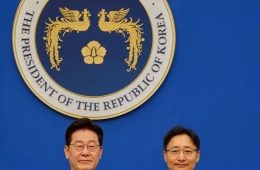
Mayor Lee Urges Swift Power and Water Supply for Semiconductor Complex, Submits Key Issues to Government
Sangil Lee, Mayor of Yongin, Submits Proposal on Key Issues at National Policy Briefing
Requests Government Support for Early Operation... Suggests Establishing a Public-Private-Government Consultative Body
Calls for Advancement of Projects Including Gyeonggang Line Extension, JTX, and Semiconductor Expressway
Sangil Lee, Mayor of Yongin Special City in Gyeonggi Province, has requested the government to expedite the supply of electricity and water, as well as the construction of roads and railway networks, in order to ensure the early operation of the Yongin Semiconductor Megacluster.

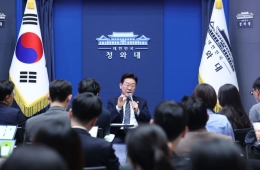
On the 27th, Mayor Lee attended the National Policy Briefing for city, county, and district leaders, held at the Presidential Blue House guesthouse, and submitted a proposal containing these requests. The event was attended by President Jaemyung Lee, Prime Minister Seongsook Han, Vice Prime Minister and Minister of Economy and Finance Yuncheol Gu, Minister of the Interior and Safety Hojung Yoon, and local government heads from across the country.
The recommendations Mayor Lee submitted to the government covered two main points: "Policies for Early Operation of the Yongin Semiconductor Megacluster" and "Prompt Advancement of National Railway and Road Projects for Timely Construction of the Yongin Semiconductor Industry."
On June 29, the government announced at the "Public Briefing on the Three Major Mega Projects for National Semiconductor Industry Competitiveness Enhancement" that the completion of all six production facilities at the Samsung Electronics Yongin Advanced System Semiconductor National Industrial Complex will be brought forward by seven years, from 2047 to 2040. Completion of the four production facilities at the SK hynix Yongin Semiconductor Cluster General Industrial Complex will also be advanced by twelve years, from 2045 to 2033.
Mayor Lee emphasized that as the construction schedules for production facilities have been accelerated, plans for the supply of electricity and water must also be revised accordingly.

In order to operate all six production facilities at the Samsung Electronics national industrial complex, approximately 10GW of electricity and 764,000 tons of water per day are needed. For the four production facilities at SK hynix’s general industrial complex, it is estimated that about 5.53GW of electricity and 308,000 tons of water per day will be required.
Mayor Lee underlined the need to construct a liquefied natural gas (LNG) power plant within the national industrial complex to supply 3GW of electricity for the first and second Samsung Electronics production facilities, and for the plan to mass-produce semiconductors at the first facility by 2029 to proceed without a hitch.
He also requested that the government’s electricity supply plans for the first SK hynix production facility, scheduled for completion in early next year, proceed as planned to ensure normal operation. Additionally, he suggested the formation of a "public-private-government consultative body" involving central and local governments, project operators, and corporations to respond swiftly to any conflicts that may arise in areas where transmission lines or water supply pipelines pass through.
Mayor Lee also called for the expansion of transportation networks connecting the semiconductor industrial complexes and surrounding areas. The National Road Route 45 expansion project aims to widen a 12.53km section, from the Namdong Daechon Interchange in Cheoin-gu through the national industrial complex to the Jangseo Interchange in Yangseong-myeon, Anseong City, from the current four lanes to a maximum of six to eight lanes. The total project cost is 891.1 billion won. The Route 45 expansion project, which traverses the national industrial complex, officially commenced following a bid announcement by the Seoul Regional Construction and Management Administration on the 12th.

Panoramic view of the Yongin Semiconductor Cluster General Industrial Complex. Provided by Yongin City
View original imageMayor Lee also requested that the completion schedules for two other projects—the new construction and expansion of the 5.1km section from Jangji, Hwaseong to Namsa, Yongin on Local Road Route 82, and the 5.3km expansion of the Bongmyeong to Agok section on Provincial Road Route 321—be brought forward to 2029, instead of the originally scheduled 2030–2031, in line with the operation timing of the first Samsung Electronics production facility.
In the rail sector, he called for the inclusion of five projects in the government’s 5th National Railway Network Construction Plan: Gyeonggi Southern Regional Railroad, Gyeonggang Line extension, Bundang Line extension, Gyeonggi Southern East-West Line, and the SRT quadruple-track project as well as the construction of Guseong Station.
As an alternative to the Gyeonggang Line extension, he requested the prompt completion of the preliminary feasibility study for the privately funded Metropolitan Express Railway (JTX) project, jointly promoted by seven local governments including Yongin. Yongin City expects that, once this line opens, residents will be able to travel from Yongin to Jamsil in Seoul or Osong Station in Cheongju within 30 minutes.
The Gyeonggi Southern Regional Railroad is essential infrastructure to alleviate transportation inconveniences for 4.2 million citizens of Yongin, Seongnam, Suwon, and Hwaseong, as well as to support the growth of advanced industries such as semiconductors and to ensure balanced development of southern Gyeonggi Province within the Seoul metropolitan area.

Yongin Special City Major Road Network Construction Plan. Provided by Yongin City
View original imageMayor Lee also emphasized the need for the construction and expansion of major roads, including the Semiconductor Expressway, to address chronic congestion caused by overcapacity on key roads within the city and to accommodate the increased traffic from large-scale development projects such as the semiconductor national industrial complex, general industrial complex, and Yongin Idong Public Housing District.
In the road sector, he requested the prompt execution of strategic environmental impact assessments for the Semiconductor Expressway, as well as for the Uiwang~Yongin~Gwangju, Yongin~Chungju, and Yongin~Seongnam Expressways. He also called for the expedited preliminary feasibility study for the Second Yongin~Seoul Expressway project to be carried out quickly.
He further proposed smooth progress on the improvement project for National Local Road Route 57, Wonsam~Mapyeong (12.3km), and the new construction of National Main Road Route 42, Namdong~Yangji (10.6km). Among these, the Wonsam~Mapyeong improvement project passed the preliminary feasibility study by the Ministry of Strategy and Finance on the 26th.
Hot Picks Today
 "Tried leveraged semiconductor stocks, watched 3.5 billion won shrink to 200 million won": Salaried investor in tears
- "Please Let Me Go Home"... Customers Trapped in Department Store Parking Lot for 5 Hours Vent Their Anger
- "I Should Enjoy It After Retirement": Prices Quadruple... Memberships Over 100 Million Won Popular, but Closures Mount
- “The Strong Drink This” Goes Viral on Social Media... What China's Millennials and Gen Z Are Hooked on After Ditching Coffee and Milk Tea
- "Come Live With Me on My Farm": Man Sells Everything and Travels 1,930 km, Trusting a Beautiful Woman
Additionally, Mayor Lee requested the prompt execution of strategic environmental impact assessments for the following projects: Semiconductor Expressway (Hwaseong~Yongin~Anseong, 45.3km), Uiwang~Yongin~Gwangju Expressway (32km), Yongin~Chungju Expressway (55km), and Yongin~Seongnam Expressway (15.4km). He also called for the swift completion of the preliminary feasibility study for the privately funded Second Yongin~Seoul Expressway (9.6km).

Mayor Lee stated, "A total of six semiconductor production facilities (fabs) are planned for the Samsung Electronics Advanced System Semiconductor National Industrial Complex in Idong and Namsa-eup, Yongin. The central government needs to take a more proactive role in building the necessary infrastructure, including land development, electricity and water supply for the national industrial complex, and the expansion of surrounding road networks. The Yongin semiconductor industrial complex has already completed administrative procedures and is in the land development stage, so its timely and successful operation is crucial for Korea to maintain its leading position in the global semiconductor market. Therefore, I urge the government to take responsibility and make every effort to ensure the complex becomes operational on schedule."
© The Asia Business Daily. All rights reserved. Unauthorized AI training and use prohibited.