"Hoe Instead of Shovel" Governor Shin Hyunsong Hints at 'Advanced Hike'... Pace to Be Adjusted Going Forward (Comprehensive 2nd Report)
Bank of Korea Raises Base Rate Back-to-Back to 3.00%
"Unconventional" Consecutive Hikes Driven by Upgraded Growth Outlook, Core Inflation Concerns
Governor Shin Repeatedly Stresses "Nipping Problems in the Bud with a Hoe Rather Than a Shovel" <
The Bank of Korea has raised the base interest rate to 3.00% per annum. This marks a back-to-back increase following last month, which, according to Bank of Korea Governor Shin Hyun-song, is an "unconventional" and proactive measure. The key factors behind the Bank of Korea's preemptive rate hike were the nation's economic growth rate and core inflation. The central bank significantly revised this year’s growth outlook upward to 3.3%, and projected that close-to-3% growth (2.9%) will be achieved next year as well. The core inflation rate, considered a good gauge of underlying demand pressure, was also raised to 2.5%. After the rate decision, Governor Shin repeatedly used the analogy, “It’s better to block an issue early with a hoe than later with a spade,” during a press briefing. With projected growth and inflation as such, he emphasized that a proactive monetary policy response is needed to maintain macroeconomic stability.
He stated that the pace of future hikes would remain gradual. The dot plot was also accommodative. The median rate forecast given by the Monetary Policy Board for a six-month outlook was 3.25%. According to the dot plot, out of four rate decisions scheduled for October and November of this year and January and February of next year, it is likely there will be one additional increase. Governor Shin said, "We expect a moderate pace of increases going forward," and added, "The effects of consecutive hikes must be assessed. As a preemptive response has been taken, we expect corresponding effects." Thus, the market interpreted the back-to-back hikes not as the prelude to further increases, but as bringing forward a planned hike. This interpretation was reinforced as Governor Shin, explaining the minority dissent for a rate hold (by Hwang Gun-il), commented, “Within the overall consensus, it can also be seen as simply a tactical difference.”

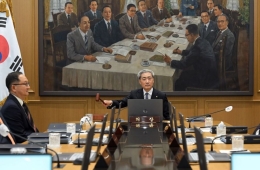
Shin Hyun-song, Governor of the Bank of Korea, is attending the Monetary Policy Committee plenary meeting held at the Bank of Korea in Jung-gu, Seoul on the 27th, tapping the gavel. Photo by Joint Press Corps
View original image"Preemptive Action, Less Intensity and Duration of Tightening... Reducing Economic Cost"
In the same press briefing, Governor Shin explained the reasoning behind raising the base rate consecutively, saying, "Above all, our economy is expected to show robust growth this year (3.3%) and next year (2.9%) thanks to the semiconductor market boom and resulting improvement in income conditions," and added, "With the core inflation rate likely to remain at a high level through next year (2.5% this year and next), there is a heightened risk of more widespread and prolonged inflation."
Although there is a lag before the benefits of improved income appear in major GDP accounts, he stated that preemptive hikes, rather than sudden, large increases at a later stage, are the way to minimize side effects. He emphasized, "Preemptive policy measures enable prompt control of inflation expectations compared to delayed responses, thereby reducing the intensity and duration of tightening, ultimately easing the growth burden and lowering the economic cost."

He still regards the exchange rate level as high. Governor Shin said, "It is still high compared to the levels we were familiar with in previous years," and explained, "Preemptive monetary policy will help stabilize market centers, including FX markets, and contribute to exchange rate stability. Early responses through monetary policy could further strengthen the won." As a result, import prices could be somewhat controlled and help mitigate inflation concerns. He also noted that, while monetary policy alone cannot stabilize housing prices, the consecutive rate hikes may at least help curb the rapid rise in home values to some extent.
Governor Shin also stated that the potential growth rate and neutral interest rate are being reassessed internally, suggesting that these figures could be revised upward. Whereas the GDP gap - the difference between the actual and the potential growth rate - was initially expected to turn positive early next year, he now believes this could happen much sooner. He explained that, depending on the indicators, the threshold for a positive change might already have been reached. Governor Shin reaffirmed that every upcoming meeting will be a "live meeting," and highlighted key economic indicators to watch before the October rate decision, including August and September consumer prices, nominal GDP to be released together with the provisional Q2 GDP, and sentiment indices.

Shin Hyun-song, Governor of the Bank of Korea, is striking the gavel at the Monetary Policy Committee meeting held on the 27th at the Bank of Korea in Jung-gu, Seoul. Photo by Joint Press Corps
View original imageFinal Rate: 'Growth Confidence' at 3.50% vs 'Somewhat Optimistic' at 3.25%
Market projections for the final interest rate level diverge. Junwoo Park, a researcher at Hana Securities, observed, "The Bank of Korea clearly regards 3.00% as a restrictive policy rate," and continued, "While gradual hikes are likely as the effects of previous increases are assessed, given the central bank's strong confidence in growth, there is no reason to expect a lower terminal rate than before." He projects a final rate of 3.50% if further hikes proceed in November this year and February next year.
On the other hand, Jina Kim, a researcher at Eugene Investment & Securities, anticipates a final rate of 3.25%. She noted, "For the final rate to rise to 3.50% rather than 3.25%, next year's 2.9% growth forecast needs to materialize." She explained, "The August economic outlook sharply upgraded forecasts for goods exports and imports and facility investment for both this year and the next, which means the government must fully realize the planned investment and fiscal policies currently under consideration." She assessed the projections as "somewhat optimistic," pointing out that this assumes the current semiconductor super-cycle continues at this year's pace through next year (with the semiconductor export growth rate premised at the high teens percent this year and low teens percent next year). She added that if inflation indexes through October are not as stable as expected or oil prices rebound, the possibility of a rate hike in November should remain open.

"Current Account Surplus to Reach USD 450 Billion This Year" ... Close to Four Times the Previous Record High
Meanwhile, in its revised economic outlook released today, the Bank of Korea projected that the nation's current account surplus for this year will reach USD 450 billion. This nearly quadruples the previous record high of USD 123.1 billion last year and is a major upward revision from the May forecast of USD 250 billion. For next year, the central bank projects a surplus of USD 430 billion, similar to this year’s revised estimate.
Hot Picks Today
![[Exclusive] "Are We Supporting Chinese Families Too?"... National Pension Handouts Extend to Overseas Parents and Children of Foreigners](https://cwcontent.asiae.co.kr/asiaresize/93/2026082710182594858_1787793505.jpg) [Exclusive] "Are We Supporting Chinese Families Too?"... National Pension Handouts Extend to Overseas Parents and Children of Foreigners
[Exclusive] "Are We Supporting Chinese Families Too?"... National Pension Handouts Extend to Overseas Parents and Children of Foreigners
- "Banks Roll Out 'High-Interest Specials' Offering Up to 7-13% a Year: 'Why Not Choose Savings Over Stocks?'"
- President Lee Meets Local Government Heads: "No Future for South Korea if Metropolitan Crisis and Regional Extinction Remain Unresolved" (Comprehensive)
- "Prices Plunged by 40%": After Buying from Korea, Japan Faces Crisis Over Surplus Rice
- Having This Habit in the Office... Your Keyboard Gets Dirtier Than a Toilet Seat
The Bank of Korea explained, "The current account surplus already amounted to USD 191 billion in the first half of this year, exceeding last year's annual surplus of USD 123.1 billion. Going forward, merchandise trade will continue to post large surpluses, buoyed by stronger semiconductor demand driven by global artificial intelligence (AI) investments and sharp price increases due to supply constraints." However, the Bank of Korea noted, "Given the high degree of uncertainty regarding the future price trajectory of semiconductors, there are considerable upside and downside risks to the forecast."
© The Asia Business Daily. All rights reserved. Unauthorized AI training and use prohibited.