[How About This Book]"Question Your Winning Strategy First"…A 6.5 Billion KRW Loss Investor Warns Today's Market
'The Gravity of Investment': An Interview with Author Junho Hwang
From Earning 5 Billion KRW a Month to Losing 6.5 Billion KRW
"Success and Failure—Two Results from the Same Approach"
Interest Rates Back to 3% and the Stock Market on a Rollercoaster
"It's More Important to Survive Being Wrong Than to Predict the Future"
"Missing an Opportunity Is Not a Real Risk... Index Funds and Asset Allocation Make Sense for Most Investors"
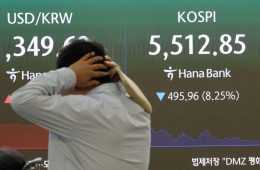
On the 27th, the Bank of Korea raised its base interest rate from 2.75% to 3.00% per annum. This marks the second consecutive hike following last month. The decision was made out of a perceived need to proactively respond to inflationary pressures and financial stability risks. Volatility in the stock market has been even more pronounced. The KOSPI, which climbed as high as 9,385.59 during trading in June, plunged 10.84% in a single day on July 28, closing at 6,023.66. Both the KOSPI and KOSDAQ triggered circuit breakers simultaneously. As of the 26th, the KOSPI had rebounded to 6,808.21.

Junho Hwang, author of "The Gravity of Investment." He emphasized that "investors lose money in the same way they earn it," stressing that survival and risk management come before profit. Bookstone
View original imageIn such a market environment, investors naturally want to know what happens next. How high will interest rates go? Will semiconductors continue to rise? Should one still be buying stocks now? Junho Hwang, author of "The Gravity of Investment" (Bookstone), reverses this line of questioning: What will you do if your expectations turn out to be wrong?
Junho Hwang began his career as a bond trader at a securities firm and has almost 20 years of market experience. While he once earned more than 5 billion KRW in a single month, he ended up losing 6.5 billion KRW during the rate hike cycle of 2022. Looking back, he attributes his failures not just to incorrect rate forecasts.
"The biggest problem was my inability to correct my mistakes, which fundamentally stemmed from overconfidence. At the time, I simply did not consider the possibility that I could be wrong."
Even as the U.S. Federal Reserve revised its view of inflation and began actual rate hikes, he stuck to his original forecast. "It wasn't that I lacked information; I just left no room within myself to accept new information," he said. The more expensive cost than the 6.5 billion KRW loss was the six months he lost. Even though the market gave him daily opportunities to revise his stance, he failed to act.
What’s striking is that the very approach that allowed him to make money also made him lose it. Concentrated investments and the ability to endure volatility brought windfall gains in a bull market, but when the market turned, those same traits stopped him from liquidating his positions. "The same trait is called ability when it makes you money, and stubbornness when it leads to losses." Junho Hwang calls his 6.5 billion KRW loss not a new mistake, but "an overgrowth of an old success formula." The more continuously profitable his approach became, the less he questioned it, causing him to employ the same strategy bigger and for longer. That’s why the time he is most careful is not during losses—but when he is making money.

Shin Hyun-song, Governor of the Bank of Korea, is striking the gavel at the Monetary Policy Committee plenary meeting held at the Bank of Korea in Jung-gu, Seoul. On the 27th, the Monetary Policy Committee raised the base interest rate by 0.25 percentage points from 2.75% to 3.00%. Bank of Korea
View original image"When you are losing, your scorecard keeps you in check. When you are winning, unless you impose your own benchmarks, no one will stop you." This year’s volatile market provided ample temptation to return to old strategies. But this time, he reduced risk from the early stages of profit. He explained, "Back then, I was someone who would take big risks to make big gains—and then lose just as much. Now, I aim to repeat a structure where I don't lose money."
This is also the key point of "The Gravity of Investment." Rather than trying to pick the right stocks or forecast the future, determine first how much you are willing to lose if you are wrong. Junho Hwang reviews the maximum loss and acceptable risk before investing, and writes down in advance the conditions under which he will buy and, more importantly, the reasons that would prompt him to sell.
"It's not about selling at a certain price, but selling when a specific rationale breaks down." He refers to cutting losses as the "cost of admission." If your judgment is wrong, pay the price and step aside, so you have the freedom to pick the next investment opportunity. His investment principle is, "It’s not about chasing profits, but making sure I live to invest another day."
In today’s market, where money is flooding into AI and semiconductors, what shakes individual investors is FOMO—the fear of missing out. Junho Hwang says this too should be distinguished from actual risk. "Missing out on an opportunity is not real risk." Even if a stock you didn’t buy doubles in value, your account doesn’t shrink. The real risk is when an asset you actually own decreases in value.
He does not deny concentrated investing per se. However, there is a difference between accumulating positions you understand and following others simply because they made money. Knowing an industry’s growth prospects, knowing which companies will profit within it, and figuring out how much of that expectation is already priced in are all separate issues. "If you can't calculate those gaps, take positions only as far as you understand."

Author Junho Hwang's new book, The Gravity of Investment, emphasizes 'investing to survive even when wrong' rather than 'predicting investments,' based on his experience of a 6.5 billion KRW investment loss. Bookstone
View original imageHe is even more clear-eyed about investing in individual stocks. He believes that for most investors, index investing and asset allocation are more reasonable approaches. That’s because picking a growing industry and identifying the companies that will survive in it are entirely different games.
"Returns are not proportional to difficulty." The market does not reward you for successfully picking difficult stocks. It is better to keep playing the easy game you understand well again and again. At the same time, he cautions that even index investing carries its own risks: overconcentration in large caps and long-term stagnation. That’s why he stresses the importance of diversifying across time and regions and investing through regular savings plans.
Although we are living in an age of information abundance, he does not chase more data. His guideline is simple: "Facts and business fundamentals belong within the realm of study; the market’s reaction to them falls in the domain of the unknown." You can check a company’s earnings or interest rates, but how the market will react to those facts tomorrow is a separate matter. He reads print newspapers and financial institution reports slowly, always double-checking original sources. "Good information is generally slow and signed," he notes. He further filters expert opinions with this standard: an expert who provides evidence is a helpful reference; one who only offers conclusions is a delegation of responsibility.
When asked what he would advise for people in their 20s and 30s entering the market for the first time with 10 million KRW, he did not mention a stock pick. "What you need to build first, before portfolio returns, is your worldview." That means knowing what you know and what you don’t—a kind of meta-cognition. There is no beginner’s league in the stock market. Someone who opens an account today is trading at the same prices as institutions, quants, and investors with decades of experience. Don’t try to win everywhere; instead, start with one industry you truly understand, one ironclad stop-loss rule, and one savings principle that endures even through volatility.
After 20 years of investing, he was asked if there was a single rule he continues to keep. "I never compete outside my circle of competence. I learned this lesson the hard way." Junho Hwang’s realization after his 6.5 billion KRW loss was not about how to predict the market’s next move. It was about admitting what you don’t know and making sure you always have capital left after a wrong call. Interest rates have returned to 3%, as have memories of 2022. Yet, he is especially wary of that very sense of familiarity.
"Familiarity is often just another name for bias, not knowledge." He doesn’t know where the market is heading, either. This time, not knowing is part of his calculation.
Hot Picks Today
!["Who knew Gangnam could be overtaken?"... 30- and 40-somethings flock with cash to 'this neighborhood' [Real Estate A to Z]](https://cwcontent.asiae.co.kr/asiaresize/93/2026082518155892412_1787649358.jpg) "Who knew Gangnam could be overtaken?"... 30- and 40-somethings flock with cash to 'this neighborhood' [Real Estate A to Z]
"Who knew Gangnam could be overtaken?"... 30- and 40-somethings flock with cash to 'this neighborhood' [Real Estate A to Z]
- "When Will the Samsung-Hynix Rescue Team Arrive?" Stock Prices at Financial Crisis Levels... What Could Turn Them Around? [Weekend Money]
- "South Korean Internet Users Are Disgusting": Man in His 30s Fined for Threatening Posts
- 'Immoral Acts' at Holy Site... Two Foreign Nationals, a Man and Woman, Executed
- "I Used to Eat This All the Time in Korea..." What Is This Snack Winning Over Taste Buds Worldwide? [K-Holic]
The Gravity of Investment | Written by Junho Hwang | Bookstone | 304 pages
© The Asia Business Daily. All rights reserved. Unauthorized AI training and use prohibited.

!["Please, Just Take Them Off" - They Made It All the Way to Bed... Then Fecal Bacteria Struck [Deep Scroll]](https://cwcontent.asiae.co.kr/asiaresize/307/2026101610053063338_1792112730.png)