226,000 More Employed at Businesses in July... Employment Growth Led by Health and Welfare Sectors
In July, the number of employees at domestic businesses increased by nearly 230,000 compared to the same month last year. Although the growth rate slowed somewhat from the previous month, it was the largest July increase since 2024.
According to the "July Business Workforce Survey" released by the Ministry of Employment and Labor on the 27th, as of the end of last month, the number of people employed at businesses with one or more employees stood at 20,718,000, up 226,000 (1.1%) from July of last year (20,492,000). In June, the number had increased by 248,000 (1.2%).

On the 19th, after the five-day Chuseok holiday ended and the daily routine of commuting to work resumed, citizens hurried on their way to work at the Gwanghwamun Intersection in Jongno-gu, Seoul. Photo by Jo Yongjun jun21@
View original imageThe increase in employees was most pronounced in the health and social welfare services sector. The number of employees in this sector totaled 2,723,000, an increase of 119,000 (4.6%) from a year earlier. The financial and insurance industry saw an increase of 27,000 employees (3.1%), while the professional, scientific, and technical services sector added 25,000 (1.8%). The manufacturing sector, which has the largest share of employees among all industries, also continued to see growth. The manufacturing sector employed 3,770,000 people, up 14,000 (0.4%) from the same month last year. The increase in manufacturing employment has expanded for four consecutive months: 3,000 in April, 7,000 in May, 12,000 in June, and now 14,000 in July.
In contrast, employment in wholesale and retail fell by 28,000 (-1.2%). The arts, sports, and leisure-related services sector decreased by 9,000 (-2.7%), and the information and communications sector dropped by 2,000 (-0.3%). By employment status, the number of regular employees stood at 17,280,000, up 78,000 (0.5%) from a year ago. The number of temporary and daily workers rose by 147,000 (7.6%) to 2,071,000, and other types of employees also increased by 1,000 (0.1%) to 1,366,000.
Both new hires and separations rose significantly. In July, the number of people joining businesses was 1,143,000, an increase of 177,000 (18.3%) compared to the same month last year, while separations totaled 1,127,000, up 178,000 (18.8%). The hiring rate rose 0.9 percentage points to 5.9%, and the separation rate also increased by 0.9 percentage points to 5.8%. Among new hires, recruitment amounted to 1,029,000, up by 168,000 (19.6%). Among those who left, involuntary separations numbered 669,000, up by 131,000 (24.3%), marking a significant increase. In particular, involuntary separations in the construction industry increased by 61,000, while the accommodation and food services sector saw an increase of 21,000.
As of June, the nominal wage per employee at businesses with at least one regular worker was calculated at 4,094,000 won. This represents an increase of 123,000 won (3.1%) from a year earlier. The wage for regular employees rose by 3.6% to 4,375,000 won, and for temporary and daily workers it increased by 3.8% to 1,773,000 won. However, real wages, adjusted for inflation, stood at 3,412,000 won, a decrease of 2,000 won (-0.1%) from the same month last year. Although nominal wages increased, actual purchasing power declined slightly due to rising prices. During the first half of the year, the average monthly nominal wage per employee was 4,294,000 won, up 2.8% from the same period last year. Real wages during the first half reached 3,606,000 won, a 0.3% increase, showing a modest overall upward trend for the half year.

Although the face is not visible, the back of the job seeker heading to the interview room reveals a sense of tension and anticipation. Sometimes, the back shows more emotion than the front. (Seoul COEX) Photo by Kang Jinhyung
View original imageBy region, employees were concentrated in Gangnam-gu and Hwaseong-si
According to the "April Regional Business Workforce Survey" also released by the Ministry of Employment and Labor, significant regional disparities in employment were observed. As of the end of April, Seoul's Gangnam-gu had the highest number of employees among cities and districts, with 731,100. This was followed by Hwaseong-si in Gyeonggi Province (529,100), Seongnam-si in Gyeonggi Province (484,000), Seocho-gu in Seoul (461,300), and Suwon-si in Gyeonggi Province (410,700).
Conversely, regions with the fewest employees were Ulleung-gun in North Gyeongsang Province (4,100), Yeongyang-gun in North Gyeongsang Province (4,200), Ongjin-gun in Incheon (5,100), Jangsu-gun in North Jeolla Province (6,400), and Hwacheon-gun in Gangwon Province (6,900). Regarding the employee growth rate, Ulleung-gun in North Gyeongsang Province recorded the highest at 5.4%, followed by Shinan-gun in South Jeolla Province (4.2%) and Seocheon-gun in South Chungcheong Province (3.9%). In contrast, Yangyang-gun in Gangwon Province and Inje-gun saw decreases of 3.1% and 2.7%, respectively.
Yeosu-si in South Jeolla Province had the highest combined hiring and separation rates in April, with a hiring rate of 13.8% and a separation rate of 15.4%, totaling 29.2%. Gongju-si in South Chungcheong Province followed with a hiring rate of 7.9% and a separation rate of 11.2%, totaling 19.2%. The Ministry of Employment and Labor analyzed that the high rates of hiring and separation in Yeosu-si and Gongju-si were due to seasonal and business-specific characteristics of the construction industry.
Hot Picks Today
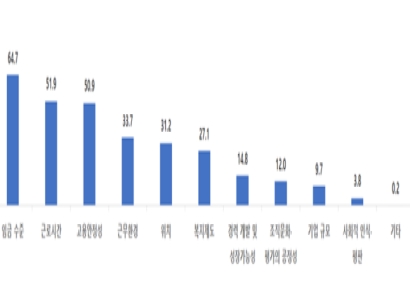 "Please Pay Me at Least 3 Million Won a Month": More Than Half of Young People Today Prioritize "Working Conditions" Over Company Size
- Selling Like Crazy Every Year... 30-Year-Old Hetbahn Takes on a New Challenge: Tastes Better Than "Mom's Home Cooking" [On-Site Report]
- He Left It in the Car and Forgot... "I Nearly Collapsed with Joy": Man Wins $1.48 Million Lottery
- Ran 18 km With 9-Year-Old Tied to Him at the Waist... "Man Banned From Competing for 3 Years"
- Beachgoer Finds 'Plastic' That Turns Out to Be Perfume Ingredient Worth More Than Twice as Much as Gold
On the other hand, the regions with the lowest combined hiring and separation rates were Jindo-gun in South Jeolla Province (3.3%), Cheorwon-gun in Gangwon Province (3.5%), Ganghwa-gun in Incheon (3.5%), Cheongsong-gun in North Gyeongsang Province (3.6%), and Yeongyang-gun in North Gyeongsang Province (3.7%). The largest year-on-year increase in combined hiring and separation rates was observed in Wando-gun, South Jeolla Province, which rose by 7.6 percentage points, followed by Suyeong-gu in Busan (up 7.2 percentage points) and Imsil-gun in North Jeolla Province (up 7.0 percentage points).
© The Asia Business Daily. All rights reserved. Unauthorized AI training and use prohibited.