More Than 3,000 Jobs Lost at Korean Petrochemical Firms in One Year... Employment Strategies Diverge Amid Restructuring
Lotte Halts Hiring for Basic Materials, Continues Recruitment for Advanced Materials
Hanwha and LG: Staff Reductions Accelerate Amid Restructuring
Kumho Petrochemical Sees Solo Workforce Growth Without NCC
More than 3,000 jobs have been cut at South Korea’s leading petrochemical companies in the past year. This was mainly due to prolonged industry stagnation and a supply glut driven by China, which have prompted companies to restructure their businesses by scaling down operations and selling assets. However, each company’s employment strategy varies. For example, while some have effectively frozen new hiring for their general-purpose businesses, others are actively recruiting—sometimes even double-digit numbers—for more profitable divisions. There are also companies that have maintained their previous hiring levels without any restructuring.

According to the semiannual reports of each company filed on the Financial Supervisory Service’s Electronic Disclosure System as of the 27th, the total number of employees at four major petrochemical firms—LG Chem, Lotte Chemical, Hanwha Solutions, and Kumho Petrochemical—fell from 25,616 at the end of June last year to 22,537 at the end of June this year, a decrease of 3,079 employees, or 12.0%.
By company, Lotte Chemical saw the largest drop, with its workforce declining by 1,046, or 23.0%, from 4,555 to 3,509. LG Chem saw a reduction of 1,431 employees, or 10.5%, from 13,674 to 12,243. Hanwha Solutions had 655 fewer employees, or a drop of 11.3%, from 5,790 to 5,135. Conversely, Kumho Petrochemical increased its workforce by 53, or 3.3%, from 1,597 to 1,650.
On the surface, the changes in headcount might seem like large-scale layoffs triggered by the downturn, but the reality differs among the companies. These figures include personnel transfers resulting from asset sales and the transfer of businesses, while the level of business restructuring has also resulted in divergent approaches to recruiting new talents.
Lotte Chemical: Pausing Hiring in Basic Materials, Recruiting for Advanced Materials
Lotte Chemical displays the clearest example of this shift. The company is currently restructuring its general-purpose petrochemical businesses at both its Daesan and Yeosu sites. At the Daesan plant, a business spin-off was completed in June, and the company is pushing ahead with a merger with HD Hyundai Chemical. In Yeosu, it is working on separating the basic materials business to integrate it with Yeocheon NCC.
As a result, the basic materials divisions involved in restructuring are not hiring new staff, while the advanced materials business—which continues to generate profit—keeps recruiting on a rolling basis.
In particular, it is understood that the advanced materials division recruits new graduates in double-digit numbers with each hiring cycle, using a rolling vs. fixed recruitment approach. Thus, even with a net reduction of over 1,000 employees company-wide over the past year, new hiring still continues selectively in certain divisions.
A representative of Lotte Chemical said, "We are continuing to hire in advanced materials, but we are not recruiting separately for basic materials. By reducing general-purpose business and expanding advanced and specialty areas, we are recruiting additional talent where needed."
Hanwha & LG: Business Restructuring Takes Priority, Hiring Kept to a Minimum
Hanwha Solutions is also currently seeing a reduction in headcount primarily due to ongoing business restructuring. In collaboration with DL Chemical, Hanwha Solutions is restructuring mainly around Yeocheon NCC: this involves halting operations at Yeocheon NCC Units 2 and 3, as well as contributing Hanwha Solutions’ polyethylene (PE) and petroleum resin businesses as assets to be integrated into Lotte Chemical’s Yeosu basic materials business. Government approval for this restructuring plan was received last month.
Recent staff reductions were also affected by internal transfers as a result of asset divestment and business downsizing. The company is currently prioritizing financial structure improvement and reducing its general-purpose businesses, and has not embarked on large-scale new recruitment campaigns.
If certain departments require replacement staff, only small-scale hiring is conducted, and the company emphasizes that it has not concentrated recruitment in new or high value-added business areas. Even in high value-added business units, the company is largely making use of existing personnel while simply expanding budgets and business or capacity plans.
A Hanwha Solutions official explained, "It isn’t so much that we have reduced staff artificially, but that numbers have declined during the restructuring and transfer process. Even in high value-added areas, we are not expanding to the point where large-scale new hires would be necessary right now."
LG Chem, too, experienced a combination of natural decrease, reduced recruitment, and business divestment. While seeking greater efficiency in its general-purpose petrochemical business, LG Chem has been reorganizing its portfolio through eliminating low-profit lines and optimizing facilities. A high average age in the petrochemical sector means retirements and voluntary resignations continue, but new hiring has not kept up, leading to an overall decline in headcount.
An LG Chem official noted, "Hiring in the chemicals sector has dropped significantly. The transition to rolling recruitment means small numbers of new staff are hired only in departments where there is need."
The industry-wide push for advanced or specialty product lines has not yet resulted in large-scale job growth. One industry source said, "There is a consensus that companies want to move towards advanced, higher-margin product groups to be less susceptible to Chinese oversupply and economic volatility, but we are still only at the beginning, so it is too soon to say the effects are apparent."
Kumho Petrochemical: No NCC, Hiring Policy Unchanged
Kumho Petrochemical was the only one among the four companies to increase its staff. Yet this was more the result of maintaining a consistent, normal level of hiring rather than a push for aggressive expansion or recruitment to support advanced businesses.
A Kumho Petrochemical representative said, "We do not pursue drastic policies of rapidly increasing or decreasing headcount. Instead, we continue to recruit the usual number of staff each year." Without large-scale naphtha cracking facilities (NCC), Kumho Petrochemical is less directly affected by the government’s move to cut NCC production capacity. While companies with NCCs are now incorporating possible production cuts into their business strategies and workforce planning, Kumho Petrochemical faces significantly less pressure in this regard.
An expansion in high value-added products does not automatically mean an increase in production personnel. In petrochemicals, changes in the product mix and headcount do not move one-to-one because the same production lines can be used for either general-purpose or high value-added products, depending on the schedule.
The company representative added, "We are moving toward strengthening our high value-added product lines, but this does not directly translate into hiring plans. The focus is more on developing and selling competitive products through R&D."
Ultimately, across the petrochemical sector, job cuts triggered by scaling back general-purpose businesses are first to materialize, while each company’s hiring policies diverge according to the speed of restructuring and portfolio shifts. While Lotte Chemical’s hiring varies distinctly by business, Hanwha Solutions is prioritizing restructuring and staff efficiency, and Kumho Petrochemical has maintained its existing hiring approach.
Hot Picks Today
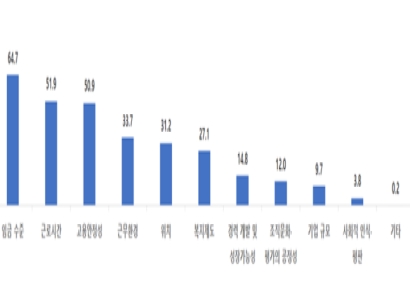 "Please Pay Me at Least 3 Million Won a Month": More Than Half of Young People Today Prioritize "Working Conditions" Over Company Size
- Selling Like Crazy Every Year... 30-Year-Old Hetbahn Takes on a New Challenge: Tastes Better Than "Mom's Home Cooking" [On-Site Report]
- He Left It in the Car and Forgot... "I Nearly Collapsed with Joy": Man Wins $1.48 Million Lottery
- Ran 18 km With 9-Year-Old Tied to Him at the Waist... "Man Banned From Competing for 3 Years"
- Beachgoer Finds 'Plastic' That Turns Out to Be Perfume Ingredient Worth More Than Twice as Much as Gold

An industry official commented, "When production volumes are expected to fall, companies reflect this in their business plans and adjust their workforce projections accordingly. Transitioning to higher value-added products is not about hiring more production workers, but about boosting R&D and product competitiveness."
© The Asia Business Daily. All rights reserved. Unauthorized AI training and use prohibited.