"Investment Decisions Are Made at the Dinner Table": Why Capital and Talent Cluster in Seoul [Weekend Money]
[Addresses of Money ①] How Relocation of Funds and Mutual Aid Associations to the Provinces Works
Meta Designs Office Where All 2,800 Employees Share a Single Space
"A Space Designed to Encourage Exchange of Ideas and Collaboration"
Hong Kong and Singapore Absorbing Talent Through Tax Benefits and Visas

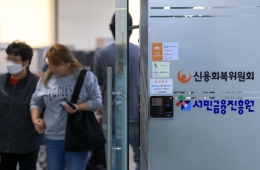
Officials from the National Office and Finance Service Labor Union shouted slogans on the 25th in front of the fountain at the Blue House in Jongno-gu, Seoul, before a press conference, demanding the cessation of unilateral attempts to relocate organizations such as the National Agricultural Cooperative Federation, the Teachers' Pension, the Korea Inclusive Finance Agency, and the Credit Recovery Committee to provincial areas. Photo by Yonhap News.
View original imageThere is a company where 2,800 employees work in one enormous open space without partitions. In 2015, Meta (then Facebook) unveiled its new headquarters MPK20 and introduced the concept behind its massive, 430,000-square-foot office as "one big room."
Instead of dividing teams by floor, they placed meeting rooms, cafes, and lounges throughout the space so employees would naturally encounter each other as they walked around. The company explained that this layout was "a space designed to encourage the exchange of ideas and collaboration."
Digital technology has eliminated most physical constraints, but the actual distance between people still affects work.
According to MIT researchers who analyzed 40,358 papers and 2,350 patents from 2004 to 2014, researchers who shared the same workspace were more than three times as likely to co-author papers as those separated by 400 meters. The likelihood of co-inventing patents was more than twice as high, too.
!["Investment Decisions Are Made at the Dinner Table": Why Capital and Talent Cluster in Seoul [Weekend Money]](http://www.asiae.co.kr/news/img_view.htm?img=2026082619362794115_1787740587.jpg)
Edward Glaeser, a Harvard urban economist, called the city "the greatest invention of humanity" in his book, Triumph of the City. When people gather in close proximity, companies can more easily secure the talent they need, and workers have access to more job opportunities. Companies share specialized services and infrastructure, and knowledge and ideas spread rapidly among people. Glaeser asserts that the core of a city is not physical buildings but the "proximity and density" among people.
The OECD estimates that when a city's population doubles, productivity rises an average of 2–5%. This is attributed to a thicker labor market, learning between companies, and the swift spread of ideas. In places where successful companies have already gathered, access to finance and venture capital (VC) is also easier. People gather, companies follow, and then capital and specialized services cluster accordingly.
Asian Financial Hub Rival Cities—Hong Kong and Singapore Race to Attract Capital and Talent
In finance, such clustering leads to fierce competition among cities to attract capital and talent. On August 19, Singapore announced new tax incentives for fund managers, visa support for high-level financial professionals, and a program to attract hedge funds. Over the last five years, Singapore's asset management industry grew at an average annual rate of 7.5%, with assets under management approaching 7 trillion Singapore dollars. Hong Kong strengthened tax benefits for fund manager performance bonuses and similar areas, prompting Singapore to respond in kind.
!["Investment Decisions Are Made at the Dinner Table": Why Capital and Talent Cluster in Seoul [Weekend Money]](http://www.asiae.co.kr/news/img_view.htm?img=2026082609385092961_1787704730.jpg)
According to the Global Financial Centres Index (GFCI 39) released in March this year, Hong Kong ranked third, Singapore fourth, Seoul eighth (climbing two spots), and Busan twenty-third. Hong Kong scored 765 points, Singapore 764, and Seoul 741. While Seoul ranked highly on the global stage, the race to attract capital and talent continues.
This stands in stark contrast to Korea, where discussions about relocating financial institutions to the provinces have gained momentum. The Financial Supervisory Service and Korea Deposit Insurance Corporation have been mentioned, and North Jeolla Province is targeting nine major mutual aid associations and Korea Investment Corporation for potential relocation. However, the targets and methods for relocation have yet to be decided.
Busan is home to financial institutions like the stock exchange and the Korea Securities Depository, but when Busan City held a briefing in April to attract asset management firms, VCs, and fintech companies from the Seoul Capital Area, it took place in Yeouido, Seoul. Efforts to recruit more asset management and investment firms are still largely centered in Seoul, where financial companies are densely concentrated.
Among the debating points, mutual aid associations provide a good example for measuring the gravity of "the street of money." These organizations invest members' assets directly, and a sizable portion involves alternative investments—real estate, infrastructure, and private equity funds (PEFs)—where personal connections and expert networks play a critical role.
Mutual Aid Associations Managing 134 Trillion Won—Over Half Involves Human-Driven Investment
According to an analysis by the Jeonbuk Research Institute at the end of last year, the combined investment assets of eight mutual aid associations—all measured on a comparable basis—amounted to approximately 134.9 trillion won. Teachers’ Pension accounted for 50.9 trillion won, Local Government Officials’ Mutual Aid Association 31.9 trillion won, Military Mutual Aid Association 20.5 trillion won, and Science and Technology Mutual Aid Association 15.4 trillion won, among others.
Of this, investments in alternatives such as real estate, infrastructure, PEFs, and private credit amounted to about 85.8 trillion won. Teachers’ Pension had 68.3% of its portfolio in alternatives, Local Government Officials’ Mutual Aid Association 74.3%, and Science and Technology Mutual Aid Association 71.7%. According to the same data, the National Pension Service’s alternative investment share was 14.6% at the time. Mutual aid associations’ total assets are smaller than the National Pension Service, but they are known to have a much higher proportion of assets that require deep involvement of external managers, investment banks, and law and accounting firms in transactions.
!["Investment Decisions Are Made at the Dinner Table": Why Capital and Talent Cluster in Seoul [Weekend Money]](http://www.asiae.co.kr/news/img_view.htm?img=2026082609492493020_1787705364.jpg)
Alternative investments are especially dependent on professional financial networks. Listed stocks and government bonds can be traded electronically at publicly disclosed prices. In contrast, corporate M&A, private equity (PEF), venture investments, and real estate and infrastructure are different. In these cases, deal sourcing, due diligence, structuring, investment committees, post-management, and exit strategies all require ongoing participation from asset management firms, securities companies, and accounting and law firms. This is why the Jeonbuk Research Institute also found that alternative investments rely much more on deal sourcing and professional financial networks than public market investments.
One VC CEO explained, "There are no boundaries between online and offline or across borders when searching for investment targets, but when it comes to generating investment ideas and making decisions, discussions over a simple dinner can have a real impact." He went on, "Even after we find an investment target, every step—confirming its business potential, negotiating prices, designing deal structures that mix lending and equity, and reviewing legal and tax issues—is accomplished through numerous meetings and collaborations." He added, "Of course, we will go anywhere to raise capital, but the fact that the infrastructure for capital is concentrated in Seoul is an irreplaceable advantage."

The Jeonbuk Research Institute, which is promoting the attraction of mutual aid associations, does not dismiss these concerns. In a report, the think tank identified as key issues the fact that “if financial networks in Seoul are severed, access to investment information declines, loss of specialized personnel and delayed decision-making could result, ultimately lowering returns.” Since mutual aid assets come from member contributions and investment profits, they emphasized that protecting member assets and maintaining strong returns must remain the top priority in relocation decisions.
Hot Picks Today
 "'Some Get KRW 74 Million, While a One-Day Difference Means a KRW 34 Million Gap' Sparks Outrage... President Weighs In"
- "Three Rooms, Great Views, Near the Station"... Japan's Shady Rental Scheme Infiltrates Luxury Apartments at 1 Million Won a Night
- White House Again Claims "South Korea to Invest $54 Billion in Alaska LNG"
- "Feeds on blood and is hard to eradicate"... the 'terrifying bug' that grounded a plane
- 220 cm-Tall 26-Year-Old Woman Dies Less Than a Year After Giving Birth... Deadly Complications Hidden Behind 'Gigantism'
© The Asia Business Daily. All rights reserved. Unauthorized AI training and use prohibited.