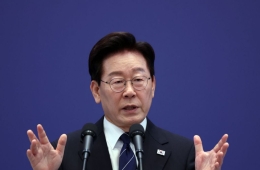
Governor Choo Proposes to President Lee Raising Local Consumption Tax Rate to 40%
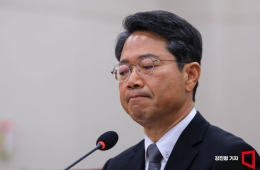
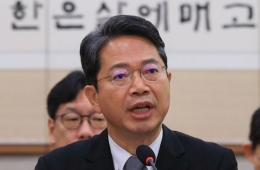
Choo Mi-ae, Governor of Gyeonggi Province, has made three proposals to the central government to secure greater local fiscal resources in support of region-led growth: raising the local consumption tax rate, allocating a portion of corporate tax revenues to metropolitan governments, and converting the local education tax on tobacco into a regional resource facility tax for firefighting.
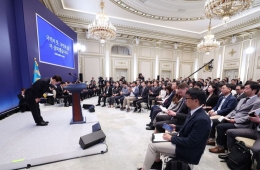
On August 26, during the 10th Central-Local Government Cooperation Meeting held at the presidential office, Governor Choo announced these strategies for successful region-led development at the local government level. The meeting was attended by President Lee Jaemyung, as well as the Prime Minister, ministers from key government departments, and mayors and provincial governors, and included discussions on cooperation between the central and local governments during the ninth term of local administrations and on plans to promote region-led growth.
Governor Choo identified Gyeonggi Province's fiscal conditions as a significant obstacle to region-led economic development. "The harsh fiscal crisis faced by Gyeonggi Province was the first reality I encountered as governor," she said. "While the province’s annual budget appears sizable at over 40 trillion won, the actual fiscal situation has been structurally constrained, with a deficit of 1-2 trillion won accumulating over several years. This presents a structural limitation that is difficult to overcome through the province’s efforts alone."
She went on to explain that, while fiscal demand continues to grow due to an increasing and rapidly aging population, Gyeonggi's revenue is highly reliant on acquisition taxes that fluctuate with the real estate market, leading to significant volatility. The combination of rising welfare needs and an unstable revenue structure is intensifying fiscal pressure.
Governor Choo stressed, "Ensuring sufficient local financial resources is essential for true region-led growth. This is not only an issue for Gyeonggi Province, but a matter that affects the overall sustainability of local autonomy in South Korea."
As her first proposal, she suggested raising the local consumption tax rate from the current 25.3% to 40%. The purpose is both to achieve the government's goal of a 70:30 ratio of national to local tax revenue and to adjust the current structure, which is heavily dependent on acquisition taxes, toward a stable, consumption-based local tax system centered on local consumption tax.

Second, she called for the establishment of a new system that allocates 5% of corporate tax revenues, currently a national tax, to metropolitan governments. Governor Choo argued that, although increased tax revenue from the growth of advanced industries such as semiconductors is mainly concentrated at the national and municipal levels, the accompanying costs of establishing industrial complexes and expanding infrastructure are borne primarily by metropolitan governments, necessitating a more equitable distribution of tax revenue.
Her third proposal was to convert the soon-to-be-terminated local education tax on tobacco products into a regional resource facility tax for firefighting. Although firefighters became national-level public servants in 2020, the proportion of state support for personnel expenses, namely, the Fire Safety Subsidy, remains at just 6-9%, forcing the province to cover much of these costs from its general budget. She asserted that securing a stable fiscal source for fire services is therefore essential.
Hot Picks Today
![Stock Down 40%, But Record Earnings: This Stock Touted as a "Buying Opportunity" [Weekend Money]](https://cwcontent.asiae.co.kr/asiaresize/93/2026090110113910454_1788225100.jpg) Stock Down 40%, But Record Earnings: This Stock Touted as a "Buying Opportunity" [Weekend Money]
Stock Down 40%, But Record Earnings: This Stock Touted as a "Buying Opportunity" [Weekend Money]
- "Almost Started a War"...U.S. Military Nearly Attacked Chinese Vessel Based on Fake AI-Generated Intelligence
- Mayor Jeong Myeong-geun: “Reasonable Adjustment of Unnecessary Regulations in 53 GB-Release Districts”
- "Dogs Living More Luxuriously Than People"... Even $4,120 Fitness Centers Emerge in China [China.zip]
- In the Same Neighborhood, One Apartment Costs 2 Billion Won, Another 450 Million... What's Happening in Gangnam?
Governor Choo emphasized that these three proposals would allow local governments to establish a stronger fiscal foundation, enabling them to proactively address issues related to regional growth, welfare, and public safety.
© The Asia Business Daily. All rights reserved. Unauthorized AI training and use prohibited.