National Assembly Holds Plenary Session, Passes Public Institutions Act Amendment Upgrading Committee Status... Approves Carbon Neutrality Act and More
National Assembly Holds Plenary Session, Passes Around 30 Bills
Public Institutions Act Amendment Approved Amid Opposition Objections
Carbon Neutrality Act Faces Backlash from Innovation Party and Progressive Party
On the 26th, after a debate between supporters and opponents, the National Assembly passed the "Partial Amendment to the Act on the Management of Public Institutions (the Public Institutions Act Amendment)," which reorganizes the Committee for the Management of Public Institutions from an advisory committee to a management committee. Both the ruling and opposition parties handled around 30 bills that were previously agreed upon.
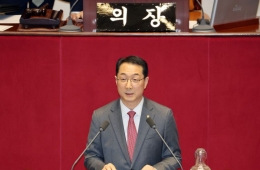
On this day, the ruling and opposition parties held a plenary session and handled public livelihood-related bills. Most of the bills processed were pre-negotiated between the two sides, but the Public Institutions Act Amendment was brought to the plenary session as a fast-track agenda item. Among 227 lawmakers present, 152 voted in favor, 74 opposed, and 1 abstained, resulting in the bill passing the plenary session.
Bae Junyoung, secretary of the People Power Party on the Finance and Economy Committee, gave a dissenting speech at the plenary session, arguing, "This bill has not undergone proper deliberation," and specifically noted, "The current law gives clear responsibility through the Minister's authority, but the amendment blurs where the responsibility lies."
In support, Park Junghyun, a member of the Democratic Party, stated, "We aim to upgrade the Public Institutions Operation Committee, which was merely an advisory body, into a management committee jointly accountable to both the private sector and the government. The chairmanship would change to a co-chair system between the Minister of Strategy and Finance and the private sector, with more private members, thereby substantively reinforcing the independence, expertise, and representativeness of public institutions." Addressing concerns over political polarization, Park argued, "A structure where private members from various fields participate in decision-making allows public institutions to be operated with consistent principles, regardless of government change."
The plenary session also passed the "Partial Amendment Act of the Framework Act on Carbon Neutrality and Green Growth for Responding to the Climate Crisis (Framework Act on Carbon Neutrality)" as well as the "Act on Adaptation and Resilience Enhancement for the Climate Crisis," which were proposed by the parliamentary Special Committee on the Climate Crisis. The Carbon Neutrality Framework Act Amendment sets mid- and long-term reduction targets in 5-year intervals within upper and lower limits up to 2045 in order to achieve emissions reduction by 2050. Introducing the bill, Democratic Party member Park Jihye stated, "This legislation reflects bipartisan will for greenhouse gas reduction and responding to the climate crisis."

At the plenary session held at the National Assembly on the 26th, the Partial Amendment Act on the Framework Act on Carbon Neutrality and Green Growth to Respond to the Climate Crisis is being passed. Photo by Yonhap News
View original imageHowever, Seo Wangjin, a member of the Innovation Party of the Motherland, stated in a dissenting speech, "The greenhouse gas reduction targets included in this legislation severely infringe on the rights of future generations," adding, "These targets even fall short of the bare minimum required by the international community." He insisted, "We must set more ambitious greenhouse gas reduction targets." In another speech, Progressive Party member Jeong Hyekyung stated, "While much attention is paid to industrial outcry about hardships, are we deaf to the voices of workers and farmers collapsing during heatwaves and our children worrying about the future amid the climate crisis?" She criticized, "Is this really the answer offered by the 22nd National Assembly, which even created a special committee with promises of an exceptional response to the climate crisis?"
Additionally, the plenary session passed a revision to the National Assembly Act, adding the Chief of the Major Crimes Investigation Agency to the list of officials subject to parliamentary confirmation hearings, as well as an amendment to the Act on Probation, etc., introducing separate detention for juveniles and adult offenders.
The Partial Amendment Act to the Special Act on Railway Undergrounding and Integrated Development of Railway Sites also passed the plenary session. This law includes projects for constructing artificial ground within the scope of railway undergrounding, allows designation of a Railway Undergrounding Integrated Development Support Center, adds the National Railroad Authority as a possible project implementer for railway undergrounding and integrated development, and enables local governments to establish special railway undergrounding accounts to secure funding for such projects.
Hot Picks Today
 "I Came to Korea and Easily Made 3.3 Million Won a Month"... The "Easy Gig" Everyone's Talking About Among International Students Turns Out to Be...
- Influenza Cases Surge Sevenfold, 900 Schools Close... Japan in Turmoil Over Outbreak
- Amazon Seeks to Acquire AI Startup Decart for $7 Billion
- "Hand in Your Resignation and Get a Year's Salary"... This Country Pushes Early Retirement for Civil Servants
- "Oh Eunyoung's Consultation Fee: Millions of Won? Not Expensive"... Yonsei Professor's Sharp Rebuke over "300,000-Won Lecture Fee"
Meanwhile, the "Partial Amendment Act on Port Redevelopment and Development of Surrounding Areas" was not submitted to the plenary session in line with an agreement between the ruling and opposition parties on the legislative schedule.
© The Asia Business Daily. All rights reserved. Unauthorized AI training and use prohibited.