Hana Securities: "Stock Picking Will Persist Amid Prolonged High Interest Rates"
As the high interest rate environment persists, there are expectations that stock market trends will continue to show a strong differentiation among individual companies. It is analyzed that attention should be paid to companies with a high proportion of net cash, those with upward earnings revisions, and those with high free cash flow (FCF).
Hana Securities stated this in its report published on August 26, titled "Practical Quant (Quant MP) - A Product of High Interest, the Era of Stock Picking."
First, Lee Kyungsoo, a researcher at Hana Securities, assessed the August market by saying, "As global big-tech companies with heavy capital expenditures (CAPEX) become entrenched in the high interest rate environment, liquidity related to these companies is flowing into other stocks, creating a 'trickle-down effect' and a market phase favoring stock picking." He noted that this trend has been observed both in the United States and Korea. He explained that the poor performance of the U.S. high-CAPEX factor this month, along with its clear inverse correlation with interest rates, supports this view.
For high-CAPEX companies in the United States, there also exists a seasonal trend in which they tend to underperform from September until the end of the year. This is because the costs, which are estimated in the first to third quarters, are finalized as actuals in the fourth quarter—the end of the fiscal year—causing accrual-based estimates embedded in cost of goods sold and SG&A expenses to be recognized all at once. Lee explained, "Simply put, the greater the capital expenditures, the higher the likelihood that FCF will deteriorate in the fourth quarter."
Accordingly, Lee predicted, "U.S. big-tech companies with high CAPEX are entering a period in which the high interest rate burden and the seasonality of year-end cost recognition overlap, making strong performance difficult to expect." He added, "There is a possibility that the trickle-down effect in capital flows, which has been observed domestically and abroad since August, will continue."
He also recommended adopting an alpha strategy during the ongoing combination of "high interest rates + weak dollar." Lee noted, "The current rise in interest rates does not reflect an improvement in the economy; rather, it is an abnormal combination where interest rates are rising while the dollar weakens." He further explained, "This essentially stems from weak demand for U.S. Treasuries. The interest rate rise is driven not by higher real rates or growth expectations, but by term premium."
He emphasized, "Now is the time to place slightly more weight on the interest rate axis," and pointed out, "The key styles most favorably correlated with macro factors are top-ranked net cash, upward earnings revisions, and high FCF." He also considered stocks with low price-to-book ratios (PBR), those trading furthest from their target prices, and those with high net institutional buying to be in a favorable phase. He stated, "The current stock-picking phase is not the result of increased liquidity, but rather a 'differentiation' created by high interest rates," and cautioned, "It is best to avoid simply chasing high-beta or high trading volume stocks based on superficial narratives."
Stocks to watch include DL E&C, Nongshim, LG Household & Health Care, Samsung Fire & Marine Insurance, SAMSUNG E&A, GS, Hankook & Company, Samsung SDS, and OCI Holdings.
Hot Picks Today
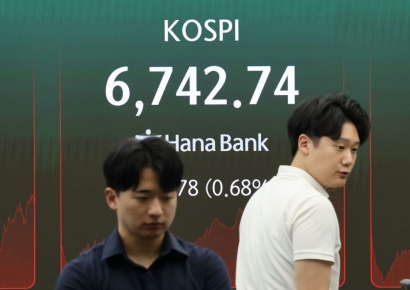 "Korea's Stock Market Dubbed 'World's Wildest'... U.S. Shocked as KOSPI Triples Then Plunges 40%"
- "What Did Billionaires Buy? These Two Stocks Take the Top Spots Side by Side"
- "Not a Regretful 300,000 Won Investment" Starbucks Fireworks Festival Prime Seats Sell Out Again in 30 Seconds This Year
- "You Clocked In but Didn't Turn on Your Computer"... Chinese Worker Dies in Restroom but Denied Work-Related Compensation
- "Jeju Should Not Be Taken Lightly... Do Not Walk Alone Even in Broad Daylight," Warns Jeju Resident of 7 Years, Hyegul Hong
However, for semiconductors, Lee maintained a position slightly overweight rather than neutral. The reason is that, should expectations for lower interest rates emerge in the future, semiconductor stocks are likely to benefit the most. He also pointed out the need to consider both the inflow of retail investor funds into the stock market following interest rate stabilization and the possibility of an overall market rally due to increased foreign purchases. Lee explained, "If the U.S.-style preference for 'high interest rates = quality' observed in the first half recurs, this trend may also transfer to the domestic market." He went on to state, "Should consensus expectations for a turn toward interest rate cuts arise from events such as the Jackson Hole meeting, the September FOMC, easing geopolitical risks, and the U.S.-China summit, the sector is poised to benefit the most."
© The Asia Business Daily. All rights reserved. Unauthorized AI training and use prohibited.