Lee Okwon: "We're Not Telling Young People to Buy Only Villas... Providing More Housing Options"
National Assembly Political Affairs Committee Plenary Session
Lee Responds to Controversy Over "Youth Future Bogeumjari Loan"
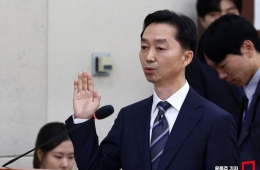
On August 24, Financial Services Commission Chairman Lee Eogwon stated that the “Youth Future Home Loan,” which supports young people in purchasing non-apartment homes, has provided an additional housing choice beyond the existing support measures.

During a plenary session of the National Assembly’s Political Affairs Committee on the same day, Chairman Lee responded to People Power Party lawmaker Jo Jeonghun’s criticism—“Are you telling young people to only buy villas?”—by clarifying, “We have not eliminated existing support measures for young people in order to introduce the Youth Future Home Loan.”
The Youth Future Home Loan is a government-backed mortgage product introduced for individuals aged 39 or younger purchasing a non-apartment residence valued at 400 million won or less with an exclusive area of 85 square meters or less for the first time in their lives. For young people with an annual income of up to 70 million won, a loan-to-value (LTV) ratio of up to 80 percent is applied, and the policy offers preferential interest rates lower than those of the standard home loan.
Chairman Lee emphasized that existing support measures—including policy mortgage products such as the standard home loan or first-time homebuyer loans for young people—remain in place and that the Youth Future Home Loan does not replace these government-backed products. He further explained, “The idea is to support, for example, single-person households who have just entered the workforce so that they can purchase a home with a financial burden similar to what they would pay in monthly rent. Young people who wish to buy an apartment can continue to use the standard home loan.”
Regarding his previous remarks on the “decoupling of real estate and finance,” he clarified that this means the need to curb speculative demand and the excessive concentration of funds in real estate.
He added, “Our aim is to normalize the situation, as finance in Korea has been excessively drawn to nonproductive areas such as speculative demand and the overheating real estate market. International organizations and experts also cite excessive household debt as the number one potential risk for Korea.” He went on to stress that “The key role of finance is to ensure a soft landing for household debt to an appropriate level and to channel funds into more productive sectors of the economy.”
Hot Picks Today
 "'Some Get KRW 74 Million, While a One-Day Difference Means a KRW 34 Million Gap' Sparks Outrage... President Weighs In"
- "Three Rooms, Great Views, Near the Station"... Japan's Shady Rental Scheme Infiltrates Luxury Apartments at 1 Million Won a Night
- Kim Minseok: "We need to sort out Shincheonji's entry into the Democratic Party"... Pro-Jeong Cheong-rae faction: "Media manipulation cannot be tolerated" (Roundup)
- "Feeds on blood and is hard to eradicate"... the 'terrifying bug' that grounded a plane
- 220 cm-Tall 26-Year-Old Woman Dies Less Than a Year After Giving Birth... Deadly Complications Hidden Behind 'Gigantism'
He concluded, “It is not our intention to sever all ties between finance and real estate. Rather, we aim to reduce the flow of funds into speculative and unproductive sectors, while providing targeted support to genuine homebuyers.”
© The Asia Business Daily. All rights reserved. Unauthorized AI training and use prohibited.