"Need for Negative-List Approach to Single-Home Residence Requirement... Broader Recognition of Exceptions Urged"
Ruling Party and Government Move to Expand Non-Resident Recognition... Expert Analysis
"Childcare, childbirth, and existing lease contracts need practical consideration"
Potential to Recognize Unavoidable Reasons Beyond School, Employment, Medical Care, and Caregiving
As the government and the ruling party have agreed to review expanding the scope for recognizing actual residence by non-resident single-home owners as part of real estate tax reform, attention is focused on the direction of future discussions. Experts positively evaluated the government and ruling party’s acceptance of calls for “slowing the pace” of reform, as reflected in the tax revision proposal released earlier this month. However, they emphasized the need for a precise approach to prevent confusion among the general public.
The tax revision proposal announced by the government earlier this month completed its pre-legislative notice on the 20th and must be submitted to the National Assembly by September 3. The goal is to pass the bill by early December after further discussion in the National Assembly.
Experts agree that the government should opt for a “negative list” approach—one that specifies only cases that are not recognized as actual residence—rather than a “positive list” that enumerates recognized cases. The government’s plan is designed so that single-home owners may be recognized as having fulfilled the residence requirement and thereby qualify for partial deductions on capital gains tax or comprehensive real estate tax, even if they do not live in the property, as long as they can provide reasons related to schooling, employment, medical treatment, or caregiving. The key issue will be how broadly to recognize “other unavoidable circumstances” beyond the enumerated reasons; experts are calling for a switch from recognizing only certain positive cases to instead disqualifying just clearly inapplicable situations and treating all others as valid.

Dukrae Kim, Director of Housing Research at the Housing Industry Research Institute, said on the 24th, “There are limits to a policy that recognizes only certain exceptional reasons as valid cases of actual residence, as it could lead to fairness issues,” emphasizing, “The positive-list approach for non-resident single-home owners needs to be changed.” She added, “It would be more reasonable to use a negative-list approach—identify only those non-resident cases subject to heavy taxation, and broadly allow exceptions for the rest, based on case studies.”
Youngjin Ham, Head of Real Estate Research Lab at Woori Bank, stated, “In particular, exemptions related to childcare are areas connected to policies encouraging childbirth among the younger generation, so enough exception cases should be uncovered to protect single-home owners who are inevitably unable to reside in their property.” He also pointed out, “To ensure that non-resident single-home owners do not suddenly face a sharp increase in property holding tax, there needs to be a comprehensive review of the government’s previously announced tax reform proposal, including standard deductions, limits on tax burden increases, and adjustments to the fair market value ratio.”
Won Gap Park, Real Estate Expert at KB Kookmin Bank, commented, “Adjusting existing lease transactions and other measures require a certain period, and the current schedule has been rather tight.” He stressed, “It is necessary to more broadly recognize exceptional reasons for extending the maximum recognized occupancy period, which is currently up to three years.”

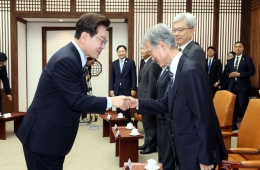
Prime Minister Han Seong-sook (front row, left), Kim Minseok, Party Leader of the Democratic Party of Korea, and Kang Hoon-sik, Secretary to the President, are moving to take a commemorative photo at the high-level party-government meeting held on the 23rd at the Prime Minister's Official Residence in Samcheong-dong, Jongno-gu, Seoul. Photo by Yonhap News Agency
View original imageThe likelihood of the government fundamentally changing the framework of the amendment has increased, given that at the high-level ruling party-government meeting held on the 23rd, consensus was reached to expand the scope of recognized actual residence for non-resident single-home owners.
Regarding the scope of application of resident vs. non-resident classification—a key issue in the current tax reform proposal—the ruling party has proposed not distinguishing between the two for the comprehensive real estate tax. Experts generally support this direction. The government has previously proposed reducing the deduction for non-resident single-home owners from 1.2 billion won to 900 million won, while raising the tax burden cap from 150% to 200%. However, since it is difficult to clearly distinguish between resident and non-resident status, experts say the same burden should apply if the asset value is equal, regardless of residency.
Nam Gieop, Director of Land + Liberty Research Institute, said, “As properties can simultaneously serve as both residence and investment/speculation, we must remove the resident/non-resident distinction.” He added, “We need to comprehensively review the policy to reduce excessive tax benefits and move towards fair taxation that lowers the expected returns from real estate.” Professor Hun Park of University of Seoul commented, “The intent to address concerns about a sudden rise in tax burdens is positive; however, there is concern that making tax policy susceptible to public opinion could send the wrong signal or cause confusion in the market, which is somewhat regrettable in terms of the policy decision process.”
Hot Picks Today
 "Two Spend 500,000 Won in a Flash, Yet Wait Two Hours?" ... 'Dreamland' Shunned by Kids and Foreign Tourists
- The Era of Getting 200 Million Won After 30 Years Is Over... A Japanese Bank's "Perpetual Department Head" Who Just Clocked In Cries Out
- Spain Hit by Its Worst Tragedy... Lee Kangin, Moreno and Real Madrid Join Soccer World in Mourning
- They Said, “Make It Your Home for Life” - Then Suddenly Kicked 200 Passengers Off... What Happened to the Around-the-World Cruise?
- "130 Rice Bowls Sold Out in a Day"... 'Unfiltered Face' Adds 8 Million Won to Night Market Sales: China's Bungeunwoo

© The Asia Business Daily. All rights reserved. Unauthorized AI training and use prohibited.