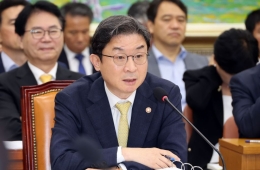
'Activist Practitioner' Venerable Myungjin’s Final Journey... Religious and Civic Communities Bid Farewell (Comprehensive)
Memorial Altar at Bongeunsa Seonbuldang
Funeral Ceremony at 10 a.m. on the 25th, Cremation at Beopjusa to Follow
Forty Meditation Retreats, Participation in the 1987 Democratic Uprising, 1994 Order Reform
Disputes over Expulsion Reconciled This Year
The Buddhist community and civil society are uniting to pay their last respects to Venerable Myungjin, the former head monk of Bongeunsa Temple, who was known as an “activist practitioner” for his unwavering commitment to Buddhist reform, democratization, and peace movements. True to the way he lived—balancing monastic discipline with outspoken advocacy for reform and social justice—his funeral is being jointly organized by the religious community and civic society.

According to the Jogye Order of Korean Buddhism and funeral officials on August 23, Venerable Myungjin, who passed away in Seogwipo, Jeju, on August 22, will be honored with a “funeral of religion and civil society.” A funeral committee has been formed with the Jogye Order, Beopjusa Temple (his home temple), and civil society organizations working together.
On the same day, his body will be transported from Seogwipo Medical Center in Jeju to Bongeunsa Temple in Gangnam-gu, Seoul. A memorial altar will be set up at the Seonbuldang of Bongeunsa Temple—where he served as head monk from 2006 to 2010—and visitors will be received from the afternoon onwards. The funeral ceremony is scheduled for 10:00 a.m. on August 25 at Bongeunsa Temple, after which the cremation ceremony will be held at Beopjusa Temple, the head temple of the fifth district of the Jogye Order where he first entered the monastic life.
Venerable Myungjin was born in 1950 in Dangjin, South Chungcheong Province, and became a monk in 1969 at Baengnyeonam Hermitage of Haeinsa Temple. After receiving his novice monk precepts in 1974 and full ordination the following year, he practiced for over 20 years in meditation halls across the nation, including Songgwangsa, Haeinsa, Bongamsa, and Sangwonsa. He completed forty intensive meditation retreats (ango), never interrupting summer and winter sessions each three months long, earning the title “attainer of forty ango retreats.”
He did not confine his practice to the mountains. In 1986, he was detained for leading the National Monks’ Convention and protests against the military regime’s control of religion, and the following year he led the Buddhist Countermeasure Committee against oppression, taking part in the June Democratic Uprising. In 1988, he became the first president of the Mahayana Buddhist Sangha, established by younger monks, and contributed to the landmark “1994 Jogye Order Reform,” calling for then-president Seo Eu-hyeon to step down and pushing for major changes within the order. He went on to serve as a central assembly member and vice-chair within the Jogye Order and was active in Buddhist exchanges and reunification movements between North and South Korea.
He rose to national prominence during his tenure as head monk of Bongeunsa Temple. Upon taking on the position in 2006, he made the finances of the major Gangnam temple public and, from December of that year, began a 1,000-day retreat without leaving the temple grounds. His efforts promoted the dual values of dedication to practice and transparency in temple management.
He also spoke out boldly against political and Buddhist establishment authorities. During the Lee Myung-bak administration, he criticized the Four Rivers Project and visited various sites of social conflict, including the Yongsan tragedy. It was later revealed that he had been a target of illegal surveillance by the National Intelligence Service during this period.
Conflicts with the leadership of the Jogye Order culminated in the revocation of his monastic status. In 2017, the order expelled him, but in the ensuing litigation, both the first and appellate court ruled in his favor. In February of this year, both sides agreed to end the dispute and not appeal to the Supreme Court. The Jogye Order expressed regret over the difficulties and hardships he had suffered, while Venerable Myungjin expressed regret for his harsh criticism of the order in the past. After a special retrial procedure, his status as a monk was reinstated, bringing nearly nine years of conflict to a close during his lifetime.
His sudden passing has prompted an outpouring of condolences from both the religious community and political circles. President Lee Jaemyung said, "I share the sorrow of bidding farewell to a great elder of Korea’s Buddhist community with the entire nation," adding, "With the conviction that ‘the world itself is the training ground,’ he never hesitated to go wherever there was suffering.” Former President Moon Jae-in also paid tribute, saying, “For Venerable Myungjin, practice meant action and implementation”—honoring his devotion to democracy, peace, reunification, and reform within the Buddhist community.
Hot Picks Today
 "30,000 Won in Korea, 70,000 Won in Japan"—Koreans Fill Suitcases as Illegal Direct Purchases Soar
- "Will Burst Within 3 Years, Gather Gold and Bitcoin"…World's Largest Hedge Fund Founder Warns
- In Korea, It's a Beloved Side Dish... But Miami Spends $4.1 Million to Remove 9,000 Tons from Its Beaches
- "Just a Day After Her Birthday" 8-Year-Old Girl Dies from 'Brain-Eating Amoeba' Infection After Swimming in Lake
- "Never Experienced This in My Aviation Career": Crew Shocked as Stranger Unexpectedly Enters First-Class Suite
Venerable Myungjin was found floating in the sea near Haye Port, Seogwipo, Jeju, at around 9:38 a.m. on August 22. He was transported to a hospital by emergency services, but was pronounced dead at 10:28 a.m. He was 76 years old and had spent 52 years in monastic life. No special injuries or signs of foul play were found on his body, so no autopsy was performed. Authorities are currently investigating the exact circumstances of the incident.
© The Asia Business Daily. All rights reserved. Unauthorized AI training and use prohibited.