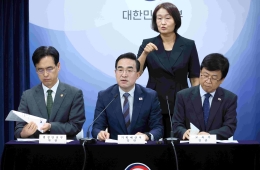
Gyeongbuk Education Chief Lim Jong-sik: "Education Funding Can't Be Cut Just Because Student Numbers Fall"... 20.79% Domestic Tax Link Must Remain
On August 20, the Gyeongbuk Office of Education strongly expressed its concerns over the government’s plan to abolish the current system that links local education financial grants to 20.79% of domestic tax revenue, pushing instead for a new framework that would factor in the economic growth rate and demographic changes in the school-age population. The office urged that the current system be maintained.
The Gyeongbuk Office of Education views this proposed reform as not merely an adjustment to the calculation method for financial grants. Rather, it considers it a major change to the fundamental structure of the local education finance system, which has been stably secured by the state for early childhood, elementary, middle, and high school education.

In particular, the office pointed out that if the reduced grant funds were to be allocated to the “Talent and Education Account” of the Future Response Fund, the responsibility for fund management would move from the Ministry of Education to the Ministry of Strategy and Budget. This would make it practically difficult for the funds to be used for primary and secondary education.
Gyeongbuk is a region where rural, fishing, island, remote areas, small schools, and branch schools are widely dispersed. Therefore, a decrease in student numbers does not lead directly to a proportional decrease in educational expenses. Even if the student population drops, the basic operational costs for schools and classrooms do not fall sharply. Additionally, there is continuing financial demand due to regional characteristics such as supporting long-distance student commutes and improving aging school facilities.
Moreover, educational demands for each individual student are expanding, including basic academic skills, special education, care and education welfare, student mental health, and artificial intelligence and digital education. If the declining school-age population rate is directly reflected in the calculation of grants, areas with many rural, fishing, and small schools would see a rapid deterioration in educational conditions, potentially intensifying educational disparities between regions.
The Gyeongbuk Office of Education stated that while it supports increased state investment in early childhood, higher, and lifelong education, this should not come at the cost of reducing resources for early childhood, elementary, middle, and high school education, nor by redirecting such resources to other funds. The office stressed that new resources needed for emerging education fields should be established as separate, stable, national funding distinct from the existing grants and without undermining them.
Jong-sik Lim, Superintendent of the Gyeongbuk Office of Education, stated, "A decline in the student population does not mean that the nation’s responsibility for education or the education due to each child should be diminished. On the contrary, as student numbers decrease, we must invest more in cultivating the potential of each individual and ensuring equal educational opportunities regardless of where a student lives. Local education financial grants are a legal safety net safeguarding public education and local educational autonomy. We oppose reforms that measure the future of education based solely on student numbers. We will unite with superintendents and educational communities nationwide to keep the current system linked to 20.79% of domestic tax revenue in place."
Hot Picks Today
 "Is It Really This Big?" World Number One in Sight... K-Beauty’s Surge Captivates Foreign Consumers with Trusted Korean Products
- "I Was Expecting a Drop, but It's Rising"... The Secret Behind Unyielding Gold Prices Despite Climbing Interest Rates [Weekend Money]
- Samsung SDI Sells Part of Its Stake in Samsung Display, Secures 4.4 Trillion Won
- "Does This Really Work?" Just Add Cold Water... Cup Noodles Sell Out in 68 Years' First Craze
- "Please Catch Me!" Woman Lets Go from 11th Floor... Leaps Toward Firefighter in Daring Rescue
The Council of Education Superintendents of the Republic of Korea also held an emergency meeting on August 19, demanding continuity of the current domestic tax-linked system and the formation of an official consultative body among the government, National Assembly, and the education sector. The Gyeongbuk Office of Education plans to work together with metropolitan and provincial offices of education across the country to continuously convey the voices of the field to the government and the National Assembly.
© The Asia Business Daily. All rights reserved. Unauthorized AI training and use prohibited.