Lee Urges Strategic Dialogue on Korean Peninsula in Meeting with Wang; China Distances Itself from 'North Korean Denuclearization'
President Lee Meets Wang Yi at the Blue House: Scrutinizing Korea-China Statements
Korea Explains 'Step-by-Step Denuclearization' Starting with Suspension
Wang Yi: "The U.S. Must Abandon Its Hostile Policy Toward North Korea"
Calls for Swif
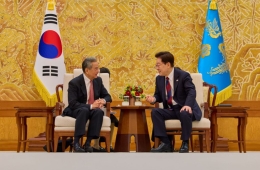
On August 20, President Lee Jae-myung met with Wang Yi, Member of the Political Bureau of the Communist Party of China and Minister of Foreign Affairs, and requested that "close and strategic communication continue regarding South Korea-China relations and issues on the Korean Peninsula." The government explained to the Chinese side its phased and pragmatic denuclearization proposal, which starts with a halt to North Korea's nuclear and missile activities, and requested constructive cooperation. In contrast, China did not mention denuclearization in its official statements, instead placing the responsibility for easing tensions on the Korean Peninsula on the United States by stating that "the United States must abandon its hostile policy toward North Korea."

President Lee Jae-myung is meeting Wang Yi, Director of the Office of the Central Foreign Affairs Commission of the Communist Party of China and Minister of Foreign Affairs, at the Blue House on the 20th. 2026.8.20 Yonhap News Agency
View original imageKorea Proposes 'Phased Denuclearization of the North'...China Prioritizes 'U.S. Policy Change Toward North Korea'
At the Blue House, President Lee received Minister Wang, who was on an official visit to South Korea, and asked for close communication regarding Korean Peninsula issues with South Korea's diplomatic and security team, including Minister of Foreign Affairs Cho Hyun and Director of the National Security Office Wi Sung-rak. This is interpreted as an attempt to draw out China's role in a situation where the South Korean government has positioned itself as a "pace-setter" for building trust between North Korea and the United States and resuming dialogue.
This request was detailed more concretely during the subsequent meeting between Director Wi and Minister Wang that followed the President's reception. Director Wi outlined the vision of peaceful coexistence on the Korean Peninsula, as presented in President Lee's Liberation Day address, and explained the phased and pragmatic approach toward denuclearization starting from a halt in North Korea’s nuclear activities, requesting China's constructive cooperation. According to the Blue House, Minister Wang stated, "China's policy on the Korean Peninsula remains consistent and stable," and expressed continued commitment to playing a constructive role in maintaining peace and stability on the Korean Peninsula.
However, the Chinese side emphasized a different aspect regarding the solution to Korean Peninsula issues. Minister Wang said, "The fundamental way to resolve tensions on the Korean Peninsula is to remove the root causes of the problem and to have the United States abandon its hostile policy toward North Korea." The government's concept of "phased and pragmatic denuclearization" was not included. While South Korea and China agreed on the need to resume dialogue and pursue peace and stability, South Korea prioritized the suspension of North Korea's nuclear and missile activities and the goal of denuclearization, whereas China placed priority on changes to U.S. policy toward North Korea and the establishment of a peace regime.
This meeting also marked the restoration, after nearly five years, of strategic dialogue between the Director of the National Security Office and the Director of the Office of the Central Foreign Affairs Commission of China, which had been suspended since December 2021. Both sides agreed to operate this channel on a regular basis, and Minister Wang invited Director Wi to visit China.
Lee: "A Solid Outcome—Full Restoration of Korea-China Relations"...Wang Yi: "Korea Made the Right Choice, On the Right Track"
Both sides offered positive assessments regarding Korea-China relations. President Lee noted his consecutive meetings with Chinese President Xi Jinping last year and this year, stating, "We are achieving the definitive outcome of a full restoration of Korea-China relations." He especially emphasized "horizontal and mutually beneficial cooperation" in the economic sector.
In response, Minister Wang stated that since the inauguration of President Lee, South Korea "has made the right choice and returned Korea-China relations to the right track," describing the Lee administration's China policy as "rational, pragmatic, and proactive." He further requested that South Korea continue its friendly policy toward China, saying, "Embracing China is embracing the future; going together with China is going together with opportunities."
Wang Yi Calls for Expedited Conclusion of Phase 2 Korea-China FTA
Minister Wang specifically raised the issue of Phase 2 negotiations on the Korea-China Free Trade Agreement (FTA) in the economic sector. Referring to the fragmentation of the global economy and the spread of protectionism, he urged the swift completion of Phase 2 FTA negotiations, stating that "Korea and China should set an example." The Phase 2 FTA negotiations are follow-up talks intended to expand the scope of cooperation, which until now has focused on goods, to the service and investment sectors. While Minister Wang's call for a swift conclusion was included in the Chinese statement, it was not part of the summary of the President's meeting released by the Blue House.
The next major milestone in bilateral relations will be the Asia-Pacific Economic Cooperation (APEC) summit, to be held this November in Shenzhen, China. Minister Wang requested support from South Korea, which hosted the Gyeongju APEC last year, for the success of the Shenzhen APEC, and pledged to prepare for fruitful high-level exchanges during the summit in Shenzhen. President Lee said, "I will spare no necessary support" and expressed hope for "fruitful outcomes that can contribute to the lives of both peoples, as the summit between the two countries continues from Gyeongju last November to Beijing this January, and on to Shenzhen in November."
Hot Picks Today
 "Bought a New Car and I'm the Tester?"... The Rise of 'Improvised Cars' Skipping Validation
- Despite 10% Annual Interest, Russians Pull Out Cash as Fears of Deposit Nationalization Spread
- "Monami Posts a 10 Billion Won Deficit, But Consistently Awards 4.7 Billion Won in Contracts to the Third-Generation Family Company"
- June Bank Delinquency Rate Falls to 0.56%... Highest June Level in 10 Years
- "You Can't Get One Even If You Want"... 38,000 Won Keycap Limited to One Per Person Sells Out in an Hour
A ruling party official commented, "While South Korea and China are speeding up the normalization of relations and dialogue channels, they each revealed different priorities on the solution to Korean Peninsula issues," explaining that "managing their differences and achieving concrete outcomes in security and trade by the November APEC meeting in Shenzhen will be the next test for the 'full restoration' of Korea-China relations."
© The Asia Business Daily. All rights reserved. Unauthorized AI training and use prohibited.