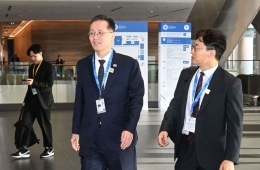
Unitree Chairman: "A 'ChatGPT Moment' for Robots Possible Within 2-3 Years"
Unitree Robotics, Leading Chinese Robot Company
Chairman Wang Xingsing Speaks at Beijing Robot Conference
Top Challenge Remains Precise Robot Operation
Wang Xingsing, founder and chairman of Chinese robotics company Unitree Robotics, predicted that the humanoid robot industry could reach an inflection point similar to the emergence of ChatGPT within as little as two to three years. He suggested that full-scale popularization of robots will begin once they reach a level where they can carry out most tasks in unfamiliar environments simply by responding to spoken or written instructions from humans.

Wang Xingsing, founder and chairman of Chinese robotics company Unitree Robotics, is delivering a speech at the "2026 World Robot Conference (WRC)" held in Beijing on the 20th. Photo by Reuters Yonhap News
View original imageAccording to the Chinese state-run Global Times on August 20, Wang stated at the '2026 World Robot Conference (WRC)' held in Beijing, "If robots can perform about 80% of assigned tasks in unfamiliar environments, including homes, that will mark the 'ChatGPT moment' for humanoid robots."
He assessed that this technological turning point could arrive within two to three years under ideal circumstances. Wang specifically defined this as "a level where robots can perform about 80% of tasks assigned in about 80% of unfamiliar environments using just spoken or written instructions."
Unitree has already deployed robots in automobile production lines and its own factories, testing them in real-world environments. Its artificial intelligence (AI) researchers are also developing technology to enable robots to carry out household chores. However, Wang explained that due to the current limitations in overall operational efficiency and the 'generalization ability' required for robots to adapt to new environments, the company has not yet moved toward large-scale distribution.
He identified the primary technical challenge as translating AI decision-making into precise movements by actual robots. Wang noted, "When a robot is trying to grasp an object, it may appear as though it is about to succeed, but at the final moment it cannot correct small errors or process the necessary tactile feedback on its own." He emphasized that these minor errors significantly reduce the robots' rate of successful operations and cited this as the greatest bottleneck facing the global embodied AI industry.

Unitree humanoid robots are demonstrating kickboxing. Photo by Reuters Yonhap News
View original imageOn the same day, Wang also introduced software currently in development at Unitree that allows the movements of humanoid robots to be pre-programmed and simulated on a computer before being tested on actual robots. He explained that this would improve the efficiency of robot development.
Hot Picks Today
!["Let's Hit It Big in Korea"... Foreigners Flock to 'This Place' [Weekend Money]](https://cwcontent.asiae.co.kr/asiaresize/93/2026101613053663640_1792123535.jpg) "Let's Hit It Big in Korea"... Foreigners Flock to 'This Place' [Weekend Money]
"Let's Hit It Big in Korea"... Foreigners Flock to 'This Place' [Weekend Money]
- "Honestly, Korean Internet Users Really Are Disgusting"... Man Who Threatened to Kill Koreans Offers Absurd Excuse
- "I Used to Eat This All the Time in Korea..." What Is This Snack Winning Over Taste Buds Worldwide? [K-Holic]
- Struck with an Axe, "I Can't Die Like This"... Captain Who Prevented Plane Crash Gives First Interview
- "RESCENE's Uncle" Reveals Three Hidden Faces... Ad Draws 2.07 Million Views
Meanwhile, Unitree was listed the previous day on the Science and Technology Innovation Board (STAR Market) of the Shanghai Stock Exchange, also known as the "Chinese Nasdaq." It is the first humanoid robot company in China to be listed on the mainland's A-share market. On the first day, its opening price surged by about 630% from its offering price (150.80 yuan) to reach 1,100 yuan. The stock later gave back a portion of its gains to close at 845 yuan, up 460%.
© The Asia Business Daily. All rights reserved. Unauthorized AI training and use prohibited.

!["Please, Just Take Them Off" - They Made It All the Way to Bed... Then Fecal Bacteria Struck [Deep Scroll]](https://cwcontent.asiae.co.kr/asiaresize/307/2026101610053063338_1792112730.png)