Ahn Gyubaek: "Two OPCON Capability Assessments Already Completed in Part One of UFS"
Remarks at the National Assembly Defense Committee
"Field Exercises to Continue After UFS"
Minister of National Defense Ahn Gyu-baek stated that, during the shortened Ulchi Freedom Shield (UFS) joint military exercise between South Korea and the United States—an exercise shortened at the direction of U.S. President Donald Trump—two separate operational capability assessments had already been carried out, including those related to counter-artillery operations, in preparation for the transfer of wartime operational control (OPCON).

On August 20, Minister Ahn, appearing before the National Assembly's National Defense Committee, responded to a related question from Assemblyman Kim Byung-joo of the Democratic Party of Korea by saying, "Two assessments, including counter-artillery operations, have already been completed during part one of the UFS exercise." He also stated, during questioning by Assemblyman Lim Jong-deuk of the People Power Party, "South Korea and the United States closely conducted evaluations of the two Full Operational Capability (FOC) items together in part one of UFS."
The South Korean government aims to complete verification of the Full Operational Capability (FOC) of the Future Combined Forces Command—which will command wartime combined operations between South Korea and the United States after the OPCON transfer—within this year. To this end, some joint South Korea-U.S. assessments of the capabilities and systems required for OPCON transfer were also planned during this UFS period.
However, there have been concerns that the joint evaluation for OPCON transfer could be disrupted, as the current UFS only conducted the simulation-based command post exercise (CPX) focused on defense operations—completing part one—while part two, which was intended to practice counteroffensive operations, was canceled. Part one of the UFS exercise was scheduled to run until the 21st, and part two was scheduled from the 24th to the 27th. Nonetheless, according to Minister Ahn and the South Korean government, the planned assessment related to the OPCON transfer was to be carried out during part one and has already been completed, so there should be no impact.
Minister Ahn also addressed the issue of the combined field training exercises (FTX) during the reduced UFS period, stating, "A total of 159 sessions are prepared this year. These will be carried out evenly throughout the year." He added, "Of course, in terms of numbers, the frequency during the UFS period has decreased slightly compared to last year, but the exercises will continue after that as well."
Minister Ahn commented on U.S. President Donald Trump's explicit mention of "57" North Korean nuclear weapons at the White House on August 19 (local time), saying, "The numbers appear to differ somewhat."
He continued, "We have generally stated that North Korea possesses about 80 to 120 nuclear weapons, a figure based on assessments from domestic and private research organizations." He added, "However, it is quite limited for me to confirm exactly how our military authorities assess this at the moment."
President Trump, in a meeting with reporters at the White House, mentioned that he has a good relationship with North Korean leader Kim Jong Un, adding, "He has 57 very powerful nuclear weapons." Given that both South Korea and the United States treat information related to North Korea's nuclear development as classified, it is highly unusual for the U.S. president to publicly mention a specific number regarding North Korea's nuclear arsenal. The South Korean government, maintaining a policy of not recognizing North Korea as a nuclear state, has also refrained from stating specific figures regarding North Korea's nuclear weapons capabilities.
Hot Picks Today
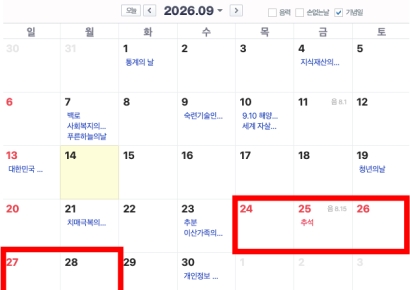 "This Chuseok Feels Too Short, Let's Take Monday Off Too"... Anticipation Grows for Surprise Designation of September 28 as a Temporary Public Holiday
- "Each 10-Won Drop in Exchange Rate Boosts Profit by 2.5 Billion Won"...Stocks Benefiting from the Strong Won at 1,340 Won Level
- President Lee's Past Remark, "It Would Be Ideal to Win Several Proportional Seats," Resurfaces After Yong Hyein's Resignation Seven Years Later
- "The First Thing You Do at a Restaurant May Expose You to Harmful Substances While Trying to Be Polite"
- '12 Billion Bottles of Surplus' – Enough for the World to Drink for 3 Years... Wasn't MZ Just Trending Recently?
However, when asked if he acknowledges that North Korea possesses nuclear weapons, Minister Ahn asserted, "That is something we cannot officially recognize." In response to the question of whether President Trump's specific mention of '57' nuclear weapons equates to an acknowledgment of North Korea as a nuclear state, he replied, "It would not be appropriate for the South Korean Minister of National Defense to comment on that matter." He further emphasized, "We cannot develop nuclear weapons, nor should we accept the deployment of U.S. tactical nuclear weapons. We are maintaining a consistent policy of firmly relying on the U.S. nuclear umbrella."
© The Asia Business Daily. All rights reserved. Unauthorized AI training and use prohibited.