"Complaints Rise About G-Valley Gloom... What’s Happening to a City With ‘0% Green Space’? [Future of Parks ③]"
[Report] Transformation of the Industrial "Gray City"... G-Valley's Green Makeover
Connecting Green Corridors through the "Garden Valley" Project
Rapid Progress on Street Forests and Other Green Spaces On-Site
"It Will Benefit Local Busines

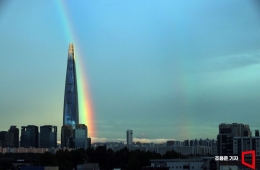
View of the Seoul Digital National Industrial Complex area from Guro Digital Complex Station on Seoul Subway Line 2. Photo by Baek Gwanghwan
View original image'Park and Green Space Ratio: 0%'
On August 18, the Seoul Digital National Industrial Complex in Guro-gu, Seoul painted a bleak picture. Even though the midday heat had dropped to 30 degrees Celsius just after lunchtime, it was difficult to spot anyone taking a walk. Kim Jeonghwan (42, alias), who has worked here for 13 years, hurried back to his office, saying, "It's hot, but more importantly, there is no park for a stroll after lunch or anywhere to sit and rest."
Guro·Gasan Digital Complex (G Valley), which began as Guro Industrial Complex in the 1960s, is now the heart of Korean industry, with 160,000 people commuting to IT venture companies every day. As development has remained focused on industrial functions for a long time, G Valley has become strongly associated with the image of a "gray city," due to a lack of green spaces and leisure areas for citizens and workers to stay and rest. Of the entire area of G Valley, which spans 1.92 million square meters, the ratio of park and green space is 0%. Instead, more than 150 designated open spaces set up during the construction of knowledge industry centers act as makeshift green areas.
However, even this gray city, G Valley, has started to change. Since late last year, the Seoul Metropolitan Government has been promoting the Garden Valley Project, aiming to connect green spaces throughout G Valley by 2030 and create a "Green Industrial Complex." With a total project budget of 43.8 billion won, this initiative will transform the entire area of G Valley, adding 40,000 square meters of streetside forest gardens and 60,000 square meters (specifically 60,909 square meters) of communal gardens.
The construction progress observed on-site is rapid. In this area where there was no park or green area in the urban design plan, "urban streetside forests" are being created by expanding street trees and linear green zones, while "communal gardens" are utilizing underused designated open spaces. These efforts are underway in various locations.

In the Seoul Digital Industrial Complex in Guro-gu, Seoul, the Garden Valley Project is underway in various locations to create a "Green Industrial Complex." Photo by Baekhwan Bae
View original image
In the Seoul Digital National Industrial Complex in Guro-gu, Seoul, the Garden Valley Project for creating a "Green Industrial Complex" is underway in various locations. Photo by Baekhwang Hwan
View original imageIn early August, a 7,750-square-meter streetside forest garden was unveiled in Guro-gu. In this area, you can find a total of 183,600 plants, including tall trees like zelkova and tree hydrangea, shrubs like golden euonymus and blue angel, and herbaceous plants such as gaura, betony, and variegated hosta. In high-traffic areas such as subway stations, pocket gardens have been created, while planter-type gardens were installed on artificial surfaces where greenery is difficult to establish.
In particular, the naturalistic planting technique has been applied to realize a green landscape distinct from the typical streets of an industrial complex. Areas with heavy pedestrian traffic and snowfall were designed with maintenance in mind, and seasonal characteristics were incorporated through consultations with garden designers.
The number of locations where old benches have been removed and movable planters installed has also noticeably increased. Digital-ro, which was previously connected only by concrete sidewalks, is now lined with mini-garden-style benches adorned with various plants. Kim Yonghyeon (45, alias), who runs a cafe in the Digital-ro area, said, "It's still insufficient, but by removing the old decks, planting greenery, and providing places to rest, there has definitely been an increase in people lingering. I hope that as more shade and visitors appear, it will help my business as well."
The driving force behind these changes has been the citizens themselves. The Seoul Metropolitan Government began working on solutions after seeing a post in an office workers' community stating, "Just going to G-Valley or Gasan Digital Complex makes you feel down, and I want to leave right after work." Seoul Mayor Oh Se-hoon took direct action by convening a special meeting of senior officials and instructed, "Develop an urban plan to turn the G Valley area into a landmark in southwestern Seoul where young people can work, enjoy themselves, and stay."
This fall, Seoul City will begin construction of a 10,410-square-meter streetside forest garden across five routes on Gasan Digital 1-ro in Geumcheon-gu, with plans to open it in November. Next year, streetside forest gardens covering 21,980 square meters are planned for nine routes in both Guro-gu and Geumcheon-gu. The city will also gradually expand shared gardens, for which it provides 70% of the funding. Beginning with nine locations in Guro-gu and Geumcheon-gu this fall, the goal is to establish a total of 68 sites by 2030.
The Seoul Metropolitan Government is taking various steps to raise the urban green space ratio starting with G Valley, as industrial complex competitiveness is no longer determined solely by the supply of factories and office space, but by the overall urban environment—which is now seen as synonymous with industrial competitiveness.
A prominent example is the development of the KyoHakSa site, the first private-sector development reflecting improvements in semi-industrial zone policies. The city plans to convert existing semi-industrial areas, which have focused on regulation and management, into mixed-use spaces where manufacturing, work, residential, and leisure functions are integrated. On the 15,021-square-meter KyoHakSa site, designated as a special planning district within G Valley, a complex facility will be constructed combining four underground and 24 above-ground floors for residential, business, exhibition, gallery, sports, and public library use, as well as green space.
Plans are also in place to connect green spaces in Garibong-dong and the Gasan Digital Complex area. Through expedited integrated redevelopment planning and the creation of the "Fun Station" at Gasan Digital Complex Station, a green network will be established.
Hot Picks Today
 "30,000 Won in Korea, 70,000 Won in Japan"—Koreans Fill Suitcases as Illegal Direct Purchases Soar
- "Only 400m from Accommodation": Body Believed to Be Jang Miran Found After 104 Days, Sparking Investigation Negligence Controversy
- In Korea, It's a Beloved Side Dish... But Miami Spends $4.1 Million to Remove 9,000 Tons from Its Beaches
- "Monster That Eats Gold" Turns Out to Be Real: Uproar in China as 5-Year-Old Swallows $7,500 Gold Bar, Sparking Questions About Family's Wealth
- Homeless Man with Necrotic Leg Refusing Help Opens Up to Police After Two Months of Consistent Visits
Kim Younghwan, Director of the Urban Garden Division of Seoul Metropolitan Government, said, "The essence of G Valley's transformation lies not simply in expanding green spaces, but in changing the structure of the urban space itself. By enhancing green spaces alongside cultural and leisure areas, we can vitalize workers’ rest and interaction, create an environment for creative collaboration among businesses, and further strengthen G Valley's industrial competitiveness."

Before and after views of the Garden Valley project underway in the Seoul Digital Industrial Complex, Guro-gu, Seoul. Guro District Office
View original image© The Asia Business Daily. All rights reserved. Unauthorized AI training and use prohibited.