Government Partners with AMD to Build AI Computing Ecosystem... Fostering Korean NPUs
Building an Open AI Infrastructure... Driving On-site Adoption
Discussing Strategies for Expanding Domestic NPU Market and Global Ecosystem Integration
The government is partnering with companies such as AMD to build an open artificial intelligence (AI) computing infrastructure ecosystem. The initiative aims both to move away from dependence on specific companies by fostering an open ecosystem with participation from domestic AI semiconductor firms, and to help ensure that Korean companies’ neural processing units (NPU) become a core part of the global ecosystem.
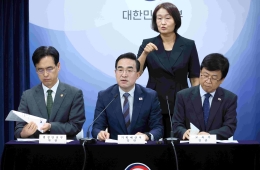
On August 20, the Ministry of Science and ICT held the ‘Open AI Computing Infrastructure Ecosystem Establishment Meeting’ at the HJ Business Center in Gwanghwamun, Seoul. This meeting followed Deputy Prime Minister and Minister of Science and ICT Baek Kyung-ho’s signing last month of a memorandum of understanding (MOU) on cooperation for the AI semiconductor ecosystem with Lisa Su, Chairman and CEO of AMD. Representatives from Korea’s AI semiconductor industry and AMD Korea also attended the meeting.

On the morning of the 20th, at the HJ Business Center in Gwanghwamun, Seoul, Deputy Prime Minister and Minister of Science and ICT Baek Kyunghun (center) and attendees are taking a commemorative photo at the "Meeting for Building an Open AI Computing Infrastructure Ecosystem." Photo by Lee Myunghwan
View original imageRecently, the AI infrastructure market, which relied heavily on a single company’s graphics processing units (GPU), has evolved into an open AI computing infrastructure encompassing a variety of computing devices, including NPUs and central processing units (CPU). With the rise of inference-oriented AI models, the importance of NPUs optimized for inference, in addition to GPUs needed for model training, has increased.
This meeting was convened to discuss ways to support Korean NPUs in securing competitiveness in the global market in response to these trends. Participants discussed specific plans for expanding NPU market adoption, strategies for increasing global ecosystem participation, government policy support, and public-private cooperation.
FuriosaAI, a domestic NPU manufacturer, presented on global trends in open AI computing infrastructure and the response strategies of the Korean AI semiconductor industry. AMD Korea shared the main points and implementation plans of the MOU signed with the Ministry of Science and ICT. MangoBoost and More presented on their ongoing efforts to optimize AI computing and collaborate on software with AMD.
During the following open discussion, participants talked about the direction of development for Korea’s AI semiconductor industry and public-private partnership strategies to respond to changes in the global AI computing environment. The attendees agreed on the importance of transitioning from a GPU-centered, single-structure model to an open AI computing ecosystem where AI semiconductors, memory, networking, and software are organically connected as AI services expand.
There were also suggestions to secure open computing architectures using next-generation AI computing infrastructure technology and to increase investment in core future AI semiconductor technologies. As competition in AI computing moves beyond semiconductor performance toward platform competition that combines hardware and software, participants voiced the need to spread open interfaces, international standards, and open-source-based technologies.
Some called on the government to provide ecosystem support and create test-bed environments at the national level to spur the spread of AI computing technology. Additionally, participants stressed that for the MOU to yield tangible results, it is essential to carry out both the identification of cooperative projects and follow-up actions without delay.
Deputy Prime Minister Baek stated, “As the global AI market shifts from training to inference focus, the arena of AI competition is expanding beyond individual chip performance to competition among open AI computing ecosystems that are efficient in terms of power consumption and costs. This presents a new opportunity for Korean AI semiconductor (NPU) companies that have strengths in inference efficiency.”
Hot Picks Today
 "Is It Really This Big?" World Number One in Sight... K-Beauty’s Surge Captivates Foreign Consumers with Trusted Korean Products
- "I Was Expecting a Drop, but It's Rising"... The Secret Behind Unyielding Gold Prices Despite Climbing Interest Rates [Weekend Money]
- "We Refuse Male Passengers"... 'Pink Bus' Launches with All-Female Drivers and Passengers
- "Does This Really Work?" Just Add Cold Water... Cup Noodles Sell Out in 68 Years' First Craze
- "Please Catch Me!" Woman Lets Go from 11th Floor... Leaps Toward Firefighter in Daring Rescue
He continued, “Going forward, we will strengthen full-stack demonstration support and make efforts to build the relevant ecosystem so that Korean NPUs can quickly achieve successful case studies in data centers and real-world AI service applications.”
© The Asia Business Daily. All rights reserved. Unauthorized AI training and use prohibited.