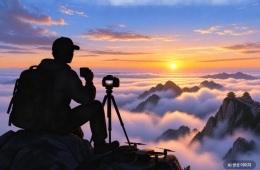
Chilling Terror Leaves Young People Breathless... Paying 170,000 Won to Dive into 'Disaster' Experiences
Pursuing Extreme Fear in a Controlled Environment
2,020,000 at Gyeongbokgung vs. 1,000 at Seodaemun Prison
"Civil Dark Tourism Remains in Its Infancy," Experts Point Out
'Dark tourism'—visiting sites of tragedy, death, and historical disasters—is emerging as a new experiential travel trend among young people in China. Many pay to enter disaster simulation centers that artificially recreate extreme scenarios such as typhoons and floods. They do so both to face their fears and to learn practical survival skills.

According to the South China Morning Post (SCMP) on August 17, the "Lvxing Base" disaster simulation center located in Hangzhou, Zhejiang Province, China, has been enjoying significant online popularity since its opening in September 2024.
Fierce Winds and Muddy Downpours: 160,000 Flock to China’s Disaster Experience Center

Participants experiencing strong winds at the China Disaster Experience Center. Photo by SCMP
View original imageAt this facility, visitors pay 899 yuan (approximately 170,000 won) per person to experience winds reaching up to 165 kilometers per hour, along with heavy rain and sudden flash floods. A family package, which includes outdoor survival skills and water rescue training, costs up to 5,000 yuan (about 960,000 won). Since its opening, the facility has attracted over 160,000 visitors.
Participants wear protective jackets and helmets and receive disaster response training from professional instructors. Safety personnel are stationed throughout the site to support visitors who may feel anxious.
One participant, who grew up in a coastal city but had never actually experienced a typhoon, recounted how, during an underground parking lot flood simulation, muddy water rose up to their neck. "I was so terrified that I forgot I was just participating in an experience," they said. "I ended up with bruises on my legs from a sudden debris flow, but helping and being helped by foreign tourists in the group gave me a profound sense of humanity."
This business was launched by the well-known adventurer couple Zhang Xinyi and Liang Hong, who leveraged their experience exploring areas such as the Chernobyl Exclusion Zone and conflict zones in the Middle East. Their aim was to use real-world survival training programs to raise awareness of nature's dangers and teach effective responses.
Local internet users reacted with a mixture of praise and criticism, describing the center as "a valuable place that teaches young people essential survival skills," while others questioned whether it trivializes the real suffering of those who have lost everything in actual floods.
The Educational Value of Disaster Sites: “Strengthening Collective Memory and National Identity”

Industry analysts attribute the popularity of these disaster experiences to the psychological satisfaction that comes from "controlled risk." In an age of fierce competition and an uncertain future, people want to confront and overcome a managed crisis, affirming their agency over their lives.
Dark tourism also manifests as visits to sites of war, massacres, and terror attacks, where visitors mourn victims and seek lessons from history. Notable examples include New York’s 9/11 Memorial & Museum, the Auschwitz-Birkenau concentration camp in Poland, and the Nanjing Massacre Memorial Hall in China.
Academic research suggests that actual disaster sites, unlike commercial simulators, are based on authentic historical facts and collective memory. Experts explain, "The authenticity offered by real disaster and tragedy sites fosters a deeper awareness of life and death for visitors, and contributes much more to self-esteem, family bonds, and national identity than simulated experiences can."
‘K-Dark Tourism’ Neglected Amid Korean Wave Boom: Gaps in Content and Policy

Foreign tourists are taking photos with Gwanghwamun in the background. Photo by Yonhap News
View original imageIn contrast, despite the surge in foreign visitors driven by the popularity of K-pop, dark tourism that communicates the pains of Korea’s modern history remains in its infancy. Representative Korean dark tourism sites include Seodaemun Prison, which holds the history of colonial exploitation and human rights abuses, and the Namyeong-dong Anti-Communist Investigation Bureau, a symbol of state violence.
According to the Ministry of Culture, Sports and Tourism’s tourism knowledge information system, 2,027,087 foreign tourists visited Gyeongbokgung Palace—ranked as South Korea’s most popular tourist spot—in 2024. In stark contrast, only 1,433 foreigners visited the Seodaemun Prison History Hall during the same period.
Support from tourism authorities and local governments has also been lacking. The Seoul Tourism Organization’s guidebook, for example, only offers brief descriptions of each site, with no in-depth multilingual walking tours designed to help visitors understand the historical context.
For travel agencies, the high proportion of Chinese and Japanese tourists presents an additional challenge. Ongoing historical disputes between the countries make it difficult to interpret and communicate historical meaning in a neutral and accurate manner.
This is not just an issue in the capital region. According to a February study by the Jeju Research Institute on developing a “Jeju-type dark tourism model,” Jeju Island was the first in Korea to enact an ordinance fostering dark tourism. Nevertheless, no comprehensive tally of visitors has been conducted, and the resources have not even been properly catalogued, pointing to a lack of effective policy.
Hot Picks Today
 "One Less Worry About Old Age": Japanese Companies Secure Senior Talent with Regular Employment Beyond 65
- "Shares Soar 600% on Debut as Retail Investors Flock to 'Robot Company'"
- "Chinese Tourists Say 'We're Not Going Anymore' as South Koreans Fill the Gap... Japan's Tourism Thrives Instead"
- "They Underestimated 'Cheap Coffee,' but Now It's Serious... MegaMGC Coffee Catches Up with Starbucks"
- Raising Prices Boosts Sales... Revival of China's 'Doomed' Ramen Market
Experts recommend developing immersive storytelling techniques that will engage even those foreign visitors who lack prior knowledge, enabling them to understand painful histories. They also advise implementing a five-year integrated master plan and focusing on improving the quality of on-site interpretation to ensure that some sites are not reduced to mere “photo zones.”
© The Asia Business Daily. All rights reserved. Unauthorized AI training and use prohibited.