KDI Revises Growth Forecast to 3.2% This Year...Semiconductor Boom to Drive $360 Billion Current Account Surplus
Revised Economic Outlook for August 2026
The Korea Development Institute (KDI), a state-run think tank, has sharply raised its economic growth outlook for this year to 3.2%, up by 0.7 percentage points from the previous estimate of 2.5%. This upward revision reflects a much stronger-than-expected global semiconductor boom related to artificial intelligence (AI), which is driving gains in exports and facility investment. The current account surplus is also forecast to reach an unprecedented level of 360 billion dollars.
According to KDI’s “Revised Economic Outlook for August 2026” released on the 19th, the country’s gross domestic product (GDP) growth rate for this year is projected to be 3.2%. This is an increase of 0.7 percentage points compared to the 2.5% forecast released in May. The growth projection for next year has also been raised by 0.5 percentage points to 2.2%. KDI analyzed that the stronger-than-expected global demand for semiconductors would primarily boost this year’s growth through increases in exports and facility investment.
In particular, the outlook for facility investment, especially in semiconductors, has improved significantly. Facility investment for this year is forecast to rise by 7.9%, bolstered by the global expansion of AI infrastructure investments. This is up by 4.6 percentage points from the projection made in May. Exports are also anticipated to grow 8.7% this year, supported by robust investments related to AI—an upward revision of 4.1 percentage points from the previous forecast.
The current account surplus is projected to reach a massive 360 billion dollars both this year and next, driven by a sharp surge in semiconductor exports. Compared with the previous estimates in May, this represents an upward revision of 120 billion dollars for this year and 142.5 billion dollars for next year, respectively. According to KDI, while the global expansion of AI investment is pushing up semiconductor prices, the rise in international oil prices due to the Middle East war is expected to be more limited than previously forecast.

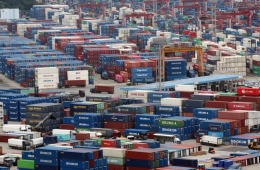
Containers piled up at Busan New Port’s Sinseondae Pier. Photo by Yonhap News Agency
View original imageHowever, it was pointed out that the semiconductor boom is not swiftly spreading to broader improvements in consumption and employment. While private consumption is expected to grow by 2.3% this year, the recovery trend is projected to be moderate, as the positive effects of income growth will primarily benefit semiconductor-related sectors. The increase in the number of employed persons is also expected to be limited to just 110,000 this year.
KDI assessed that the Korean economy is currently delivering robust growth thanks to the global semiconductor boom connected to AI. In fact, GDP in the second quarter of this year grew by 0.6% quarter-on-quarter and 3.7% year-on-year. As semiconductor export prices soared, Korea’s terms of trade improved significantly, resulting in a surge in gross domestic income (GDI) growth that far outpaced GDP growth.
This year’s consumer price inflation is maintained at 2.7%, the same as the previous estimate. International oil price and exchange rate increases are pushing prices higher, while demand pressures due to economic improvements have also contributed in part. Next year’s consumer price inflation is forecast to fall to 2.2%, reflecting expectations of stabilized international oil prices.
Hot Picks Today
 "Apparently, you can easily make 3.3 million won a month in Korea"... The "easy-money gig" making waves among international students
- "Got a Parking Ticket? Pay with 'This' Instead of a Fine"... U.S. Launches Unusual Program
- "Hand in Your Resignation and Get a Year's Salary"... This Country Pushes Early Retirement for Civil Servants
- "Oh Eunyoung's Consultation Fee: Millions of Won? Not Expensive"... Yonsei Professor's Sharp Rebuke over "300,000-Won Lecture Fee"
- "'100% Cat Fur' - It Seemed Unbelievable, but It Was Real... Chinese Shopping Mall Rocked by Shocking Revelation"
KDI identified the semiconductor business cycle as the most significant variable influencing future growth trends. The institute warned that concerns about the profitability of AI investment could dampen global demand for AI-related investments, or that a decline in the market share of domestic semiconductor firms could rapidly weaken economic growth. Conversely, if AI investment demand remains high and domestic firms expand their supply capacity faster than anticipated, growth could surpass current projections.
© The Asia Business Daily. All rights reserved. Unauthorized AI training and use prohibited.