Justice Cho's 'Written Notice' Irks Presidential Office and Stokes Outrage in Democratic Party
Cho Hoidae Breaks Precedent with Written Recommendation for Supreme Court Justices
De Facto Notification to Presidential Office Without Candidate Consultation
Ruling Party Moves to Impeach the Chief Justice
Two Vacancies on Supreme Court Appear Inevitable
There is a palpable sense of displeasure among the presidential office and the ruling party following Chief Justice Hoidae Cho's unilateral written notification regarding the appointment of new Supreme Court justices. As calls for Chief Justice Cho's resignation mount, signs are emerging that tensions between the executive branch and the judiciary are escalating.
According to political sources on August 19, some inside the presidential office have expressed unease over Chief Justice Cho's recommendation for the appointment of Supreme Court justices. This reaction stems from the fact that Chief Justice Cho broke with precedent by notifying the president in writing the previous day, rather than meeting in person. Such an approach, which amounts to a direct notification, could be perceived by the presidential office as a lack of respect for the president’s authority to make appointments.

Chief Justice Chohui Dae is going to the Supreme Court in Seocho-gu, Seoul on the 19th. On the 18th, Chief Justice Cho nominated Son Bonggi, chief judge of Daegu District Court, and Kim Seongsu, chief judge of Seoul High Court, to President Lee Jae-myung as successors to former Justice No Taeak and Justice Lee Heunggu. August 19, 2026 Yonhap News Agency
View original imageNo prior consultation took place between the presidential office’s Civil Affairs Secretariat and the Supreme Court’s National Court Administration. While the authority to recommend Supreme Court justices is vested in the Chief Justice by the Constitution, it has been customary for the presidential office and the Supreme Court to coordinate and select candidates together. Chief Justice Cho recommended the appointment of Son Bonggi, Chief Judge of Daegu District Court, and Kim Seongsu, Chief Judge of Seoul High Court. However, it is reported that disagreements over Judge Son have yet to be resolved.
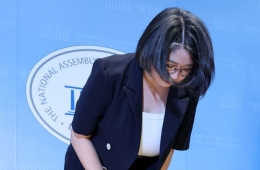
The ruling party's response has been sharply critical. Minseok Kim, leader of the Democratic Party of Korea, criticized at an on-site Supreme Council meeting in Busan, "How dare you behave so disgracefully in front of the people?" and demanded, "Come to your senses and resign immediately." Assemblywoman Younggyo Suh, chair of the National Assembly Legislation and Judiciary Committee, also denounced Cho, stating, "Chief Justice Cho bypassed the president," and warned, "The National Assembly and the people will hold him accountable."
Conflict between the legislative and judicial branches looks set to intensify further. The ruling party has already mentioned the possibility of impeachment against Chief Justice Cho, citing both the delay in recommending candidates for the Supreme Court and alleged sympathies with insurrectionist movements. The latest incident could further inflame calls for impeachment. Democratic Party lawmaker Park Ji-won warned on CBS Radio, "If this continues, impeachment of Chief Justice Cho will become inevitable."
The appointment procedure for the justices has also become unclear. Until now, there has been no instance of a president refusing to appoint a Supreme Court candidate recommended by the Chief Justice. However, since Chief Justice Cho made his recommendation without prior consultations, the presidential office is reportedly deliberating whether to proceed with the appointments. Even if President Lee Jae-myung does decide to appoint them, the candidates must still undergo confirmation hearings in the National Assembly and secure approval through a plenary vote, leading to expectations of considerable controversy.
Hot Picks Today
!["Don't Use Chinese-Made Products": One U.S. Warning Triggers a 5 Trillion Won Jackpot for Korean Batteries [Weekend Money]](https://cwcontent.asiae.co.kr/asiaresize/93/2025121709393659037_1765931975.jpg) "Don't Use Chinese-Made Products": One U.S. Warning Triggers a 5 Trillion Won Jackpot for Korean Batteries [Weekend Money]
"Don't Use Chinese-Made Products": One U.S. Warning Triggers a 5 Trillion Won Jackpot for Korean Batteries [Weekend Money]
- "Dividend Payouts of 40 Million Won Before Their First Birthday"...'Baby Shareholders' Put Ordinary Workers at a Disadvantage
- Foreign Tourists Leave in Tears Praising Seoul: "Wi-Fi So Fast, My Fingers Can't Keep Up" [K-holic]
- Gold-Plated Door Handles and All... The World’s Only Car Sets Cadillac’s All-Time Record at 1.8 Billion Won
- 'How Bad Was the Mistreatment'... Boss Tearfully Asks for Understanding and Generosity
This makes it virtually certain that there will be two vacancies on the Supreme Court for the time being. Even under smooth circumstances, the process from recommendation through to the final appointment typically takes about a month. Former Justice No Taeak has already retired, and Justice Lee Heunggu is set to retire in only about three weeks. If the new justices are not appointed in time, it could affect cases currently under review by the Supreme Court en banc, including the case involving First Lady Kim Gunhee and the so-called “three major allegations.”
© The Asia Business Daily. All rights reserved. Unauthorized AI training and use prohibited.