[Good Morning Market] US Weakens on Soaring Long-Term Yields... Korea Expected to Open Lower
Soaring 30-Year Treasury Yields Weigh on Market
Profit-Taking Pressures Centered on Semiconductor Stocks
The U.S. stock market weakened due to a sharp rise in long-term interest rates. The Korean stock market is also expected to open lower, but it is anticipated to recover losses during the session.
On the 18th (local time) in the New York stock market, the Dow Jones Industrial Average closed at 53,343.4, down 0.22% from the previous session. The S&P 500 index fell 0.69% to 7,691.76, while the Nasdaq Composite dropped 1.33% to 26,289.71.
Rising inflation concerns stemming from instability in the U.S.-Iran war negotiations, along with the 30-year U.S. Treasury yield reaching its highest level since 2007 (surpassing 5.33% intraday), led to an increase in long-term interest rates across advanced economies, dragging down the equity markets. As a result, profit-taking pressures intensified for stocks such as Micron (-6.9%) and SanDisk (-9%), and the Philadelphia Semiconductor Index ended down 5%.

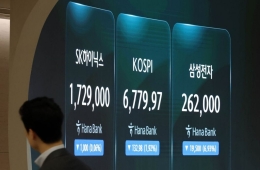
On the 18th, as the KOSPI index rose more than 3% in the early session, reclaiming the 7200 level, the current status of the domestic stock market was displayed throughout the dealing room at the headquarters of Hana Bank in Jung-gu, Seoul. 2026.8.18 Photo by Kang Jinhyung
View original imageThe rapid rise in long-term interest rates in advanced economies is attributed to a widening duration burden caused by increased long-term bond supply and a rise in term premiums. Specifically, major governments are issuing bonds to cover fiscal deficits and big tech companies are issuing corporate bonds to fund investments in artificial intelligence (AI). However, demand from long-term investors such as central banks and insurance companies is not keeping up with the pace of increased supply, prompting the market to demand higher interest rates.
Ji-Young Han, a researcher at Kiwoom Securities, said, "While the market correction has not been significant enough to harm fundamentals, sensitivity to related indicators such as U.S. 10-year and 30-year yields and tech company corporate bond spreads is likely to temporarily increase during the week."
The Korean stock market is also expected to open lower due to the rise in long-term interest rates, weakness in U.S. semiconductor stocks, and the sharp drop of over 4% in the KOSPI 200 overnight futures. However, as the market correction caused by rates was already reflected in the previous session's plunge, it is projected that the losses will be pared during today's session.
Hot Picks Today
!["SK hynix Is Our Target"... Japanese Firm Bets 7 Trillion Won as Germany Competes for Investment [AIDC Era of Coexistence] ⑪](https://cwcontent.asiae.co.kr/asiaresize/93/2026082117123788782_1787299957.png) "SK hynix Is Our Target"... Japanese Firm Bets 7 Trillion Won as Germany Competes for Investment [AIDC Era of Coexistence] ⑪
"SK hynix Is Our Target"... Japanese Firm Bets 7 Trillion Won as Germany Competes for Investment [AIDC Era of Coexistence] ⑪
- Was 110 Trillion Won Not Enough? Samsung Electronics Plunges, Dragging Down KOSPI
- All 118 CCTV Footage of Missing Jeju Woman Deleted...Han Donghun: "Police Requested Access Two Months Later"
- "This Trend Is Common in Korea Too"... American Tourist Couple Shocked by Resident's Reprimand, Face Fine for Jogging Shirtless in Venice
- "Monster That Eats Gold" Turns Out to Be Real: Uproar in China as 5-Year-Old Swallows $7,500 Gold Bar, Sparking Questions About Family's Wealth
Researcher Han added, "Although macro uncertainties may lead to heightened market volatility in the future, the likelihood of repeating last month's abnormal deterioration in supply-demand conditions and stock market crash is low," citing the currently low absolute level of volatility. In fact, the proportion of leveraged trading in single stocks, which stood in the 30% range in July, has recently declined to below 5%. Additionally, the KOSPI 200 Volatility Index (VKOSPI), which previously fluctuated between 80 and 90 points, has now plunged to the 50-point range.
© The Asia Business Daily. All rights reserved. Unauthorized AI training and use prohibited.





![[Regional Finance Survival Strategy]①While Commercial Banks' Net Profit Soars 54%, Regional Banks Grow Only 6%...Why They Face a Survival Crisis](https://cwcontent.asiae.co.kr/asiaresize/307/2026082017393587431_1787215174.png)