Geumcheon Residents Protest for Five Months: "Is This the Next Humidifier Disinfectant Crisis?" [Coexistence in the AIDC Era] ①
Ⅰ. Surging Demand for AIDCs: The Current Situation in Korea
[On the Scene] A Protest in Front of Geumcheon District Office
Residents Rally for Over Five Months
"Everyone knows data centers are necessary. But if one is built right next to your home without your knowledge, would anyone welcome it?"
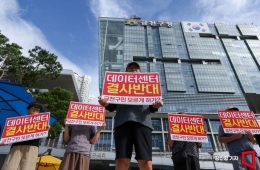
In his 60s, Mr. Kim held a picket reading "Strong Opposition to Data Centers" alongside other residents in front of the Geumcheon District Office in Seoul on the morning of August 10, despite the sweltering temperature exceeding 30 degrees Celsius. Even though just standing still caused sweat to drip, he and the other residents participated in the rally for nearly an hour without showing signs of fatigue. The rallies, which began at the end of February, entered their 178th day on August 20. About 20 residents have been demanding for over five months that construction on the data center be halted. Currently, at 724-4 Doksan-dong in Geumcheon-gu, construction is well underway, with the underground groundwork completed and the building frame rising. One of the residents leading the protest was recently sued by the developer for interfering with business operations and defamation.

On the 10th, residents voluntarily held a rally in front of Geumcheon District Office in Seoul, urging the Geumcheon District Office to revoke the data center permit. Photo by Jin-Hyung Kang
View original imageResidents in this area say they only found out a data center was being built three months after construction began. This was the first time in their lives they found themselves holding protest signs. With a large apartment complex nearby, they expected prior notification or public consultation from the district office before construction began. However, they report that there was none.
According to current laws, data centers can be built without resident consent, as the Enforcement Decree of the Building Act classifies them as broadcasting and communications facilities. Such provisions have existed since the days when telephone exchanges, broadcasting stations, and base stations were categorized as data centers.
However, residents argue that data centers in the AI era are different. They are angry that data centers, which are large-capacity, high-risk facilities with lithium batteries, emergency diesel storage tanks, and massive cooling towers, are still being permitted as broadcasting and communications facilities.
![Geumcheon Residents Protest for Five Months: "Is This the Next Humidifier Disinfectant Crisis?" [Coexistence in the AIDC Era] ①](http://www.asiae.co.kr/news/img_view.htm?img=2026082008304686026_1787182246.jpg)
Another resident, Mr. Hwang, stated, "A data center is like another humidifier disinfectant crisis. Those disinfectants legally met all standards and were sold at supermarkets, weren't they?" He added, "The district office claims it has no legal grounds to block these projects, but it is the residents who are being sacrificed for the sake of capital." Ms. Park, who lives in a nearby apartment complex, questioned, "Why must a data center be built in the middle of a residential area where so many people have settled and lived for decades?"
In another area where advance notice of data center construction was issued—151-5 Doksan-dong and 151-16 and 151-17—residents are also resisting the project. Residents here expressed concerns about health risks from data center electromagnetic waves, and the possibility of major damages in the event of a fire. The average age of residents in Geumcheon-gu is 47.3 years, making it the third-oldest district in Seoul after Gangbuk-gu and Dobong-gu, with a large elderly population. A direct visit to the site where the data center is to be built revealed it is a densely populated residential area, with roads so narrow even a fire truck would struggle to enter. There is a villa with 117 units less than a meter from the site, along with elementary and middle schools, and a hospital nearby.

On the 10th, residents voluntarily held a rally in front of Geumcheon-gu Office in Seoul, urging the Geumcheon-gu Office to revoke the data center permit. Photo by Jinhyung Kang
View original imageIn February of this year, some local governments enacted ordinances requiring notification to residents within a 1 kilometer radius if a facility is expected to cause conflict. However, Geumcheon-gu residents explained that they did not receive proper notice. In response, an official from the Geumcheon District Office stated, "Since forming a task force (TF), we have continued face-to-face communication and collected opinions from residents on-site." Regarding the 724-4 Doksan-dong data center, the official explained, "The application was filed in October 2024, before the ordinance was enacted this February, so the new prior notification rules do not apply to its permit process."
No-gwon, head of the Geumcheon Data Center Emergency Response Committee, said, "Even though we visited three times and delivered our opinions on behalf of residents and the committee, the district office gave no response." He added, "We plan to visit the district office again and directly request a meeting with the district office head."
Hot Picks Today
 Despite 10% Annual Interest, Russians Pull Out Cash as Fears of Deposit Nationalization Spread
- [Exclusive] Yoon's "Daewang Whale" Gets Zero Funding for Third Year... Next Year's Oil Field Development Budget Slashed by 80%
- Geumcheon Residents Protest for Five Months: "Is This the Next Humidifier Disinfectant Crisis?" [Coexistence in the AIDC Era] ①
- "One Less Worry About Old Age": Japanese Companies Secure Senior Talent with Regular Employment Beyond 65
- "I Love Traveling Without Spending My Own Money"... Gen Z Turns to Family Trips as Vacation Costs Soar
This feature was supported by a media promotion fund established through government advertising fees.
© The Asia Business Daily. All rights reserved. Unauthorized AI training and use prohibited.