U.S.-ROK Drills Cut and Carrier Withdraws from Pacific... U.S. Alliances Shaken by Prolonged Iran War
Concerns Over South Korean Nuclear Armament Sparked by Reduction of U.S.-ROK Joint Exercises
George Washington Carrier Moves to the Middle East... Aircraft Carrier Absence in the Western Pacific
Prolonged Iran War... U.S. Security Commitment
As the war in Iran drags on, both America's credibility among its allies and its deterrence strategy in the Indo-Pacific are being put to the test. After U.S. President Donald Trump ordered a reduction in joint military exercises with South Korea in response to Seoul's refusal to support the Iran war, the movement of a U.S. Navy aircraft carrier from the Western Pacific to the Middle East has further intensified concerns regarding America's security commitments.

On August 18 (local time), the Financial Times (FT) reported that President Trump's directive to scale back the U.S.-South Korea joint military exercises is exacerbating worries among Indo-Pacific allies about the credibility of America’s regional security commitments.
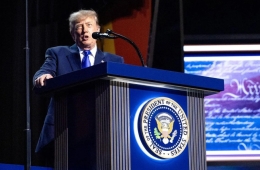
On August 16, President Trump instructed the U.S. Department of Defense to significantly reduce the "Ulchi Freedom Shield (UFS)" exercise. He cited training expenses and his "very good relationship" with North Korean leader Kim Jong Un as reasons for the move. He also publicly noted that South Korea had rejected the United States’ request for support regarding Iran’s denuclearization.
The president’s decision is controversial even within the United States given North Korea’s nuclear and missile capabilities have strengthened compared to the past. While Trump had also suspended or scaled back joint exercises following the first U.S.-North Korea summit in 2018, denuclearization negotiations ultimately broke down and North Korea expanded its nuclear and missile arsenal. Recently, North Korea has also increased its military cooperation with Russia. Foreign media have assessed that Trump's characteristically "transactional approach" has once again put the 70-year-old U.S.-South Korea alliance to the test.
Concerns Over Calls for South Korean Nuclear Armament... Carrier Gap in the Western Pacific

On the first day of the Eulji Exercise, military vehicles are crossing the Imjin River at the Unification Bridge in Paju, Gyeonggi Province on the 22nd. Photo by Moon Honam munonam@
View original imageThe Wall Street Journal (WSJ) also criticized the reduction in exercises in an editorial the same day, stating that Trump’s move undermines deterrence against North Korea and weakens the joint readiness of U.S. and South Korean forces. The WSJ argued that using his personal relationship with Kim Jong Un as grounds for scaling back regular military exercises could send the wrong signal to North Korea.
The WSJ noted that such developments increase questions in Asia and Europe about the reliability of the U.S. as an ally, and could even provoke internal debate in South Korea over self-initiated nuclear armament.
Along with political pressure on allies, actual cracks are appearing in the deployment of American military power. The George Washington Carrier Strike Group, homeported in Yokosuka, Japan, is leaving the Western Pacific to relieve the Abraham Lincoln, which has been deployed in the Middle East for an extended period. As a result, the Western Pacific will temporarily be without a U.S. aircraft carrier. The Abraham Lincoln’s return, originally scheduled for this past May, was delayed due to its support for operations related to Iran, and it has carried out long-term maritime missions.
The FT analyzed that the reduction of the U.S.-South Korea exercise, coinciding with the redeployment of aircraft carriers, is amplifying concerns over the credibility of America’s deterrent in the region. While the Iran war places increasing strain on the U.S. military’s weapons stockpiles, it is also reported that deliveries of certain weapons, such as Tomahawk missiles meant for Japan, are being delayed.
The United States has presented the Indo-Pacific as a key strategic region for countering China. Yet, as China expands its military activities in the region, U.S. forces are in fact being redirected to the Middle East.
Greg Poling, Director of the Southeast Asia Program at the Center for Strategic and International Studies (CSIS), noted that the United States is moving in the opposite direction of its stated goal to disengage from the Middle East. He analyzed that China would welcome a situation in which the U.S. is distracted elsewhere and its allies grow dissatisfied.
Prolonged Iran War... U.S. Security Commitments Under Pressure
The crux of the issue is that as the war in Iran continues, the burden on the U.S. to maintain deterrence simultaneously in the Middle East, Europe, and Indo-Pacific regions will only grow heavier. Because aircraft carrier assets are rotated following maintenance and training, any prolonged deployment in the Middle East could further strain force management in the future.
Hot Picks Today
 "Please Pay Me at Least 3 Million Won a Month": More Than Half of Young People Today Prioritize "Working Conditions" Over Company Size
- Selling Like Crazy Every Year... 30-Year-Old Hetbahn Takes on a New Challenge: Tastes Better Than "Mom's Home Cooking" [On-Site Report]
- I Thought Only 'Old Guys' Ate It... Young People Are Hooked on This 'Unusual Food' at Risk of Disappearing? [Delicious Stories]
- "Hey, Lady, Teach Your Kids to Behave!" ... 300,000 Won in Cash and a Bodily Injury Claim Demanded Over Child's Door Ding
- Beachgoer Finds 'Plastic' That Turns Out to Be Perfume Ingredient Worth More Than Twice as Much as Gold
The FT analyzed that the reduction of U.S.-South Korea joint exercises and the gap in aircraft carrier presence in the Western Pacific are separate issues, but have emerged simultaneously in the context of the Iran war, putting America’s alliance strategy to the test. The analysis further points out that even as President Trump demands greater financial and operational contributions from allies, if America's military resources remain tied down in the Middle East, Asian allies could begin reassessing their faith in U.S. security commitments.
© The Asia Business Daily. All rights reserved. Unauthorized AI training and use prohibited.