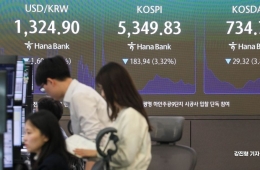
If Budget Is Set Below 820 Trillion Won... Reduced Government Bond Issuance to Ease Pressure on Bond Market
According to recent analysis, if the total expenditure for the 2027 budget, set to be announced at the end of this month, is determined at below 820 trillion won, it is expected to provide relief to the bond market. With the net increase in Treasury bond issuance next year projected to fall sharply compared to this year, the ongoing supply-demand pressure and upward pressures on Treasury bond yields could be partially alleviated.
According to a bond strategy report from Korea Investment & Securities on the 19th, the securities industry is focusing on the 2027 budget proposal and the Treasury bond issuance limit, both slated for public release at the end of August. Since 2022, the budget proposal for the following year has been announced annually between August 27 and 31. This year, the Bank of Korea's Monetary Policy Board meeting is scheduled for the 27th, raising the likelihood that the budget proposal and Treasury bond issuance cap will be revealed on the 28th or 31st after the meeting.
Korea Investment & Securities estimated that, depending on next year’s total expenditure, Treasury bond issuance would range from 207 trillion to 227 trillion won. If total expenditure is set at 810 trillion won, the total issuance is projected to be 207.4 trillion won; for 820 trillion won, it is expected to be 217.4 trillion won; and for 830 trillion won, 227.4 trillion won. When compared to this year's Treasury bond issuance cap of 225 trillion won, a total expenditure below 820 trillion won would mean that next year's issuance would decrease by 8 trillion to 18 trillion won.

The reduction in net increase of Treasury bonds is expected to be even larger. Assuming total expenditure of 810 trillion, 820 trillion, and 830 trillion won, the net increases are projected to be 71 trillion, 81 trillion, and 91 trillion won, respectively. Compared to this year's net increase of 109.4 trillion won, these represent reductions of 38 trillion, 28 trillion, and 18 trillion won, respectively.
Jae-Kyun An, a researcher at Korea Investment & Securities, explained, "Over the past three years, the average annual deficit of managed fiscal balance and consolidated fiscal balance was 106 trillion and 48 trillion won, respectively. However, with strong tax revenues, next year's deficits are expected to narrow to 71 trillion and 17 trillion won." He added, "As a result, we anticipate a reduction in next year's Treasury bond issuance compared to this year." An also noted, "In particular, since the net increase in Treasury bonds is expected to decrease by at least 18 trillion won, this could partly ease future supply-demand concerns."
Next year's national tax revenue is expected to surpass 500 trillion won, with total expenditure exceeding 800 trillion won. In particular, increased corporate and income tax revenue—driven by an improved semiconductor industry outlook—is likely reflected in the tax forecasts. If the portion of tax revenue that surpasses the long-term trend is accumulated in a separate Future Response Fund, the resulting reduction in the Treasury bond issuance burden on general fiscal resources could also be significant.
However, it is analyzed that the impact of the Future Response Fund on next year’s Treasury bond issuance will be limited. Since there is a time lag between the fund's establishment and actual execution, the impact is expected to be more prominent in the 2028 Treasury bond issuance plan than in 2027. An commented, "The government's Future Response Fund will likely be funded by this year’s excess tax revenue and next year’s additional tax revenue," and "It is expected to have an impact on the 2028 Treasury bond issuance plan rather than in 2027."
Within the bond market, there is an assessment that the upcoming Treasury bond issuance plan to be announced at the end of this month is unlikely to trigger as much market weakness as in 2024. Back in August 2024, on the day the 2025 budget proposal and Treasury bond issuance cap were disclosed, the intraday movement of the 3-year and 10-year Treasury bonds reached 5.8 basis points and 10.7 basis points, respectively. At that time, the issuance cap was set at 198 trillion won, up 40 trillion won from the previous year.
An also stated, "While expectations remain that next year’s total expenditure will exceed 800 trillion won and that the inflow of WGBI funds has ended, supply-demand concerns continue to linger. Even so, downward pressure from the budget announcement on the bond market this year is expected to remain low."
By maturity, the 2- to 3-year Treasury bond issuance is projected to drop by about 2.7 trillion won; the 5- to 10-year maturities by 5.1 trillion won; and ultra-long-term bonds of 20 years or more by roughly 8.4 trillion won. If the ongoing trend of increasing the share of short-term issuance continues, the reduction in ultra-long-term issuance could be even greater.
Hot Picks Today
 He Left It in the Car and Forgot... "I Nearly Collapsed with Joy": Man Wins $1.48 Million Lottery
- Goldman Sachs Cuts KOSPI Target by 25%... "Excessive Pessimism, Still Attractive"
- "'Nodding Off' on the Subway? Here's Why Koreans Are Getting Even Less Sleep"
- "Please Pay Me at Least 3 Million Won a Month": More Than Half of Young People Today Prioritize "Working Conditions" Over Company Size
- Beachgoer Finds 'Plastic' That Turns Out to Be Perfume Ingredient Worth More Than Twice as Much as Gold
There is also a forecast that the recent pronounced bear steepening—when long-term yields rise more than short-term ones—could come under some correction pressure after the end of August. However, it was noted that if next year’s total expenditure expands to over 830 trillion won, the reduction in Treasury bond issuance could be weakened, amplifying the negative impact on the bond market.
© The Asia Business Daily. All rights reserved. Unauthorized AI training and use prohibited.