Kim Sung-hwan: "No Final Answer Yet for the 12th Basic Electricity Plan... Nuclear and Energy Mix Debate Begins"
Regional Industrial Electricity Rate System to Be Announced Next Week
Electricity Demand Forecast for Semiconductors and Data Centers to Be Revised
Expanded Role and Budget for Climate Disaster Response
Kim Sung-hwan, Minister of Climate, Energy and Environment, announced that with regard to the 12th Basic Plan for Long-term Electricity Supply and Demand (referred to as the “Basic Electricity Plan”), the government will not predetermine the conclusions on the energy mix, such as nuclear, renewable, and gas-fired generation, but will instead officially begin public deliberations this month. The government’s policy is to start by revising demand forecasts, taking into account the phase-out of coal-fired power by 2040 and the sharply rising electricity demand in the semiconductor and data center sectors.
In a meeting with reporters at the Government Complex Sejong on the afternoon of August 18, Minister Kim stated, “We have not yet reached any conclusions for the 12th Basic Electricity Plan,” and added, “Rather than settling on an answer first, we intend to determine the largest possible consensus through a series of forums and collect opinions before making the final decision.” The Ministry of Climate, Energy and Environment plans to launch sector-based forums starting this month, collect public and expert input throughout September, and draft the government's proposal for the 12th Basic Electricity Plan around October, during the regular session of the National Assembly. The plan will be finalized through legal procedures, including reviews by the Presidential Committee on Climate Crisis Response and the National Assembly.
Minister Kim noted, “With the additional electricity demand centered around semiconductors and data centers, we will reexamine the demand forecast from scratch.” In particular, since 2040 is the year the government has set for phasing out coal-fired power plants, major points of contention will include how to process the roughly 20 coal-fired plants that will still have remaining design life at that time, as well as how to structure alternative power sources.

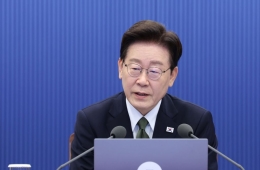
Kim Sung-hwan, Minister of the Ministry of Climate, Energy and Environment, is having a chat with reporters at the Government Complex Sejong on the 18th. Ministry of Climate, Energy and Environment
View original imageHe said, “If we reduce coal use, we must consider which power sources will replace it, how much to expand renewables, and if renewables and nuclear power overlap in spring and autumn, to what extent we can deploy batteries or pumped hydro storage. These issues must all be reviewed together.” He continued, “It will be inevitable for some gas-fired generation to increase, but we will design the entire process so that we can reduce the resulting carbon emissions and move towards carbon neutrality by 2050.”
He did not provide specifics on the most controversial matter: the construction of new nuclear plants. Minister Kim commented, “Whether to use nuclear power, and if so, how many units to add, will likely become the most critical issues for the energy mix. As these are not decisions I can make as an individual minister, I will make a determination after a full debate process.”
The detailed procedures such as how public discussions on nuclear power will be held and how many times will be decided within this week, or at the latest, by next week. However, regarding reports that the government is considering extending the operational life of nuclear reactors by 20 years beyond the current standards, Minister Kim clarified, “I merely stated that I agreed in principle with the intent, not that we have decided to implement anything specific.” He added, “As this falls under the Nuclear Safety and Security Commission, it is not something the Ministry of Climate, Energy and Environment can confidently respond to.”
Regional Industrial Power Pricing to Be Released Next Week... Residents Near Transmission Grids to Receive Greater Compensation
Minister Kim also revealed that plans for regional differentiation of electricity rates for industrial use will be made public next week. The official title will be "Regional Industrial Electricity Rate System.” The initial plan had been to hold a public hearing and announce the basic draft this week, but this has been postponed to next week due to the Ulchi civil defense drill schedule. Minister Kim said, “There could be some misunderstandings that general residents will face differentiated electricity rates, so the formal name will be the Regional Industrial Electricity Rate System. We’ll release the basic plan through a public hearing next week and collect public input.”
Regarding transmission grid congestion due to surging electricity demand, he announced plans to build multistory transmission towers to minimize new towers, and to bury transmission lines underground as much as possible near residential areas. Support and compensation for residents in regions traversed by transmission grids will also be strengthened. Minister Kim said, “In regions where it is unavoidable to install transmission lines, we will reflect residents’ opinions as much as possible and further democratize the site selection committee process.” He continued, “In the past, this was handled by KEPCO staff alone, but now KEPCO managers and the Minister must actively work together to resolve conflicts with residents.”

Kim Sung-hwan, Minister of the Ministry of Climate Energy and Environment, is having a chat with reporters at the Government Complex Sejong on the 18th. Ministry of Climate Energy and Environment
View original imageReinforcing Climate Disaster Response System
Minister Kim also announced plans to strengthen disaster response systems to address the recent increasing frequency of extreme heavy rain and drought. He said, “Existing systems designed for rain events occurring once every 30 or 50 years can no longer cope, as we now face heavy rain and drought with a 200-year recurrence period.” The ministry will enhance weather forecasting accuracy and reinforce infrastructure such as stormwater drainage in areas with severe flooding.
Regarding water supply for semiconductor industrial complexes in Gwangju and Jeonnam, Minister Kim explained that, except for ultrapure water production, the reuse rate for cooling water and other uses will be increased, and supply will be secured by recycling household wastewater and utilizing existing water resources. Instead of building a new Dongbokcheon Dam, plans are underway to raise the height of the existing Dongbok Dam to minimize new submersion areas and ecological damage.
Minister Kim stated that of the 14 candidate dam sites considered under the Yoon Suk Yeol administration, seven were excluded due to lack of necessity, opposition from local residents, or procedural problems, and the necessity, scale, and alternatives for the other seven are still under review. He said, “Once we determine the fate of the remaining seven sites, we will report on this within August.”
Hot Picks Today
 "Only 3 Passengers on a 180-Seat Flight"... The Shocking State of the 'Honeymoon Hotspot'
- "Work That Took a Month Now Done in Just 8 Hours"…Samsung and LG Turn to AI to Counter China's Pursuit
- "Returning Excess Fees Collected Under Previous Administration"...$680 Per Person Refund for 950,000 Americans
- "Such chaos for the first time in 140 years"... Even illnesses surge, Tokyo stunned by 'unbelievable' event
- "Nothing Left to Buy, Feeling Indifferent"... 'Rich Daughter' Vibe in Department Stores with 'Hyunbaek Core'
The minister also suggested the possibility of expanding both the organization and duties of the Ministry of Climate, Energy and Environment in response to the climate crisis. He said, “While the ministry has so far mainly focused on carbon reduction, it will now need to take much stronger responsibility and play a larger role in protecting people’s lives from disasters resulting from the climate crisis.” He added, “It appears that next year’s budget will include more resources for these areas.”
© The Asia Business Daily. All rights reserved. Unauthorized AI training and use prohibited.