Integrated Special City Takes On Gwangju's Debt... Jeonnam Lawmakers Ask, "Will Our Budget Be Cut to Fill the Gap?"
Choi Seonguk and Park Moonok: "Gwangju's Debt and Fiscal Shortfall Must Be Disclosed"
Debt Ratio Only Appears Lower After Integration; Illusion Due to Inclusion of Jeonnam's Budget
Concerns Over Reduced Support for Agriculture, Fisheries, and SOC... Calls to Halt Transfer of ACC Operating Rights
After the inauguration of the Jeonnam Gwangju Integrated Special City, concerns were raised in the city council that the entire integrated city would have to bear the debts and structural fiscal shortages previously held by the former Gwangju Metropolitan City, potentially leading to a reduction in budget allocations for the Jeonnam region. In particular, it was argued that clear fiscal principles must be made public regarding how to handle debts arising from pre-existing Gwangju projects, such as Subway Line 2, and the recurring annual essential funding shortages.
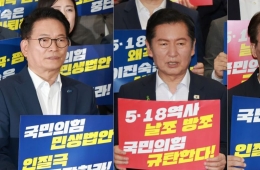
On the morning of August 18, Assembly members Choi Seonguk (Planning and Finance Committee) and Park Moonok (Administrative and Firefighting Committee) of the Jeonnam Gwangju Integrated Special City Council held a press conference at the Jeonnam Government Complex, stating, "Jeonnam, with relatively sound fiscal health, should not be placed in a structure where it is forced to take on Gwangju's fiscal burdens as well." They called on the integrated city administration to disclose its financial status and to prepare measures to prevent disadvantages for the Jeonnam region.

On the morning of the 18th, Choi Seonguk and Park Moonok, members of the Jeonnam Gwangju Integrated Special City Council, held a press conference at the Jeonnam Government Office, demanding the disclosure of Gwangju’s financial status and measures to prevent disadvantages in the Jeonnam region. Provided by the Jeonnam Gwangju Integrated Special City Council
View original imageThe first issue raised by the two assembly members was debt.
According to them, the debt ratio of Gwangju City before integration was 25.61%. After integration, the debt ratio for the entire special city is calculated at 16.25%. However, the two lawmakers emphasized that this should not be interpreted as an improvement in fiscal conditions.
The decrease in the overall ratio is not because Gwangju's debt has declined, but because it was combined with Jeonnam, which had relatively healthier finances.
The assembly members stated, "The debts held by Gwangju will not simply disappear after integration," and, "Now that we've become a single special city, responsibility for existing debts will inevitably have to be shared."
They argued that debt, including additional construction costs for Gwangju Subway Line 2, amounts to about 2.2 trillion won, and the Gwangju Urban Corporation's liabilities total around 1.4 trillion won. The combined debt of these two items alone reaches approximately 3.6 trillion won.
They further added that, for the latter half of this year, there is a funding shortfall of 380.8 billion won required to maintain urban functions and daily life for citizens in the Gwangju area.
Specifically, this includes 24.5 billion won for free school meals for elementary, middle, and high schools; 50.3 billion won for the city bus quasi-public operating system; 100 billion won in educational fiscal contribution funds; 22.8 billion won in private investment support for the second ring road; 23.2 billion won in medical benefit fund transfers; 9.1 billion won for the disaster management fund; and 139.8 billion won for other national and local matching funded projects.
The problem is that many of these are essential expenditures that are difficult to cut selectively. Since it is nearly impossible to make drastic cuts to free school meals, the bus quasi-public operating system, medical benefits, or national matched projects, there is a need to secure funds from other sources.
The two assembly members contended that this situation is not a one-off issue but a "structural deficit" that could recur every year.
They expressed particular concern that if Gwangju's funding shortfalls are supplemented from the integrated city's general finances, this so-called "balloon effect" could result in reduced allocations for the Jeonnam region.
The legislators stated, "If a limited special city budget is constantly used to fill one area's shortfall, the resources available for other regions will inevitably decrease. If funds allocated for Jeonnam are reduced to repay debts from the Gwangju subway and urban projects—which Jeonnam residents did not use—then the administration must explain what benefit such integration brings to the people of Jeonnam."
They also cited the gap in per capita expenditure as evidence.
Based on data from the Local Finance 365 portal, the two members presented that, prior to the integration in 2026, the per capita expenditure budget was about 7.15 million won for Gwangju, compared to approximately 14.77 million won for Jeonnam—more than double in Jeonnam's favor.
The assembly members voiced concern that if the integrated city's fiscal situation deteriorates, this gap could be narrowed by adjusting down the budget for the Jeonnam region. They particularly asked the executive branch to clarify whether agricultural and fisheries support, welfare, regional SOC, or living infrastructure projects for Jeonnam would be subject to structural adjustments.
They also pointed out the possibility of a conflict between the "no disadvantage for residents" principle suggested during the integration process and the realities of the city's current fiscal situation.
The special law on integration contains principles aimed at preventing disadvantages to residents due to the integration, and Mayor Min Hyung-bae has consistently emphasized "raising the bar" for welfare and other citizen-related matters.
However, the assembly members stated that, despite these assurances, on June 18, Vice Chair Baek Seung-joo of the Jeonnam Gwangju Transformation Planning Committee expressed that restructuring expenditure was unavoidable. They remarked, "If, after affirming there would be no disadvantages, spending is restructured following integration, then which region and which sector will ultimately bear the burden must be made clear."
The persistent deficits of large cultural facilities in Gwangju have also become a focal issue.
The two lawmakers argued that the Gwangju Arts Center posted a deficit of 32.3 billion won in 2025, with an accumulated deficit reaching around 70 billion won.
They also raised concerns about the National Asia Culture Center (ACC), for which Mayor Min recently requested the transfer of operating rights to the central government.
The assembly members estimated the ACC's accumulated deficit at about 200 billion won, with annual deficits in the range of 50 to 70 billion won. They claimed that, without secured and stable national funding from the central government, taking over operating rights could create new fiscal burdens for the special city.
Accordingly, the lawmakers demanded that the executive branch fully disclose legacy Gwangju accumulated debts and category-by-category fiscal shortfalls, as well as the accumulated deficits of major public agencies and cultural facilities; prepare measures to prevent disadvantages to the Jeonnam region's agricultural and fisheries, welfare, and SOC budgets; verify the fiscal soundness and secure national government funding guarantees before taking over the operation of major deficit-running facilities such as the ACC; and maintain the level of per capita benefit budget and public administrative services for Jeonnam residents.
Assemblyman Choi and Assemblywoman Park stated, "Integration is not just about combining names; it means sharing funds, debts, and responsibilities." They asserted, "The fiscal problems arising in Gwangju should not be shifted to the residents of Jeonnam under the name of integration."
Hot Picks Today
 "Earned 500 Million Won in Three Months from Samsung Electronics"... Cash-Rich Samyang Foods' Stock Investment Revealed
- "Can't Stand My Child Falling Behind": US Parents Resort to Gambling and Loans for Back-to-School Purchases
- Jeonju Job-Seeking Youth Take a Pause and Recharge at a Mountain Temple
- Paek Jongwon's US Visit Sparks Two-Day Stock Surge... Will The Born Korea’s 'K-Sauces' Continue to Thrive?
- "Did They Really Have to Cast a War Criminal Descendant?" Heated Online Debate Over Japanese Actress in Hyukoh's New Music Video
They added, "Going forward, we will continue to verify and release additional undisclosed fiscal data, and we will pursue ongoing legal and institutional oversight to ensure that the Jeonnam region's budget and residents' rights are not undermined following the launch of the integrated special city."
© The Asia Business Daily. All rights reserved. Unauthorized AI training and use prohibited.