Party Members Choose Kim Minseok, Public Favors Jeong Cheongrae... Ruling Party Faces Task of Broader Public Appeal
Aug. 17 Democratic Party Convention
Kim Minseok Leads in Party Member Votes
Jeong Cheongrae Tops in Public Opinion Polls
At the August 17 Democratic Party of Korea (DPK) National Convention, Kim Minseok was elected as the new party leader. However, in a public opinion poll, candidate Jung Chungrae outperformed Kim. While core party supporters—rights-holding members and national delegates—chose Kim, the general public survey showed a higher preference for Jung. As a result, the convention highlighted the gap between party sentiment and public sentiment.

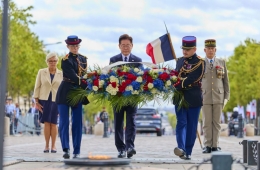
Kim Minseok, the newly elected leader of the Democratic Party of Korea, is embracing candidate Jung Chungrae after being elected as party leader at the 3rd Democratic Party of Korea Regular National Members Convention held at the Daejeon Convention Center on the 17th. Photo by Yonhap News
View original imageAccording to the results of the party leadership election announced at the Daejeon Convention Center on the 17th, Kim secured a final vote share of 54.08%, while Jung received 45.92%. Kim won by a margin of 8.16 percentage points.
However, when looking only at the public opinion poll, the outcome was reversed. Jung received 50.70% in the poll, surpassing Kim, who garnered 49.30%, by 1.40 percentage points.
Within the party, Kim held a significant lead. In the national delegate vote, Kim won 66.69%, far ahead of Jung’s 33.31%. In the rights-holding members’ vote, Kim received 55.94%, outpacing Jung, who gained 44.06%, by 11.88 percentage points.
The final vote share was calculated by combining the votes of national delegates and rights-holding members (70%) with the public opinion poll (30%). Although Jung led in the public poll, Kim widened the gap in the party votes, thereby maintaining his advantage in the final count.
This outcome demonstrates that Kim, the new leader, secured party leadership based on members’ support, but it also suggests there are remaining tasks concerning the party’s appeal to the wider public. As the ruling party, balancing the leadership of the Lee Jae-myung administration, operating as a party centered on its members, and meeting the demands of the broader public are challenges the new leadership must address.
The election for the Supreme Council also showed a different pattern from the leadership race. Choi Minhee took first place with 18.35%, followed by Park Sunwon (17.57%), Seo Mihwa (16.60%), Lee Sungyun (16.35%), and Han Minsu (15.86%). Kim Yong finished sixth with 15.26%.
In particular, the final vote share difference between Han Minsu and Kim Yong was only 0.60 percentage points. The race for fifth place continued until the last moment, but in the end, Han entered the winning ranks, resulting in a change to the new Supreme Council lineup.
Hot Picks Today
 "Why Over 100 Employees?" Samsung Electronics in Turmoil as 700,000 Won in Improper Housing Payments Uncovered: "Afraid of Losing My Job"
- "Shocking Discovery for Tuna Sashimi Lovers: 1,600 Parasites Found Crawling Inside"
- "I'm Fine Because I Don't Turn Red After Drinking"? Why You Still Can't Be Assured of Cancer Risk
- "Securing 100 Researchers by Next Year"... Samsung Electronics Invests 350 Billion Won in This Initiative
- "This Act Led to Death"... Chinese Influencer with 1 Million Followers Dies After Eating 60-70 Duck Eggs in Mukbang
Ultimately, while the main structure of the convention confirmed the party members’ choice of Kim Minseok as leader, the public opinion poll and Supreme Council contest revealed trends distinct from party sentiment. Going forward, the key political challenge for the Democratic Party of Korea’s new leadership will be how it pursues stable party operations as the ruling party—based on the support of its members—while also seeking to broaden its appeal to the general public.
© The Asia Business Daily. All rights reserved. Unauthorized AI training and use prohibited.