Blue House on Trump's Order to Reduce US-ROK Drills: "Hope for US-North Korea Dialogue... South Korea Will Strive as a Pace-Setter" (Comprehensive)
Trump Publicly Orders "Substantial Reduction in Drills, Citing 'Good Relationship with Kim Jong Un'"
Blue House: "Combined Defense Posture, Joint Exercises Closely Coordinated; Close Cooperation to Continue on Details"
On Claim That 'South K
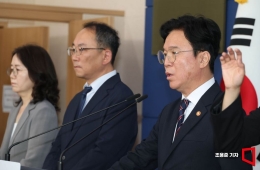
On August 17, the Blue House commented on U.S. President Donald Trump's social media post instructing the substantial reduction of South Korea-U.S. joint military exercises, in which he emphasized his "good relationship" with North Korean leader Kim Jong Un. The Blue House stated, "We hope that the amicable relationship between the leaders of the United States and North Korea will lead to meaningful U.S.-North Korea dialogue." With this statement, the Blue House signaled that it hopes President Trump's remarks will serve as an opportunity to resume U.S.-North Korea talks rather than a crack in the South Korea-U.S. alliance. The Blue House also announced that it would continue consultations with the United States on the specifics of adjusting the joint exercises.

U.S. President Donald Trump and North Korean leader Kim Jong Un crossed the military demarcation line at Panmunjom on the afternoon of the 30th. 2019.7.1 Yonhap News Agency Photo by Yonhap News
View original imageAn official from the Blue House said, "The government is closely watching President Trump's SNS message." The official added, "To this end, we will continue to make the necessary diplomatic efforts as a pacemaker under close South Korea-U.S. cooperation." Since President Trump directly linked the reduction of joint exercises to the improvement of relations with Chairman Kim, the government also intends to use this as an opportunity to expand the space for resuming dialogue between the United States and North Korea.
On August 16 (local time), President Trump announced on his social media platform Truth Social that he had instructed Secretary of Defense Pete Hegseth to "substantially reduce" the South Korea-U.S. joint military exercises. He stated, "Given the very good relationship between Kim Jong Un and myself, I am not pleased that the United States agreed long ago to participate in joint military exercises with South Korea."
President Trump also argued that the joint exercises are not only costly but also send an "entirely inappropriate and hostile signal" to North Korea. He particularly described North Korea as a country that "has not been threatening to and has shown respect for the United States" during his presidency. Although he acknowledged that it is already too late to cancel the exercises, he publicly revealed that he had instructed Secretary Hegseth to dramatically scale back their size.
President Trump's instructions were aimed at the 'Ulchi Freedom Shield (UFS)' exercise, the regular South Korea-U.S. joint exercise that began on the same day. This year's UFS is scheduled to run for 11 days, from the 17th to the 27th, with approximately 18,000 South Korean troops participating. The drills commenced as scheduled.
However, the Blue House emphasized that the South Korea-U.S. combined defense posture and the joint exercises themselves have been operated under the close coordination of the two countries. A Blue House official stated, "South Korea and the United States have tightly coordinated over the maintenance of a solid combined defense posture, as well as joint exercises and training," and added, "We will continue to work closely together on specifics related to this matter."
The Blue House also responded to President Trump mentioning South Korea's stance on the Iran situation in his SNS post. President Trump prefaced that this was "somewhat unrelated" to the joint exercises, and claimed, "I recently asked the President of South Korea if they would join us on Iran's denuclearization, and they said, 'No thanks'." This remark could be construed as expressing dissatisfaction that, in addition to the cost of the joint exercises, South Korea did not actively support U.S. military action against Iran.
In response, a Blue House official explained, "The government has been actively participating in international discussions to achieve a ceasefire in Iran and to restore freedom of navigation in the Strait of Hormuz." The official continued, "Taking into account the security posture on the Korean Peninsula and domestic legal procedures, we are discussing practical and military contributions with the United States in close consultation." Contrary to President Trump's comments, it appears that the South Korean government is highlighting that it has not simply rejected U.S. requests. Instead, discussions are ongoing regarding possible military contributions, subject to the security situation on the Korean Peninsula and domestic procedures.
Hot Picks Today
 "Why Is the Amount in My Account So Low?"... Why Pension Savings Subscribers Were Surprised
- "After Sleeping Well with Strangers"... Who Is the 24-Year-Old Woman Who Won 19 Million Won?
- "SK hynix to Hit 4.7 Million Won, Samsung 670,000 Won"... Why Nomura's Bold Forecast justifies it
- "Even Underwear Has to Be Cut Up with Scissors"... China Hit by Rise of "Trash Hunters" in an "If You're Slow, You're Out" Scramble
- "NPS loses 240 trillion won, 1990s-born get zero pension"... What's behind rumors spreading after the KOSPI plunge?
Meanwhile, attention is being paid to whether the stalled U.S.-North Korea dialogue will resume, as President Trump, in a rare move, brought his personal relationship with Chairman Kim to the forefront as the reason for reducing the joint exercises. The previous day, he posted a photo with Chairman Kim on SNS, sharing a message to the effect that the two are "getting along very well." President Trump met with Chairman Kim three times during his first term in 2018-2019 and has expressed his willingness to resume dialogue multiple times since the start of his second term.
© The Asia Business Daily. All rights reserved. Unauthorized AI training and use prohibited.