577mm of Rain Hits Geoje in a Day... Heaviest Rainfall Since Typhoon Rusa in 2002
Tongyeong Also Records 409 mm:
Both Regions Experience Highest Rainfall Ever Recorded
124.5 mm Falls in Geoje Within One Hour
'Intensity Seen Only Once in 200 Years'
On August 17, more than 570 mm of torrential rain fell in Geoje, Gyeongnam Province. This rainfall is not only record-setting for Geoje but also ranks among the highest nationwide.
By 1 p.m. that day, Geoje had recorded 577.4 mm of precipitation. This is the highest daily rainfall in Geoje since meteorological observations began on January 24, 1972. It is also the third highest daily rainfall ever recorded among the 97 nationwide Automated Synoptic Observing System (ASOS) sites managed by the Korea Meteorological Administration for rainfall ranking.

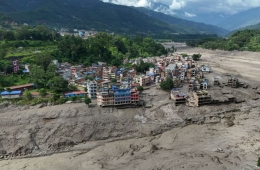
On the morning of the 17th, a landslide occurred near a residential area in Okpo-dong, Geoje City, Gyeongnam Province, damaging vehicles. Photo by Yonhap News Agency
View original imageThe only instances when more rain fell than in Geoje on this day were during the landfall of Typhoon Rusa 14 years ago: Gangneung (870.5 mm of daily rainfall on August 31, 2002) and Daegwallyeong (712.5 mm on the same day).
In Tongyeong, adjacent to Geoje, the city also recorded a daily precipitation of 409.7 mm by 1 p.m., setting a new all-time record since weather observations began there on January 1, 1968.
In Geoje, from 1:32 a.m. for one hour, an intense 124.5 mm of so-called 'extreme heavy rain' was recorded. This also set a new all-time hourly rainfall record in Geoje, easily surpassing the previous record of 96.5 mm on July 5, 2001.
In Seoilmal, Irun-myeon, Geoje, 100.5 mm of rainfall fell in one hour from 12:21 a.m.; on Gadeokdo Island in Gangseo-gu, Busan, 101.5 mm was recorded from 2:59 a.m. for one hour. It was the first time this summer that more than 100 mm of rain fell within an hour in both Geoje and Gadeokdo.
In Tongyeong, 97.4 mm of rain fell in one hour from 5:11 a.m., also setting a new hourly rainfall record for the city. The Korea Meteorological Administration explained that the level of rain that fell in Geoje and Tongyeong corresponded to events that statistically occur 'once in 200 years' and 'once in 100 years,' respectively.
Cumulative rainfall from National Liberation Day up until 1 p.m. on August 17 reached 851.1 mm in Geoje, 704.8 mm in Tongyeong, 441.0 mm in Gadeokdo, 380.5 mm in Sacheon (Samcheonpo), Gyeongnam, and 377.0 mm on Hallasan (Nambyeok), Jeju, indicating that rain was concentrated on the southern coastal areas and Jeju mountain regions.
Considering that the average summer rainfall for Geoje and Tongyeong (based on the average from 1991 to 2020) is 935.1 mm and 728.8 mm, respectively, these regions received over 90% of a typical summer's rainfall in less than three days.
This heavy rain was the result of the weakened low pressure from Typhoon Dolphin (Typhoon No.13) approaching from the southwest of Korea and moving northeastward, bringing rainfall nationwide during the National Liberation Day holiday.
In the Northern Hemisphere, winds blow counterclockwise around a low-pressure system. As the low-pressure area approached, hot and humid winds from the south flowed in, leading to concentrated rainfall in the southern coastal and Jeju regions where these winds collided with the terrain.
In particular, as the low pressure approached Korea, the distance between it and the high pressure to the northeast narrowed, which also tightened the wind corridor between the systems. This intensified the southerly winds, resulting in historically high rainfall totals. Additionally, the sea surface temperature in the South Sea remained high at 27 to 28 degrees Celsius, contributing to the high moisture content carried by the southern winds.
Hot Picks Today
 Chairman Hyun-joo Park: "If Only Dividends Had Increased, There Would Be No Samsung or SK hynix"…Emphasizes Investment First
- "No More Remote Work? 'I'll Quit'...Japanese Companies Increasing Office Attendance Face Growing Pushback"
- Police Officer Who Falsely Closed Jang Miran’s Missing Person Case Received Police Commissioner’s Commendation for “Finding Missing Person” a Month Later
- Children, Grandchildren, and Great-Grandchildren... Stir Over Donghak Revolution Descendants Receiving 100,000 Won Monthly Stipend 132 Years On
- "Soojung Lee Questions Cause of Death for Jang Miran: 'A Young Woman Hanging Herself on a Palm Tree at Night? That's Laughable'"
As of 1:50 p.m., the rain clouds that brought the extreme heavy rain have mostly moved away from the Korean Peninsula. However, intermittent rain is still expected to continue in Gyeongnam and Jeju until nighttime, and some areas in the central region, Honam, and Gyeongbuk may also experience showers.
© The Asia Business Daily. All rights reserved. Unauthorized AI training and use prohibited.