Trump Orders Significant Reduction in South Korea-U.S. Joint Exercises, Signals Dialogue to North Korea
Order for Drastic Reduction Issued on Ulchi Freedom Shield Start Date; Attention on Response from Kim Jong Un
Potential Diplomatic Shift as Trump Seeks Achievements Amid Iran War and Upcoming Midterm Elections
U.S. President Donald Trump has ordered a significant reduction of the South Korea-U.S. joint military exercises. This move is being interpreted as a conciliatory signal to North Korea, aimed at seeking the resumption of U.S.-North Korea dialogue.
On the 16th (local time), President Trump disclosed on his social media platform, Truth Social, that he instructed Secretary of Defense Pete Hegseth to drastically reduce the scale of the South Korea-U.S. joint exercises, saying it was "too late to cancel." He cited the high costs of the drills and the fact that the United States shoulders a significant portion of the expenses as the reasons for this order.

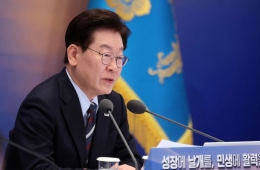
President Lee Jae-myung is seen conversing with U.S. President Donald Trump after a commemorative photo at the invitation country welcome event held at the Group of Seven (G7) summit venue in Evian-les-Bains, France, on the 16th (local time). Photo by Yonhap News Agency
View original imageThe South Korea-U.S. joint exercise "Ulchi Freedom Shield" will be conducted from August 17 to August 27. North Korea has consistently denounced these joint drills, labeling them as "preparations for a war of aggression" and has opposed them.
Given that President Trump specified the magnitude of the reduction as "significant" and made his order public to coincide with the start date of the exercises, there is speculation that he may be seeking to resume dialogue with North Korean leader Kim Jong Un.
Although President Trump has continued to emphasize that he maintains good relations with Chairman Kim since returning to power, it is noteworthy that this is the first time he has openly mentioned concrete actions such as reducing the scope of the South Korea-U.S. joint exercises.
Some suggest that with the protracted Iran war and the upcoming midterm elections in November, President Trump may be seeking to shift the current landscape through diplomatic achievements. Should U.S.-North Korea talks resume, there is also mention of the possibility of a "small deal" focused on short-term gains, such as halting North Korean intercontinental ballistic missile (ICBM) launches.
It is worth noting that right after the 2018 U.S.-North Korea summit in Singapore during his first administration, President Trump also announced the suspension of the South Korea-U.S. joint exercises, again reasoning that it was to reduce costs.
Hot Picks Today
 "Please Pay Me at Least 3 Million Won a Month": More Than Half of Young People Today Prioritize "Working Conditions" Over Company Size
- Selling Like Crazy Every Year... 30-Year-Old Hetbahn Takes on a New Challenge: Tastes Better Than "Mom's Home Cooking" [On-Site Report]
- "It's so popular you can't get it": 'Legendary liquor' returns after 11 years, causing a stir... 'Newtro' craze takes over convenience stores [How We Shop Today]
- "Hey, Lady, Teach Your Kids to Behave!" ... 300,000 Won in Cash and a Bodily Injury Claim Demanded Over Child's Door Ding
- Beachgoer Finds 'Plastic' That Turns Out to Be Perfume Ingredient Worth More Than Twice as Much as Gold
Meanwhile, in this recent post, President Trump claimed that he had requested South Korea to participate in Iran's denuclearization but was refused. He did not disclose the specific details of the request. Bloomberg interpreted this as a sign of President Trump's disappointment over South Korea's limited support for the U.S. in the Iran war.
© The Asia Business Daily. All rights reserved. Unauthorized AI training and use prohibited.





![[Market ING] KOSPI Seeks Rebound in Superweek Packed with Corporate Earnings and FOMC](https://cwcontent.asiae.co.kr/asiaresize/307/2026102514484873155_1792907327.jpg)