An Eco-Friendly Complex with 1,840 Households to Be Built at the Foot of Guksabong in Sangdo-dong
Seoul City Finalizes Rapid Integrated Plan for Redevelopment of 214 Sangdo-dong Area
Zoning Upgrade from Type 1 and 2 (7 Floors) to Type 2 Residential; Up to 29 Floors Permitted
An old low-rise residential area located at the foot of Guksabong in Sangdo-dong, Dongjak-gu, Seoul, will be redeveloped into an apartment complex with up to 29 floors and 1,840 households.
On August 17, the Seoul Metropolitan Government announced that it has finalized the rapid integrated planning for the residential renewal redevelopment project in the area of 214 Sangdo-dong.

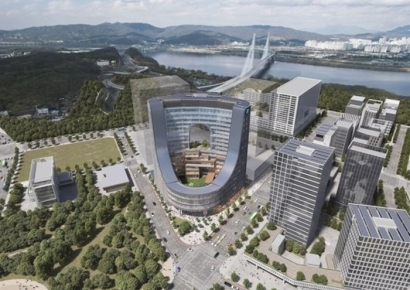
A perspective rendering of the redevelopment project around 214 Sangdo-dong, Dongjak-gu, Seoul, where the construction of an apartment complex with 1,840 households is being promoted following the rapid integrated planning approval by the Seoul Metropolitan Government. Provided by Seoul Metropolitan Government
View original imageThe project site is an 88,596-square-meter old low-rise residential area at the foot of Guksabong. Due to its sloped topography, the area is at high risk for natural disasters such as landslides and flooding. Since 2015, urban regeneration projects have been promoted here. However, there have been ongoing criticisms that the narrow alleyways and high ratio of semi-basement homes make it difficult to improve the residential environment through small-scale improvement initiatives.
With the confirmation of the rapid integrated planning, the area will now be redeveloped into an apartment complex with up to 29 floors and 1,840 households.
The city explained that the rapid integrated planning prioritizes creating an eco-friendly residential complex by organically linking this area—which had been isolated from surrounding neighborhoods—through green pedestrian pathways, transportation networks, and open community spaces.
To achieve this, three key planning principles were established: ▲ Creating a complex that enhances both the Guksabong landscape and the future value of the Sangdo area ▲ Integrating parks, green corridors, and community spaces into a single network that interacts with the local community ▲ Improving the disconnected transportation system to better connect living areas and enhance pedestrian convenience.
Accordingly, the zoning in the area will be upgraded from Type 1 and Type 2 general residential zones—which previously allowed up to 7 stories—to Type 2 general residential, permitting the construction of buildings up to 29 stories high. At the same time, the plan secures both public value and project viability by designing an open skyline and view corridor that takes advantage of the natural landscape of Guksabong.
Along the Sangdo Neighborhood Park, where steep slopes and retaining walls posed disaster risks and caused isolation, structural safety will be ensured by spacing out buildings and creating terraced flower beds. A green corridor will be built between Yangnyeong-ro and Sangdo Neighborhood Park to improve pedestrian access, while a new park will be established on flat land to the northwest.
Community facilities such as care centers, senior clubs, and fitness centers will be spatially arranged under decks that utilize the area's topographical differences. On the western main street, street-facing commercial facilities will be placed.
The road network will also be improved. The previously one-way Yangnyeong-ro 26-na-gil, located to the north, will be widened to allow two-way traffic, and signalized intersections will be introduced for smoother entry and exit. The accident-prone connection between Yangnyeong-ro and the Guksabong Tunnel exit will be blocked to prevent entry. Internal roads through the complex will be converted into pedestrian paths connecting Sinsangdo Elementary School and Guksabong Middle School, and a detour road and village bus stops will be established along the western boundary.
With this confirmation, 195 out of 311 designated areas in Seoul have now completed rapid integrated planning.
Hot Picks Today
 JYP Bought a 75.5 Billion Won Site, Only to Face an 18-Story Building Right in Front? ... SH's "Surprise Rezoning" Makes JYP Pull Out
- "What Becomes of the Geniuses Who Devoted Their Lives?"... 722 Papers Released in Just 3 Hours Spark 'Shock and Awe' [Reading Science]
- "It Shut Down Just From Showing My Face"... 1,500 iPhone 18 Pros Exchanged; "Cause Is Confidential"
- "'Assassin(s)' Actors: Is This Why They Won't Apologize?" Joo Jinwoo Reveals Incentive Deal
- "I Want to Look Like Glowing Koreans" ... The Trend Is Taking the World by Storm, but Experts Warn Against It
Changgyu Kim, Director General of Urban Space at the Seoul Metropolitan Government, said, "This rapid integrated planning will not only create a premium residential complex that meets residents' expectations but also serve as an opportunity to further elevate the value of the Sangdo-dong area."
© The Asia Business Daily. All rights reserved. Unauthorized AI training and use prohibited.