Ministry of Unification Seeks Alternative to "Main Enemy" Expression... Launches Public Discussion
Announcement of Plans to Advance the Korean Peninsula Peaceful Coexistence and Development Initiative
The Ministry of Unification is considering referring to North Korea using names such as the "Democratic People's Republic of Korea" as a gesture of mutual respect. The ministry also plans to gather opinions from various sectors on alternative terms to replace the use of "main enemy."

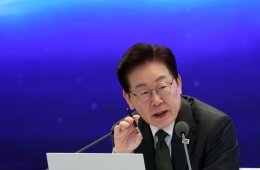
On August 15, the Ministry of Unification released a statement regarding President Lee Jaemyung's National Liberation Day address, saying, "The President's 'three blueprints' are in line with the ministry's 'Korean Peninsula Peaceful Coexistence and Development Initiative,' which was announced in its work report." The ministry also revealed its plans to move forward with follow-up measures, including ways to replace hostile language within our society.
As the first of his three blueprints, President Lee mentioned "inclusive peaceful coexistence" based on mutual respect, emphasizing the need to eliminate hostility in inter-Korean relations, perceptions, norms, and institutions. In this context, the Ministry of Unification announced that as follow-up measures, it will launch public discussions to promote "mutual respect in naming between the two Koreas" and identify alternative expressions to "main enemy." The ministry will listen to a wide range of opinions and, through consultations with relevant ministries, develop concrete plans.
With regard to President Lee's reference to "stable peaceful coexistence" where there is no need for conflict, and his mention of institutional mechanisms as well as proactive and continuous peace measures to control tension and conflict, the ministry highlighted efforts to restore inter-Korean communication channels and to reinstate the September 19 Military Agreement. These measures will also be discussed with related ministries to specify their details and timing.
Regarding President Lee's emphasis on "responsible peaceful coexistence" that contributes to global peace, and his proposal for multilateral talks to transition the armistice system to a peace regime and facilitate an end-of-war agreement, the ministry stated that it would begin talks and establish effective measures to halt the further advancement of North Korea's nuclear capabilities. The Ministry of Unification plans to explain this transition toward a peace regime to major countries, seeking their support during the UN General Assembly in September and the APEC Summit to be held in Shenzhen, China, in November.
The Ministry of Unification stated, "Based on the President's unwavering commitment to peaceful coexistence on the Korean Peninsula—reaffirmed through this National Liberation Day address—we will promote follow-up measures without setbacks, ensuring close cooperation and sufficient public discussion with relevant ministries."
Hot Picks Today
 "A Family of Four Could Pay an Extra 160,000 Won"... Thailand Weighs Reviving Departure Tax After 35 Years
- "Shall We Grab a Drink?" KRW 30,000 a Round... Young Adults: "Prices Make My Hands Shake; I Can't Drink Out"
- "Suddenly Sat Up"... 15-Year-Old Girl Wakes Up in Coffin During Funeral
- "Vacation Benefits Alone: 10 Million Won per Person"... 'This Organization' Cut Employee Allowances and Raised the Executive Director's Salary by 50 Million Won
- "No Need to Hire a Model"... The 25-Year-Old Woman Who Entered Social Media with a Face That Cost Just 1,500 Won [AI Content: The Bright and Dark Sides] 1
This is the first time that President Lee's National Liberation Day address has specifically mentioned multilateral discussions on an end-of-war agreement. Unlike last year's address, which directly mentioned "denuclearization," this year's focus on discussions among the parties concerned for a halt to North Korea's nuclear program is interpreted as a practical consideration of North Korea's refusal to denuclearize.
© The Asia Business Daily. All rights reserved. Unauthorized AI training and use prohibited.