President Lee: "4-Year Consecutive Term Constitutional Amendment... Willing to Accept Term Reduction if Needed"
Partial Transfer of Presidential Powers to the National Assembly
Clear Rejection of Semi-Presidential and Parliamentary Systems
President Lee Jae-myung has stated that he is willing to accept a reduction of his own term if necessary during the constitutional amendment process for introducing a four-year presidential term with the possibility of one consecutive re-election or renewal. However, he drew a clear line against the adoption of a semi-presidential or parliamentary cabinet system, emphasizing that it would be preferable to restructure the distribution of power by transferring some presidential authorities to the National Assembly.

On the afternoon of August 14, President Lee said via X (formerly Twitter), "It has been my campaign promise and consistent position to amend the Constitution so that the presidential term can be changed to a four-year term with the possibility of one consecutive re-election or renewal, thereby enabling accountable politics through a mid-term review, while also strengthening local autonomy and the fundamental rights of the people."
He continued, "My official position during the 2022 presidential election was that, if required for such a constitutional amendment, I could accept a reduction of my term, and my thinking has not changed even now."
President Lee stressed that the specifics of the amendment should be determined by the National Assembly through bipartisan agreement. He explained, "It is widely agreed by the public that, after 40 years, our Constitution no longer fits the times and thus needs to be amended."
For the direction of the amendment, he proposed explicitly stating the spirit of the May 18 Democratic Movement and the Busan-Masan Uprising in the Constitution’s preamble, as well as dispersing presidential powers. He suggested that the mandate of the Board of Audit and Inspection, the authority to recommend the Prime Minister, and part of the appointment authority be transferred to the National Assembly, thereby adjusting the balance of powers between the President and Parliament.
However, he made it clear that he is firmly opposed to the introduction of a semi-presidential or full parliamentary cabinet system. President Lee said, "A semi-presidential or parliamentary cabinet system is neither desirable nor realistic given public opinion. It is a misunderstanding to equate the idea of partially dispersing presidential powers to the National Assembly with a semi-presidential or parliamentary cabinet system."
President Lee’s direct statement appears to be a response to the expanding debate within the political community regarding the restructuring of the power structure. Recently, Kim Taeho, a member of the National Assembly from the People Power Party, reportedly suggested during a golf meeting with President Lee the need for constitutional amendment to establish a more decentralized power structure, and President Lee replied that "a constitutional amendment must be made even if it means shortening my own term."
In response, a spokesperson from the presidential office commented that morning on the direction President Lee is seeking for the restructuring of the power structure, stating, "We believe that a four-year presidential term with the possibility of one consecutive re-election, which strengthens the powers of the National Assembly, has the highest level of public acceptability."
The spokesperson added, "Since the goal is to compensate for the limitations of the imperial presidency through a system of consecutive presidential terms, this is not a parliamentary cabinet system; nor is it an explicit reference to or designation of a decentralized presidential system or any such variant."
Regarding the procedure for pursuing constitutional amendment, the presidential office emphasized bipartisan agreement centered on the National Assembly. The spokesperson explained, "Since constitutional amendment requires the approval of at least 200 seats in the National Assembly, it is desirable for discussion and progress to occur within the legislature," indicating that President Lee’s principle is to pursue constitutional change through consensus.
The presidential office said it is difficult to confirm the details of private arrangements or specific conversations between President Lee and Assemblyman Kim. However, it explained that this latest statement serves to reaffirm the constitutional amendment principles previously articulated by President Lee.
Constitutional reform is the "Number One National Policy Task" of the Lee Jae-myung administration. The National Policy Planning Committee has included proposals for the introduction of a four-year consecutive presidential term and a runoff voting system as part of its constitutional amendment agenda.
Hot Picks Today
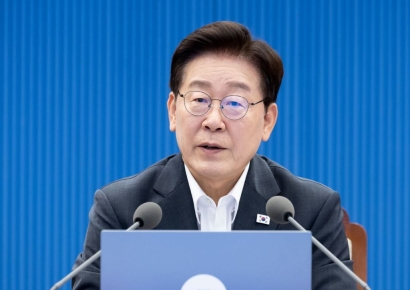 President Lee: "4-Year Consecutive Term Constitutional Amendment... Willing to Accept Term Reduction if Needed"
- "It's So Cheap, It's My Favorite" ... Counterfeit Perfume Found With Methanol Up to 484 Times the Safety Limit
- 7,000 Stranded at Airport, Many Koreans Among Them... Emergency as Record-Breaking Rain Hits Greater Tokyo Area
- "I Regretted It Every Day"... Comedian Lee Jin-ho Faces Two Years in Prison for Gambling and Drunk Driving
- "Can Insomnia Be Solved by Just Sticking It On?"... REM Sleep Ultrasound Patch Developed
Since taking office, President Lee has been inclined to pursue a step-by-step, partial approach to constitutional amendment—starting with issues that can draw bipartisan agreement, such as strengthening the requirements for martial law and explicitly referencing the spirit of the May 18 Democratic Movement in the Constitutional preamble, rather than trying to restructure the power system all at once.
© The Asia Business Daily. All rights reserved. Unauthorized AI training and use prohibited.