Youth Meeting Lasts Over 3 Hours... Lee Reflects, "Government Youth Policies Show No Results" (Comprehensive)
Chaired Meeting with Youth Policy Experts on the 14th
Lee: "Support for the Elderly Has Increased, But Has Support for Youth Grown as Well?"
Identifies 'Supplier-Centered Mindset' as a Policy Problem
President Lee Jae-myung stated on the 14th, "We make numerous policy efforts to address the difficulties youth are facing, but these efforts have not yet produced tangible results that young people can truly feel."
On the afternoon of August 14 at the Blue House, President Lee made these remarks during a meeting with youth policy experts, saying, "There are aspects in which not enough opportunities are given to the younger generation, resulting in a sense of frustration among youth."

President Lee Jae-myung is entering the Youth Policy Expert Meeting held at the Blue House on the 14th. Photo by Yonhap News
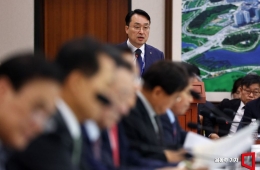
View original imageThis meeting was organized to listen to policy proposals from experts in various fields and to comprehensively review budgeting, administration, and communication regarding youth policy. The attendees included Seo Bokkyung, Vice Chairperson of the Youth Policy Coordination Committee; Jeong Seowon, President of the National Youth Policy Network; Kim Jongjin, Director of the Working Citizens Research Institute; columnist Cheon Gwanyul, and a total of eleven participants. The meeting, originally scheduled for 90 minutes, ran for about 200 minutes, far exceeding the planned duration.
President Lee said, "For quite a long time, discussions have revolved around providing policy support to youth, and when viewed from the perspective of older generations, this seems significant. However, when considering the reality faced by young people today, I question whether prior measures are truly sufficient."
He continued, "If you look at it by generation, our policy support for the elderly is considered natural and has overwhelmingly increased. For youth, there has always been an underlying belief: since young people have many opportunities, healthy bodies, and a bright future ahead of them, they should challenge themselves and get back up after setbacks; this would be helpful for them. In reality, that has been the prevailing perspective."
President Lee further remarked, "Now, if you say things like 'Failure is the mother of success' or 'Challenging youth are admirable,' you are likely to be met with backlash. Our society has become one with a serious lack of opportunity." He added, "Economically, we have become a low-growth society. The older generation enjoyed many opportunities and reaped many rewards, but for the new generation, opportunities seem to have declined significantly."
He also noted, "Since the establishment of our people's government, growth rates have been somewhat restored, but what is now prevalent is 'jobless growth' that does not require much labor force. Going forward, as artificial intelligence becomes central to the industrial society of the future, there is uncertainty as to whether economic growth will generate as many jobs as it did in the past."

President Lee Jae-myung is presiding over a meeting with youth policy experts at the Blue House on August 14, 2026. Photo by Yonhap News
View original imageAddressing the experts at the meeting, President Lee said, "Today, I would like us to take a fundamental look and reflect. I hope we can review what is truly effective and what concrete outcomes are being expected."
He also commented, "A general problem I feel with government policy is that it is often based on a supplier-centered mindset. For policy recipients, there may often be a sense of 'this isn't right, it's missing the point.' I believe a shift in perspective is necessary."
On the same day, Cheong Wa Dae Chief Spokesperson Kang Yoo-jung announced through a written briefing that President Lee and the participants discussed reorganizing the scattered youth budget into a 'perceived impact, growth investment' type. The participants agreed that despite the presence of 389 government youth policies and a budget approaching approximately 30 trillion won, there is a low sense of tangible improvement among young people.
The participants suggested key tasks including establishing a new planning and coordination function for youth policy, setting up a systematic direction focusing on jobs and housing, implementing customized AI services to make youth policy participation easier and more convenient, and transforming communication channels using youth-centric language and platforms. Opinions were also expressed advocating for actively reflecting youth voices during policy formation.
Hot Picks Today
 "If You Don't Apply, My KRW 1.7 Million Will Be Gone"... Unclaimed National Pension Refunds Vanish After 'This Deadline'
- "King crab is 3,000 won per 500 grams; just eating it makes the trip worthwhile"... Chinese flock to North Korea on 'fake business trips'
- "When I get Home from Work, This Is All I Do, and It's Making Me Stupid"... Short-Form Craze Sparks 'Electronic Drug' Debate in China
- Lee Juwan, Who Forecast Samsung at 70,000 Won and SK hynix at 200,000 Won, Says They're "Still Overvalued"; Others Counter: "Fundamentals Are Solid, Correction Is Excessive"
- "What Was I Thinking..." Gen Z Regrets Habitual Delivery Orders After Seeing the Bill, Falls Into "Delivery Guilt"
In response to the experts’ proposals, Chief Spokesperson Kang stated, "We will conduct an in-depth review going forward, and these ideas are scheduled to be announced as part of the youth policy vision later in the second half of the year."
© The Asia Business Daily. All rights reserved. Unauthorized AI training and use prohibited.

!["Please Take Them Off!" They Made It All the Way to the Bed... Then "80% of Fecal Bacteria" Struck [Deep Scroll]](https://cwcontent.asiae.co.kr/asiaresize/307/2026101610053063338_1792112730.png)