Heamin Lee: "The State Must Proactively Respond to the AI Transformation Era"...Proposes Basic Social Act for AI Transition
Mandatory National Strategy and Five-Year Master Plan
Prior Notification and Consultation Required for Major Workforce Changes
Support Fund Established Through AI Transformation Response Levy
Assemblyman Heamin Lee of the Party for National Innovation sponsored the “Basic Social Act for Responding to the AI Transformation” on August 14, aiming to ensure that the state proactively responds to the industrial and employment shocks brought about by the introduction of artificial intelligence (AI). The legislation proposes that the state actively supports corporate AI transformation to preserve productivity gains, while also leading industrial adaptation policies to preemptively alleviate employment shocks and social disparities occurring in the process.
On the same day, Assemblyman Lee also proposed related amendments, including the “Partial Amendment to the National Finance Act” and the “Partial Amendment to the Basic Act on the Management of Levies,” which provide the legal basis for the establishment of funds and imposition of levies under the new act.

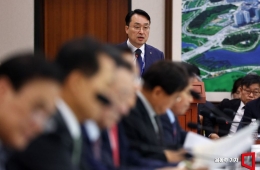
Hae-Min Lee, member of the Progressive Party for National Innovation, is being interviewed by The Asia Business Daily in his National Assembly office. August 12, 2026. Photo by Hyunmin Kim
View original imageThis bill addresses social and economic imbalances stemming from changes in employment structure, growing gaps between industries, and the weakening of regional economies—all resulting from increased industrial productivity through AI.
The bill consists of four main components. First, it obliges the government to establish a national strategy and a basic plan every five years for adapting to AI-driven industrial transformation, ensuring systematic implementation by linking industrial, employment, welfare, and educational policies.
Furthermore, it explicitly guarantees citizens’ rights to vocational retraining and capacity development, job transition and re-employment support, and a basic standard of living. Regions significantly affected by industrial transformation will be designated as transition areas and targeted with tailored support policies.
Additionally, the bill requires companies to develop plans for worker retraining and job redeployment. If workforce changes exceed a certain scale specified by presidential decree, firms must comply with prior notification and consultation procedures. Companies faithfully fulfilling these requirements will receive tax incentives.
Finally, the government will impose and collect an “AI Transformation Response Levy” from businesses where the introduction of AI and automation technology significantly impacts employee work or employment. The funds collected will be used to establish a “Basic Social Support Fund for AI-Based Industrial Transformation.” Lee’s office explained that the levy is designed to incentivize companies to maintain and redeploy their workforce, emphasizing that it is not intended to increase tax revenue, but rather to coordinate the pace of technological change and employment transition.
Hot Picks Today
 Changing Outfits and Snapping Photos in Hotels... "Please Don't Take Pictures": Europe Cracks Down on Influencers Over Privacy Concerns
- "Tried leveraged semiconductor stocks, watched 3.5 billion won shrink to 200 million won": Salaried investor in tears
- "Please Let Me Go Home"... Customers Trapped in Department Store Parking Lot for 5 Hours Vent Their Anger
- "I Should Enjoy It After Retirement": Prices Quadruple... Memberships Over 100 Million Won Popular, but Closures Mount
- "Come Live With Me on My Farm": Man Sells Everything and Travels 1,930 km, Trusting a Beautiful Woman
Assemblyman Lee stated, "This law is intended to make the AI transformation sustainable," adding, "Protecting jobs and the purchasing power of citizens is the only way for companies that have improved their productivity through AI to continue thriving." He further pledged, "During the National Assembly’s deliberations, we will collect opinions extensively from both business and workers to ensure a balanced approach."
© The Asia Business Daily. All rights reserved. Unauthorized AI training and use prohibited.