[Good Morning Market] U.S. Closes Higher as Inflation and Oil Prices Ease... Korea Also Expected to Strengthen
S&P 500 Closes at All-Time High
U.S. PPI Below Consensus, Easing Inflation Concerns
Korea Expected to Rise on Positive Momentum from Sandisk
U.S. stock markets closed higher as concerns over inflation and oil prices eased simultaneously. In particular, the S&P 500 index finished at its highest closing level ever. This momentum is also expected to carry over to the domestic stock market, which is projected to show strength.

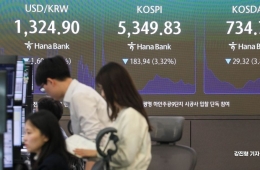
On the 13th, the KOSPI index started the session at 6773.92, up 194.88 points compared to the previous trading day. The status of the domestic stock market was displayed on the electronic board in the dealing room at the headquarters of Hana Bank in Jung-gu, Seoul. 2026.8.13 Photo by Jinhyung Kang
View original imageOn August 13 (local time), the S&P 500 index, which focuses on large-cap stocks, closed at 7,798.99, up 50.49 points (0.65%), hitting a new record high at closing. The Dow Jones Industrial Average ended at 53,839.99, up 69.72 points (0.13%) from the previous trading day, while the tech-heavy Nasdaq index rose by 214.54 points (0.81%) to finish at 26,803.03.
This upward trend is attributed to the alleviation of market concerns regarding inflation. The July Consumer Price Index (CPI), announced the previous day, matched market expectations (consensus), and the Producer Price Index (PPI) released that day also came in below consensus. In July, both headline and core PPI rose 4.7% (market estimate: 4.9%) and 4.2% (market estimate: 4.2%) year-over-year, respectively.
The sharp drop in international oil prices also played a role. Brent crude for October delivery fell 2.15% to $87.07 per barrel, and West Texas Intermediate (WTI) for September delivery declined by 2.42% to $81.25 per barrel.
Jiyoung Han, a researcher at Kiwoom Securities, commented, "The market currently has several factors in hand: slower job growth in July, the July CPI meeting consensus, PPI below consensus, and limited upward pressure on oil prices." She added, "This means the grounds for a rate hike by the U.S. Federal Reserve within the year are weakening. Therefore, at least until the Jackson Hole meeting scheduled for the end of this month, macroeconomic uncertainty is unlikely to have a significant impact on the stock market."
The positive outlook for Sandisk's mid- to long-term growth also served as a catalyst. During its Investor Day, the company forecasted annual sales growth in the mid- to high teens from 2028 to 2030, planned to reduce cycle volatility through expansion of long-term supply agreements, targeted a gross margin of 80%, and pledged to return 100% of free cash flow to shareholders. Following these announcements, the share price soared 13.8%. Chipmakers such as Micron (4.2%) and Lam Research (3.3%) also posted robust gains. On the same day, the Philadelphia Semiconductor Index rose 56.62 points (0.46%) to close at 12,456.
The domestic stock market is expected to continue its strong performance on August 14. Despite potential profit-taking after a recent rally and a wait-and-see attitude ahead of the holiday, relief over the July U.S. inflation data and positive news stemming from Sandisk are likely to support investor sentiment.
This week, the KOSPI has been buoyed by reconfirmed robust demand for artificial intelligence (AI) infrastructure and a shift to net buying by foreign investors amid easing concerns about a Federal Reserve rate hike in September. In addition, the rebound is being driven by a virtuous cycle of buying across multiple sectors, not just concentrated in a few areas like semiconductors, indicating that market fundamentals are also improving.
A researcher commented, "While increased leveraged trading and a decline in deposit balance during the August rebound could point to a potential vulnerability in market liquidity, credit balances and deposit indicators for both KOSPI and KOSDAQ are not yet at worrisome levels in absolute terms." As of the end of July, the credit balances for KOSPI and KOSDAQ stood at KRW 23.7 trillion (up KRW 1.3 trillion month-on-month) and KRW 6.3 trillion (up KRW 0.17 trillion), respectively, while the deposit balance recorded KRW 99.98 trillion (down KRW 4.2 trillion).
Hot Picks Today
 He Left It in the Car and Forgot... "I Nearly Collapsed with Joy": Man Wins $1.48 Million Lottery
- Goldman Sachs Cuts KOSPI Target by 25%... "Excessive Pessimism, Still Attractive"
- "'Nodding Off' on the Subway? Here's Why Koreans Are Getting Even Less Sleep"
- "Please Pay Me at Least 3 Million Won a Month": More Than Half of Young People Today Prioritize "Working Conditions" Over Company Size
- Beachgoer Finds 'Plastic' That Turns Out to Be Perfume Ingredient Worth More Than Twice as Much as Gold
He further noted, "Even though the total net assets (AUM) of single-stock leveraged products increased from around KRW 5 trillion to KRW 7 trillion earlier in the week, they only accounted for 2.6% of total KOSPI trading value as of the previous day, the lowest level on record. This suggests that market dominance by a few sectors has weakened, and the probability of an extreme concentration in select industries, as seen in May and June, has decreased."
© The Asia Business Daily. All rights reserved. Unauthorized AI training and use prohibited.