Luxury Shopping at Department Stores, Quick Meals at Convenience Stores: Distribution Industry Sees Recovery and Changing Consumer Trends in H1
Three Major Department Stores See ‘Qualitative Growth’
Luxury Sales and Foreign Tourists Drive Surge in Operating Profit
Large Discount Stores Focus on Profitability as Grocery Demand Shifts Online
Convenience Stores Benefit from Increased Local Shopping
As consumer sentiment, previously dampened by high inflation and an economic slowdown, began to recover, the distribution industry experienced a favorable first half of the year. Department stores and convenience stores, in particular, saw increases in both sales and operating profit compared to last year, reflecting a rebound in consumer demand in their performance. Thanks to booming stock markets and the resulting asset effects, as well as an increase in foreign tourists, department stores recorded robust sales of luxury goods and fashion items. Meanwhile, convenience stores saw a rise in demand for cost-effective meal options such as lunch boxes and ready-to-eat foods. Large discount stores managed to retain customers by holding promotional events and offering private-label products (PB) and bulk items.

According to the distribution industry on August 14, all three major department store chains—Lotte, Shinsegae, and Hyundai—achieved record results in both sales and operating profit in the first half of this year, driven by an influx of foreign tourists and robust sales of luxury goods and fashion. Lotte Department Store reported sales of KRW 1.7635 trillion and operating profit of KRW 310.9 billion in the first half, up 8.7% and 59.4% year-on-year, respectively. Shinsegae Department Store's sales reached KRW 1.4794 trillion and operating profit was KRW 249.9 billion, up 14.9% and 39.7%, respectively, from a year earlier. Hyundai Department Store’s sales amounted to KRW 1.2764 trillion, with operating profit of KRW 246 billion, marking increases of 8.3% and 47.7%, respectively. Notably, this represents 'qualitative growth.' While sales grew by around 10%, operating profit surged as much as 80%, indicating a much greater improvement in profitability.
The strong performance of department stores is primarily attributed to a resurgence in high-priced and discretionary spending, especially on luxury goods and fashion. Additionally, the increase in foreign tourists to Korea has also elevated department store results. Lotte Department Store alone recorded KRW 640 billion in sales to foreign tourists in the first half of this year, approaching nearly 90% of last year's record annual total of KRW 734.8 billion. At the current pace, foreign tourist sales are expected to exceed KRW 1 trillion in the third quarter. Shinsegae Department Store also saw a 120% year-on-year surge in sales to foreign tourists in the first half, reaching KRW 580 billion.
Yoo Junghyun, a researcher at Daishin Securities, stated, "Department stores enjoyed strong consumer sentiment boosted by the asset effect, leading to a dramatic increase in both the number of customers and average transaction value in high-margin categories like luxury and fashion. Strong foreign tourist sales also contributed significantly to their outstanding performance."

Convenience stores also benefited from the recovery in consumer demand. CU, operated by BGF Retail, posted first-half sales of KRW 4.5472 trillion and operating profit of KRW 123 billion, up 5.6% and 33.7% year-on-year, respectively. GS25, run by GS Retail, recorded first-half sales of KRW 4.4707 trillion and operating profit of KRW 92.7 billion, up 5.5% and 21.7%, respectively. Seven-Eleven, also scheduled to announce its second-quarter results that day, is expected to report strong performance as well. Industry analysts attribute this to rising food prices, which have led more consumers to seek relatively affordable meal options at convenience stores. The strengthening of private-label products, the increasing number of one- and two-person households, and a growing preference for local shopping have also contributed to the improved performance of convenience stores.
Oh Rin-a, a researcher at LS Securities, analyzed, "Convenience stores continue to expand as channels for local food purchases. Favorable weather conditions and the recovery in consumer sentiment have also had a positive impact on their performance."
In contrast, large discount stores primarily focused on defending their performance as they faced growing competition from e-commerce platforms such as Coupang and Kurly, as well as the rise of overnight delivery services. Emart reported first-half sales of KRW 9.1581 trillion and operating profit of KRW 171.9 billion, representing increases of 2.7% and 15.4% over the previous year’s first-half sales of KRW 8.9163 trillion and operating profit of KRW 148.9 billion. Lotte Mart posted sales of KRW 3.1334 trillion, up 21.6% year-on-year, while reducing its operating loss from KRW 35.2 billion to KRW 4 billion. Large discount stores are prioritizing the defense of profitability through strengthening product competitiveness and optimizing store operations, rather than focusing on top-line growth. By contrast, Kurly, a leading e-commerce company, achieved record results in the first half with sales of KRW 1.5 trillion and operating profit of KRW 51.6 billion.

Although the distribution industry as a whole experienced a recovery in consumer sentiment during the first half of the year, there was a clear differentiation in consumer objectives and channels. High-value consumption, driven by rising asset prices and an increase in foreign tourists, flocked to department stores, whereas convenience stores absorbed demand for small-scale grocery shopping. As bulk shopping demand rapidly shifted to e-commerce, large discount stores focused more on defending profitability than on capturing the upside of consumer recovery. Experts interpret this trend as not just a simple recovery, but also a process of realignment in the roles of distribution channels.
Hot Picks Today
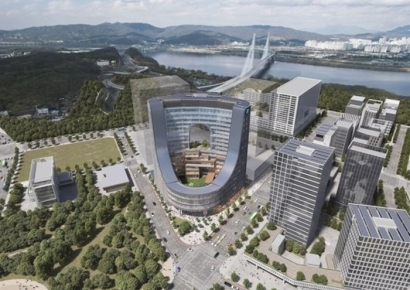 JYP Bought a 75.5 Billion Won Site, Only to Face an 18-Story Building Right in Front? ... SH's "Surprise Rezoning" Makes JYP Pull Out
- "What Becomes of the Geniuses Who Devoted Their Lives?"... 722 Papers Released in Just 3 Hours Spark 'Shock and Awe' [Reading Science]
- "If It's This Good, It Rivals the Santa Fe"... New Tucson Grows Bigger, Adds 8-Speed Transmission [Test Drive]
- "'Assassin(s)' Actors: Is This Why They Won't Apologize?" Joo Jinwoo Reveals Incentive Deal
- "I Want to Look Like Glowing Koreans" ... The Trend Is Taking the World by Storm, but Experts Warn Against It
Heo Kyungok, a professor of consumer industry studies at Sungshin Women’s University, stated, “The wealth effect—centered on the semiconductor sector—has increased high-value consumption such as luxury goods; however, whether this positive consumer trend will be sustained remains to be seen. Currently, there are no alternatives to convenience stores for absorbing local shopping demand, and since large discount stores are losing competitiveness in terms of convenience to both convenience stores and e-commerce, easing regulations on store openings would need to accompany changes for these stores to enhance their competitiveness,” she said.
© The Asia Business Daily. All rights reserved. Unauthorized AI training and use prohibited.