"Protecting Agriculture and Livestock" ... Goseong County Determined to Overcome Heat Wave and Drought
From Emergency Water Supply for Agriculture
to Stress-Relief Supplements for Livestock
Strengthening On-Site Responses Across All Sectors
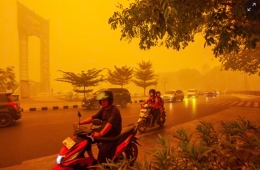
As the national fire mobilization order has been issued in Goseong County, South Gyeongsang Province, the county government has stepped up its measures in the agriculture and livestock sectors to minimize crop growth decline and livestock deaths caused by the ongoing heat wave and drought.
The county is closely monitoring agricultural water supply, crop growth status, and livestock facility cooling systems over 5,917 hectares of farmland and 1,208 livestock farms, and is providing equipment and materials that can be immediately used in the field.
![Fire trucks were mobilized as County Governor Ha Hak-yeol personally sprayed water on the rice paddies using a fire hose. <br>[Photo by Goseong County]](http://www.asiae.co.kr/news/img_view.htm?img=2026081310234479577_1786584224.jpg)
Fire trucks were mobilized as County Governor Ha Hak-yeol personally sprayed water on the rice paddies using a fire hose.
[Photo by Goseong County]
Even before the onset of the full heat wave, in April, the county provided 70 sets of water-cooled vests to prevent heat-related illnesses in elderly farmers, and designated 13 field monitoring personnel to inspect crop growth and disaster situations for each crop type.
In greenhouses and orchards, where the risk of heat-related growth disorders and outbreaks of pests and diseases is higher due to high temperatures, the county is intensively guiding farmers on crop-specific management practices such as ventilation, shading, and proper moisture management.
To tackle the drought, an agricultural disaster countermeasures situation room has been operating from May 15 to October 15, for a total of 154 days. The situation room continuously monitors weather conditions and crop damage, compiles daily drought damage reports from each town and township, and provides on-site technical guidance.
The county has visited the Goseong-Tongyeong-Geoje branch of Korea Rural Community Corporation to request maximum agricultural water supply, and is supporting the installation of 10 water wells for fruit, flower, vegetable, and specialty crop farms.
In the livestock sector, 83,3065 animals including Korean native cattle, dairy cows, pigs, and chickens are being raised by a total of 1,208 farms. Among these, pigs and chickens are particularly susceptible to high temperatures, and if the heat wave persists, the risk of reduced feed intake, delayed growth, and increased mortality is significant.
Starting July 18, until the end of the heat wave period, the county has organized a livestock inspection team of three people on weekdays and two on holidays, inspecting livestock farms, slaughterhouses, livestock markets, feed mills, and key disinfection facilities.
Support to reduce heat stress in livestock is also being expanded. The county is providing stress-relieving supplements such as vitamins valued at a total of 80 million won to 54 pig and chicken farms, and plans to supply an additional 20 million won worth of vitamins to 16 house-type poultry farms.
With increased use of barn ventilators and cooling equipment due to the heat wave, the risk of power outages and electrical fires has also grown, so on-site inspections include checks on the operation of circuit breakers, the condition of aging wiring, and the presence of combustible materials near electrical installations.
Hot Picks Today
 "I Should Enjoy It After Retirement": Prices Quadruple... Memberships Over 100 Million Won Popular, but Closures Mount
- "I thought getting into a big company was the goal"... The 'position' only 1 in 121 employees reaches
- "Jealous of Koreans" - Now a Must-Do on Every Trip... The Place Where Foreigners Spent KRW 229.8 Billion
- “I Bought Big Packs to Stock Up Because They Were a Better Deal”... Why Are They Disappearing From Grocery Stores?
- "Please Let Me Go Home"... Customers Trapped in Department Store Parking Lot for 5 Hours Vent Their Anger
It is hoped that Goseong County will mobilize all available administrative resources to ensure that necessary support for local farmers and livestock farms is provided in a timely manner, so as to prevent major damage.
© The Asia Business Daily. All rights reserved. Unauthorized AI training and use prohibited.