What Comes After Semiconductors?... Kim Yongbum: "Nurture 7 'Seeds' Into New 'Megas'"
Emphasizing the Fostering of Seven Key Areas, Including SMR, Nuclear Fusion, Renewable Energy, Quantum, and Advanced Bio
"Mega nurtures SEED, and SEED grows into a new Mega—Creating a Virtuous Industrial Cycle"
President Lee Highlights '7 SEED'
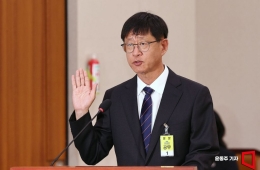
Kim Yongbeom, policy chief at the Blue House, emphasized the need to reinvest the capital and accumulated technologies acquired from current core industries such as semiconductors and artificial intelligence (AI) into next-generation industries, creating a virtuous cycle in which today’s mega-industries foster tomorrow’s mega-industries. His vision is to further expand globally competitive semiconductor and AI industries, while also planting the 'seeds (SEED)' of future industries—including small modular reactors (SMRs), nuclear fusion, quantum, and advanced bio—starting now.

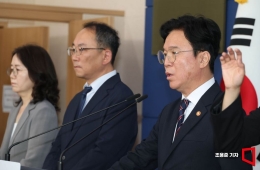
Kim Yongbeom, policy chief, is listening to participants' remarks at the Cabinet meeting presided over by President Lee Jae-myung at the Blue House on August 4. From left: Lim Gi-geun, Secretary-General for Policy Coordination; Kim Yongbeom, policy chief; Choi Dong-seok, Commissioner of the Ministry of Personnel Management. August 4, 2026. Photo by Yonhap News.
View original imageOn August 12, in a Facebook post titled "3 Mega and 7 SEED," Kim wrote, "Mega nurtures SEED, and SEED grows into a new Mega," adding, "The essence of 3 Mega and 7 SEED lies in this cycle." President Lee Jae-myung, after promoting three major mega projects—semiconductors, physical AI, and AI data centers—presided over the "7 SEED Briefing," which discussed seven future industrial sectors to foster as the next growth engines.
Kim pointed out that the current competitiveness in semiconductors does not automatically guarantee future growth. He stated, "The history of technology has repeatedly shown that today’s success does not guarantee tomorrow’s dominance. Semiconductors are among the most significant industrial assets that the Republic of Korea has painstakingly built. This is why we must now ask what comes next."
As the answer, he reiterated seven fields: SMR, nuclear fusion, renewable energy, quantum, advanced bio, aerospace, and advanced materials and components. While these fields have yet to form large markets like semiconductors, the aim is to identify and invest early in technologies that could become new growth engines for the Korean economy in the next 10 or 20 years.
Kim said, "A seed is not a tall tree from the start," stressing, "The crucial task is to anticipate which of these small seeds will be able to sustain Korea in 10 or 20 years, and to secure the soil where they can take root ahead of others." He especially emphasized that the 3 Mega and 7 SEED strategies should not be implemented separately, but rather designed as a single, interconnected industrial ecosystem.

He identified energy as a core link within the industrial ecosystem. As AI data centers and semiconductor manufacturing facilities rapidly increase, power demand will inevitably surge. Consequently, the importance of next-generation energy sources such as SMRs and nuclear fusion is also rising. Kim explained, "As the AI data center and semiconductor industries grow, power demand will also rise. Conversely, if Korea can secure an abundant supply of inexpensive and stable energy, it will be able to attract and expand semiconductor plants and AI data centers more aggressively."
He also sees the technological capabilities accumulated in AI and semiconductors as a foundation for the growth of the 7 SEED industries. Large-scale AI computing capacity can accelerate research and development in quantum and advanced bio sectors, and combining Korea's strength in precision manufacturing with AI and robotics could significantly boost the competitiveness of the aerospace industry.
Beyond the cross-sectoral utilization of technology, Kim highlighted the importance of a virtuous cycle of capital. "The capital earned from today’s core industries must flow into research and development (R&D) and new companies, allowing some of them to grow and create new industries," he stated. "Newly emerging industries should, in turn, reinvest into the next wave of technologies and firms." He stressed, "The capital generated by today’s profit-making industries must be channeled into the industries that will lead profit-making tomorrow. Capital from large enterprises, technologies developed by researchers, and the challenges taken on by startups all need to be interconnected." He explained that Korea needs to broaden the industrial base so that the entire national economy does not become beholden to the cycle of a single industry.
To this end, Kim argued that it is not enough to simply repeat the past government-led development strategy that sequentially fostered steel, shipbuilding, automotive, and semiconductors into global industries. He stressed the need for a new growth structure in which companies, researchers, startups, and capital are organically connected. "We cannot repeat the success strategies of the past verbatim. The era has changed, and so has technology. However, it is possible to rebuild a structure in which the success of one industry leads to the birth of the next," he said.
Hot Picks Today
 "Why Is the Amount in My Account So Low?"... Why Pension Savings Subscribers Were Surprised
- "After Sleeping Well with Strangers"... Who Is the 24-Year-Old Woman Who Won 19 Million Won?
- "SK hynix to Hit 4.7 Million Won, Samsung 670,000 Won"... Why Nomura's Bold Forecast justifies it
- "Even Underwear Has to Be Cut Up with Scissors"... China Hit by Rise of "Trash Hunters" in an "If You're Slow, You're Out" Scramble
- "NPS loses 240 trillion won, 1990s-born get zero pension"... What's behind rumors spreading after the KOSPI plunge?
He added, "What is needed now is to further strengthen industries that have already grown into large trees, while also planting new seeds. Korea's next phase of growth will begin when one or two of the seven seeds planted today grow into new mega-industries."
© The Asia Business Daily. All rights reserved. Unauthorized AI training and use prohibited.