Hwang Hee's 'Bus House' Proposal: Is It for Real?... Why a Six-Year-Old Report Is in the Spotlight
KBS Venezuela Report from 2020 Resurfaces
Pilgrimage-style Comments Appear on Six-Year-Old Video
The "Bus House" concept—renovated bus units proposed as temporary housing for young people by Hwang Hee, a member of the Democratic Party of Korea—has sparked intense backlash and anger among Millennials and Gen Z, amplifying the controversy. Criticism is mounting from those who accuse the policy of failing to truly grasp the despair of young people losing hope of homeownership amid high interest rates and surging housing prices. The controversy has grown even more severe as real-life cases from Venezuela, where abandoned buses became shelter during a dire economic crisis, have been brought back into the spotlight.

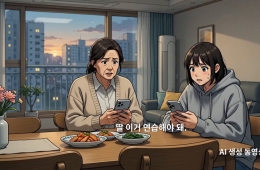
An artificial intelligence (AI) image satirizing the 'Bus House' proposed by Hwang Hee, a member of the Democratic Party of Korea. Screenshot from SNS.
View original image'50 Million Won Bus House' Proposal Angers Millennials & Gen Z: "Are We Refugees?"
The controversy began with Assemblyman Hwang's recent "Bus House" proposal. Inspired by the Netherlands' "Boat House," which repurposes decommissioned vessels, Hwang announced his vision to remodel abandoned buses as short-term temporary housing for young people near university areas. He argued that if 10,000 units were supplied at about 50 million won each, the total cost would be around 50 billion won—presenting it as a practical, quickly scalable alternative through various types of bus houses, including mobile and trailer versions.
However, the response from young people was not just cold, but outright furious. On various social media channels, criticisms such as "You’ve blocked all loan routes, and now you’re telling young people to live in abandoned buses?", "We may not have houses, but we certainly have dignity," "Are young people supposed to be homeless or refugees?" and "The assemblyman who proposed it and his family should move in as the first residents" were widespread, denouncing the idea as an out-of-touch, hypocritical thought experiment detached from reality.
Such pushback stems not merely from emotional outrage, but is seen as an outpouring of anxieties and loss of opportunity compounded over years of housing insecurity. According to the National Statistics Portal (KOSIS), in the previous year, the homeownership rate among people under 39 stood at only 27.7 percent. This is the lowest since the data was reorganized in 2017, starkly illustrating the hardships faced by the vast majority of young adults—more than 7 out of 10—in owning a home.
AI Satire Memes Spread... Venezuelan Real-life Cases Resurface
Younger generations’ anger has intertwined with their distinct meme culture, rebirthing the controversy into artificial intelligence (AI)-based satirical content. On Instagram, a parody vlog went viral—allegedly by a "bus house" resident after six months—mocking the mold-infested interiors and commenting, "It’s a sauna in summer, a freezer in winter." The video surpassed 230,000 views within two days.
On X (formerly Twitter), digitally manipulated images using AI have rapidly circulated, parodying luxury Seoul apartments—"Hannam The Wheel" (sales price 20 million won), "Acro Rivers Park" (sales price 15 million won), "Banpoter Xi" (sales price 15 million won)—with the building supervisor listed as "Hwang Hee".

The controversy intensified when actual examples of bus homes from Venezuela resurfaced. Amid the currency collapse and rampant hyperinflation triggered by the COVID-19 outbreak in 2020, a KBS report featuring the Gonzalez family living out of an old, rain-leaking bus with buckets to catch water and hammocks for beds drew renewed attention.
On these old articles and videos, comments have poured in, such as "Is this where you got the idea from?" and "Was Venezuela your role model?" pointing out the resemblance. Even if Assemblyman Hwang's premise of remodeling with 50 million won per bus doesn't perfectly match the Venezuelan case, critics note that the notion of young people living in abandoned buses itself evokes a sense of misery.
Bipartisan Criticism from Political Circles... Apology Fails to Quell Backlash
Both sides of the political spectrum have voiced criticism. The People Power Party denounced the proposal as "a bizarre idea that mocks young people," while Lee Jun-seok, leader of the Innovation Party, questioned the feasibility of connecting utilities and cited U.S. statistics on vehicle dwellers, pointing out, "Vehicle living is classified as homelessness, not housing."
Concerns also emerged within the ruling party. Han Jung-ae, Democratic Party policy chief, stated, "With Korea's wide seasonal temperature variations, this is unfeasible," and added, "If there is unused land, building proper housing would make more sense." She further apologized, "It was presented at the idea level, but I sincerely regret unintentionally hurting young people."
Hot Picks Today
!["Despite Complaints About Sweat, She Straps On a 15kg Bag and Pushes Through the Deadly Heatwave [Sociology of Heatwaves] ①"](https://cwcontent.asiae.co.kr/asiaresize/93/2026081215431278523_1786516992.gif) "Despite Complaints About Sweat, She Straps On a 15kg Bag and Pushes Through the Deadly Heatwave [Sociology of Heatwaves] ①"
"Despite Complaints About Sweat, She Straps On a 15kg Bag and Pushes Through the Deadly Heatwave [Sociology of Heatwaves] ①"
- "Samsung 200 Trillion + Hynix 100 Trillion"... The 300 Trillion Won Shareholder Return Race Set to Reshape the Domestic Market
- "You Could Even Go to Europe"...When to Catch This Fall's 11-Day Golden Holiday
- Choo Mi-ae: "Illegal Orders Must Be Refused"... Gyeonggi Province Reviews Integrated Defense Ahead of Ulchi Exercise
- "Your Loose Tongue Boasts Even Pro-Japanese Ancestors"... Author Slams Prestigious Family Actor over Great-Grandfather Controversy
As the controversy spread, Assemblyman Hwang deleted his Bus House proposal post and offered an apology: "It was sincerely just a conceptual idea for providing temporary housing for young people in poor environments such as Goshiwons. I sincerely apologize for any distress and disappointment caused to young people and the public."
© The Asia Business Daily. All rights reserved. Unauthorized AI training and use prohibited.