Kim Younghoon: "Basic Rights Act for Workers and Presumed Employee Status System to Be Enacted This Year... Customized Youth Job Opportunities to Expand"
The "Basic Rights Act for Workers" and the "Presumed Employee Status System," which are intended to protect workers outside the institutional framework, such as specially employed and platform workers, are being promoted with the goal of legislative enactment within this year. Supervision over repeated serious industrial accidents and wage arrears will also be strengthened, while employment support for youth and middle-aged workers and responses to the transition to artificial intelligence (AI) will be pursued in tandem.

Minister of Employment and Labor Kim Younghoon is reporting on work at the plenary meeting of the Climate, Energy, Environment and Labor Committee of the National Assembly on the 12th. Photo by Yonhap News
View original imageKim Younghoon, Minister of Employment and Labor, announced these plans during a work report at the plenary session of the National Assembly's Climate, Energy, Environment, and Labor Committee on the 12th. In his opening remarks, Minister Kim identified the main priorities for the second half of the year as: a safe workplace where fair compensation is guaranteed; ensuring opportunities for everyone to work; and spearheading an industry-wide transformation grounded in labor.
Minister Kim stated, "With the rapid increase in service providers due to advances in AI and platform economies, the existing system is insufficient to fully protect them," adding, "We will actively support parliamentary discussions so that the Basic Rights Act for Workers (the Workplace Basic Act) and the Presumed Employee Status System can be enacted within this year."
The Ministry of Employment and Labor is working to establish a so-called "K-Work Welfare Chamber" so that service providers such as the specially employed and platform workers can receive needed support from a single source. The ministry will also transition social insurance to an income-based system and gradually expand the application of the Labor Standards Act to workplaces with fewer than five employees, through social dialogue.
A roadmap for implementing the principle of equal pay for work of equal value will also be prepared within this year. The ministry will work to address the practice of repeatedly hiring under one-year short-term contracts and the different treatment given to workers doing the same jobs, and will promote improvements to the treatment of non-regular workers in the public sector, the contract work system, expansion of employment opportunities for people with disabilities, and establishment of an integrated support system for protecting migrant workers’ rights.
Minister Kim stated, "We will lay the groundwork for narrowing the gaps by increasing the unionization rate so that the voices of vulnerable workers are heard, and we will prevent unnecessary confusion in the field by preparing detailed guidelines for collective bargaining." He also pledged to implement joint agreements among labor, management, and government on reducing actual working hours, and to complete improvements to the retirement pension system by year-end.
The response to industrial accidents will focus on repeated incidents. The ministry will conduct intensive supervision, inspections, and close management for companies where the same type of serious accident has recurred over the past 10 years. Minister Kim said, "There should never be a case where the same type of serious accident is repeated at a single business site," emphasizing, "To eradicate recurring accidents, we will closely manage companies where the same accident has recurred over the past 10 years through intensive supervision and inspections." He added, "We will ensure that workers’ rights to avoid danger and to participate in occupational safety and health prevention activities are fully guaranteed at worksites."
Sanctions against wage arrears will also be strengthened. Starting in October, the maximum statutory sentence for employers with wage arrears will be raised to five years, and wage payment segregation systems will be introduced in the construction and shipbuilding industries. Minister Kim said, "From October, the statutory maximum sentence for wage arrears will be increased to five years, and we will introduce wage payment segregation in the construction and shipbuilding sectors to block exploitative structures arising from subcontracting."
Support for youth employment will also become multi-layered. Minister Kim stated, "For the younger generation, we will expand private sector job and startup opportunities in new industries linked to government business support initiatives, and we will reinforce job and retention incentives for those employed at local small and medium-sized enterprises." The government will also expand the "K-New Deal Academy," where major companies by sector and region—including large corporations—directly design and manage job skills development and adaptation programs in youth-preferred fields, as well as public and private work experience projects. Furthermore, for young people who still have not found employment after completing vocational skills training, a so-called "Playground" program will be provided, offering continuous support from training to employment through activities involving professional counselors and peer communities.
For the middle-aged and older generations, the Ministry of Employment and Labor will gradually extend the mandatory reemployment support services to workplaces with 300 or more employees, and the number of career development centers for middle-aged workers will be increased to 12. Minister Kim stated, "Based on social dialogue, we will also promote support measures for the coexistence of youth and middle-aged generations, including intergenerational win-win retirement extensions."
Hot Picks Today
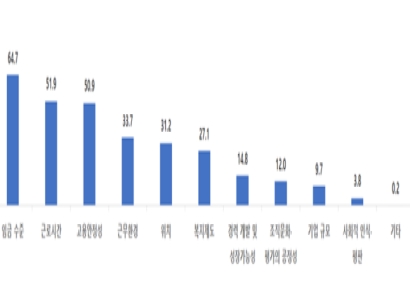 "Please Pay Me at Least 3 Million Won a Month": More Than Half of Young People Today Prioritize "Working Conditions" Over Company Size
- Selling Like Crazy Every Year... 30-Year-Old Hetbahn Takes on a New Challenge: Tastes Better Than "Mom's Home Cooking" [On-Site Report]
- He Left It in the Car and Forgot... "I Nearly Collapsed with Joy": Man Wins $1.48 Million Lottery
- Ran 18 km With 9-Year-Old Tied to Him at the Waist... "Man Banned From Competing for 3 Years"
- Beachgoer Finds 'Plastic' That Turns Out to Be Perfume Ingredient Worth More Than Twice as Much as Gold
All 102 employment centers nationwide will be revamped into "My AI Employment Centers." The ministry will promote "Lifelong AI Job Total Care," which provides support tailored to each stage of life, from the first job for young people to career transitions and reemployment for older adults, and "AI For All," which expands basic vocational training so that anyone can develop AI skills. Employment policies to respond to AI transformation (AX) and industrial transition will also be promoted. The government will thoroughly implement the basic plan for employment stability amid industrial transformation, and will develop AI ethics guidelines to ensure that AI does not displace people in the workplace. Minister Kim stressed, "We will turn the challenges of great transition into opportunities for a major leap forward, ensuring that no one is left behind in the process."
© The Asia Business Daily. All rights reserved. Unauthorized AI training and use prohibited.