The Paradox of 'Safe Alternatives': 'Mini Brain' Growth Inhibited by Up to 35% [Reading Science]
KIT Identifies Developmental Neurotoxicity of PFAS Substitute GenX
Neural Network Function Also Impaired
A recent study has shown that substances developed to replace hazardous per- and polyfluoroalkyl substances (PFAS) may themselves disrupt brain development. When these alternative substances were introduced to mini brains created from human stem cells, the organoids shrank by up to 35%, with both neuron formation and neural network function impaired.
The Korea Institute of Toxicology (KIT) announced on August 12 that a research team led by Dr. Min Han Ga at the Center for Convergence Toxicity has identified the developmental neurotoxicity of the PFAS substitute "GenX (HFPO-DA)" using cerebral organoids derived from human embryonic stem cells.

Comparison of cerebral organoid size according to GenX exposure concentration. As the concentration of GenX increases, the cerebral cortical organoids fail to grow normally and become smaller in a concentration-dependent manner. Provided by the research team
View original imagePFAS have been widely used in various industrial and consumer products due to their strong resistance to water and oil and their non-stick properties. However, because they do not easily degrade in nature and accumulate in the environment and in the human body, regulations have become increasingly strict. GenX was introduced as a substitute for perfluorooctanoic acid (PFOA), a representative PFAS compound.
The research team continuously exposed cerebral organoids, which mimic human brain development, to GenX. As a result, the size of the organoids decreased by up to 35%, depending on the concentration. The number of proliferating neural progenitor cells also decreased by up to 26%.
Interestingly, the reason for the reduction in organoid size was not cell death. Although the team initially suspected that GenX might induce apoptosis in the organoids, apoptosis analysis did not show significant differences.
Further analysis of the neural rosette and ventricular-like structures showed that GenX inhibits the growth of the brain not by directly killing cells but by interfering with the proliferation and differentiation of neural progenitor cells, thus suppressing the overall process of brain development.

Summary of the study on the inhibition of cerebral organoid growth and neural network formation due to GenX exposure. Provided by the research team
View original imageBrain development impaired even without cell death... Neural network function diminished as well
The effects of GenX were also apparent in the formation and function of neurons. The generation of neurons, astrocytes, and cortical neurons decreased, and indicators related to both excitatory and inhibitory synapses were similarly reduced.
Measurements using multi-electrode arrays (MEA) revealed that the number of active electrodes, firing rate, and burst frequency all declined. Structural developmental impairment of the organoids actually led to decreased spontaneous activity and synchronization in neural networks.
Transcriptomic analysis also showed reduced expression of genes involved in axon guidance, synapse assembly, and the maintenance of neural progenitor cells, while genes related to oxidative stress increased. Based on these results, the team suggested that GenX may disrupt neurodevelopmental signaling and induce oxidative stress, thereby potentially affecting development.
This research is significant in that it addresses the issue of "regrettable substitution"—the emergence of new risks when using structurally similar replacement substances after banning traditional hazardous chemicals—using a human-derived brain model.

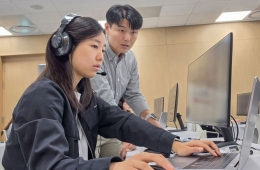
Co-authors and corresponding authors from the Korea Institute for Advanced Science and Technology (KIT) who conducted the research. (From left) Byungseok Lee, Senior Researcher; Youngjoo Lee, Principal Researcher; Minhan Ga, Senior Researcher; Seongae Hyun, Senior Researcher. Courtesy of KIT
View original imageAnother notable feature is the use of human-derived organoids instead of animal experiments, allowing the simultaneous analysis of morphology, cell types, synapses, electrophysiology, and gene expression. The researchers hope that such next-generation alternative testing methods (NAMs) can be used in the future to evaluate the developmental neurotoxicity of chemicals and to develop international test guidelines.
However, this study does not confirm a causal relationship between GenX exposure and neurodevelopmental disorders in humans. This stage provides evidence of potential toxicity and underlying mechanisms that may affect brain development, as observed in human-derived organoid experiments.
Dr. Sung Ae Hyun, the lead author, said, "This study is an example of multilayered assessment of developmental neurotoxicity using a human organoid platform," adding, "We will continue our research to establish internationally standardized testing systems, so new chemical substances can be evaluated for safety more quickly and accurately."
Hot Picks Today
![Selling Like Crazy Every Year... 30-Year-Old Hetbahn Takes on a New Challenge: Tastes Better Than "Mom's Home Cooking" [On-Site Report]](https://cwcontent.asiae.co.kr/asiaresize/93/2026102216175071025_1792653470.jpg) Selling Like Crazy Every Year... 30-Year-Old Hetbahn Takes on a New Challenge: Tastes Better Than "Mom's Home Cooking" [On-Site Report]
Selling Like Crazy Every Year... 30-Year-Old Hetbahn Takes on a New Challenge: Tastes Better Than "Mom's Home Cooking" [On-Site Report]
- "Please Pay Me at Least 3 Million Won a Month": More Than Half of Young People Today Prioritize "Working Conditions" Over Company Size
- A 12-Year-Old Girl Went to the Hospital After Her Blood Pressure Hit 225 and Was Stunned: "What Is This Coral Reef-Like Thing in Her Aorta?"
- "Hey, Lady, Teach Your Kids to Behave!" ... 300,000 Won in Cash and a Bodily Injury Claim Demanded Over Child's Door Ding
- Beachgoer Finds 'Plastic' That Turns Out to Be Perfume Ingredient Worth More Than Twice as Much as Gold
The results of this study were published last month in the international journal 'Materials Today Bio.'
© The Asia Business Daily. All rights reserved. Unauthorized AI training and use prohibited.