KOSDAQ Surpasses KOSPI in August... Will It Recover the 1,000-Point Mark?
Drawdown Last Month Surpassed the COVID-19 Period
Triple Drivers This Month: Policy, Liquidity, and Leading Sectors
Attractive Valuations Supported by Supply-Demand and Fundamentals
This year, after experiencing extreme volatility, the KOSDAQ index hit its lowest point last month and is now posting a strong rebound. As the trend of KOSDAQ outperforming KOSPI continues, market experts unanimously agree that this rebound is not just a result of short-term supply and demand improvements, but also a result of a combination of structural reforms and momentum.

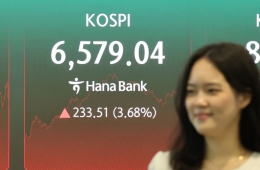
According to the Korea Exchange on August 12, the KOSPI has declined by 3.79% so far this month (from the closing price on July 31 to August 11), dropping from 6,595.45 points to 6,345.53 points. In contrast, the KOSDAQ surged 19.18% during the same period, rising from 719.76 points to 857.84 points.
Looking back at key moments in history when the KOSDAQ outperformed the KOSPI, there is increasing confidence in the market’s further upside potential. According to SK Securities, in December 2004, amid the aftermath of the dot-com bubble burst and credit card crisis, relaxed listing requirements, expanded venture capital policies, and the emergence of bio and entertainment as leading sectors, led to a successful rebound fueled by capital inflows into installment-type funds. In January 2018, after the semiconductor super cycle, measures such as tax deductions for KOSDAQ Venture Funds and an expansion in the proportion of institutional investments like pension funds drove the market upwards. Similarly, in the first half of 2023, following the end of the interest rate hike cycle, the US Inflation Reduction Act (IRA), and electric vehicle momentum, secondary battery stocks emerged as leading sectors, with strong retail investor buying lifting the index.
Compiling these past examples, the core conditions for a rebound are as follows: a favorable liquidity and interest rate environment; a gap period without clear KOSPI leaders; strong proactive policy measures; and the emergence of a leading industry that reliably generates profit. Currently, the KOSDAQ is seen as benefiting from sector rotation following blue-chip rallies, robust government policy including the exit of insolvent companies, and the rise of next-generation themes such as bio and robotics.

The KOSDAQ is considered attractively valued from a long-term investment perspective. According to Samsung Securities, it is extremely rare for the index to fall below its 120-month moving average after only three months of declines following a 52-week high. Statistically, after falling below this average, the KOSDAQ’s expected one-month return is 4.4% (with a 79.9% probability of a rise), and the expected 12-month return is 36.7% (with a 100.0% probability of a rise). The 12-month forward price-to-earnings ratio (P/E) stands at 18.0 times, which is in line with its historical average of 17.5 times, reducing valuation pressure.
Positive signals are also being detected from both supply-demand and fundamental perspectives. Since the early implementation of strengthened basic deposit requirements on July 31, individuals have continued net selling of single-stock leveraged exchange-traded funds (ETFs), resulting in an increase in market-adjacent funds such as deposits. In addition, with tighter delisting criteria such as raising the minimum market capitalization to 20 billion won and delisting of penny stocks, clean-up of riskier listings is expected to raise KOSDAQ net profits from 7.6 trillion won to 8.66 trillion won, an increase of 12.9%. Furthermore, return on equity (ROE) is projected to rise from 3.08% to 3.57%, and earnings per share (EPS) are expected to increase by 14.0%.
As the KOSDAQ market works to resolve its structural discount, some predict it will enter a long-term upward trajectory. NH Investment & Securities projects that, as the system for expelling marginal companies becomes stricter, up to 100–220 companies may be delisted this year. The introduction of a KOSDAQ promotion and relegation system, with the final draft expected to be confirmed in September or October, is seen as a key measure to prevent the exit of high-quality companies and to attract investment from long-term institutional investors such as pension funds. Even if a sharp V-shaped rebound is limited in the near term, the KOSDAQ is expected to gain renewed momentum from policy effects starting next month and recover to the 1,000-point level.

Beomseok Kwon, Senior Researcher at Samsung Securities, diagnosed, "Last month, the maximum drawdown (MDD) on the KOSDAQ was -47.4%, exceeding the -44.2% seen at the height of the 2020 pandemic, indicating considerable price volatility. Such volatility could be exploited as an investment opportunity." He added, "Given that the minimum market capitalization criterion will be raised from 20 billion won to 30 billion won starting in January next year, the shift from a 'high birth, low death' to a 'high birth, high death' system is progressing smoothly. Fundamental improvements stemming from structural changes in the market are also acting as positive factors for KOSDAQ gains."
However, some caution against concentrated investments in the KOSDAQ. Jiyoung Han, Researcher at Kiwoom Securities, advised, "There is growing discussion that market leadership in supply and demand is shifting from the KOSPI to the KOSDAQ. While it is reasonable to focus on the KOSDAQ, which is enjoying a short-term rally driven by momentum, reducing KOSPI holdings drastically should not be a top priority." He continued, "The recent relative strength of the KOSDAQ largely reflects a rebound from previous excessive declines and a process of converging with the KOSPI. Upward momentum remains for large-cap stocks as well."
Meanwhile, the KOSPI opened at 6,438.50 on August 12, up 1.47% from the previous trading day, and was trading at 6,466.77 as of 9:55 a.m., up 1.91%. At the same time, the KOSDAQ was trading at 850.13, down 0.90%.
Hot Picks Today
!["Despite Complaints About Sweat, She Straps On a 15kg Bag and Pushes Through the Deadly Heatwave [Sociology of Heatwaves] ①"](https://cwcontent.asiae.co.kr/asiaresize/93/2026081215431278523_1786516992.gif) "Despite Complaints About Sweat, She Straps On a 15kg Bag and Pushes Through the Deadly Heatwave [Sociology of Heatwaves] ①"
"Despite Complaints About Sweat, She Straps On a 15kg Bag and Pushes Through the Deadly Heatwave [Sociology of Heatwaves] ①"
- "Samsung 200 Trillion + Hynix 100 Trillion"... The 300 Trillion Won Shareholder Return Race Set to Reshape the Domestic Market
- "You Could Even Go to Europe"...When to Catch This Fall's 11-Day Golden Holiday
- Oh Se-hoon: "Housing Is a 'Ladder of Life' for Young People... Seoul Should Not Be Left Because of Housing" (Comprehensive)
- "Your Loose Tongue Boasts Even Pro-Japanese Ancestors"... Author Slams Prestigious Family Actor over Great-Grandfather Controversy
Overnight, the New York stock market declined due to concerns over navigation through the Strait of Hormuz and inflation. On August 11 (local time), the Dow Jones Industrial Average fell 184.13 points (-0.34%) to close at 53,791.85. The Standard & Poor's (S&P) 500 Index dropped 24.91 points (-0.32%) to 7,728.20, and the tech-heavy Nasdaq Composite Index fell 159.91 points (-0.60%) to finish at 26,445.45.
© The Asia Business Daily. All rights reserved. Unauthorized AI training and use prohibited.