[NYSE] Strait of Hormuz Remains Shut... All Major Indexes Close Lower
International Oil Prices End Slightly Higher
Iran: "Strait Will Only Open If Conditions Are Met"
On August 11 (local time), all three major indexes on the New York Stock Exchange finished lower, as tensions persisted despite reports of an imminent agreement regarding the reopening negotiations for the Strait of Hormuz, with Iran maintaining a hardline stance.
At the New York Stock Exchange (NYSE), the Dow Jones Industrial Average declined by 184.13 points (0.34%) to close at 53,791.85. The large-cap-focused S&P 500 index fell by 24.91 points (0.32%) to 7,728.20. The tech-heavy Nasdaq index slid by 159.91 points (0.60%) to finish at 26,445.44.

Investor sentiment weakened late in the session, as the standoff between the United States and Iran over the reopening of the Strait of Hormuz led to a slight rebound in international oil prices.
Mohsen Rezaei, Secretary of Iran's Supreme National Security Council (SNSC), warned that Iran would not open the Strait of Hormuz unless the United States ended the conflict and released Iran's frozen assets.
Secretary Rezaei, during a meeting with the Chinese ambassador to Iran, stated, "The United States is the source of instability in the Persian Gulf, the Strait of Hormuz, and the Gulf of Oman," adding, "The Strait of Hormuz will never be opened until the United States changes its attitude and accepts Iran's conditions."
He further emphasized, "Even if an agreement is reached between Iran and Oman regarding passage through the Strait of Hormuz, this is an entirely separate matter from the issue of maintaining the blockade of the Strait."
As a result, West Texas Intermediate (WTI) crude for September delivery rose 1.3% to $83.20 per barrel on the New York Mercantile Exchange. Brent crude for October delivery increased 1.4% to $88.91 per barrel on the ICE Futures Exchange.
Jose Torres of Interactive Brokers commented, "Investors have been waiting for an agreement for weeks, and at this point, tangible progress is necessary for stocks to rise further."
Major technology stocks also faltered. Alphabet's share price, after rebounding the previous day following three consecutive days of decline since Google's announcement of an artificial intelligence (AI) restructuring, fell again by 3.84% compared to the previous session.
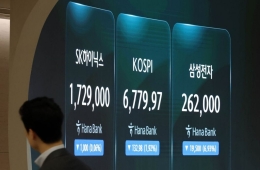
Nvidia, which rose by more than 2% early in the session, reversed course to close marginally weaker by 0.02%. In contrast, Meta rose by 0.71%, Micron by 0.87%, and SK hynix ADR climbed 4.70%, all finishing higher.
Investor attention is now focused on the July Consumer Price Index (CPI) and Producer Price Index (PPI). Amid growing uncertainty surrounding the Federal Reserve's outlook following the recently released weak jobs report, the weight of upcoming inflation data is increasing.
Dennis Palmer, Chief Investment Officer of Montis Financial, said, "Despite the weak jobs report, we expect the CPI report to show a continued downward trend in inflation, which will further bolster the case for the Fed to maintain rates on hold."
He added, "While price increases in the service sector may remain a chronic issue, this sector is not particularly sensitive to interest rates, so it does not significantly weaken the rationale for maintaining the status quo."
Hot Picks Today
!["SK hynix Is Our Target"... Japanese Firm Bets 7 Trillion Won as Germany Competes for Investment [AIDC Era of Coexistence] ⑪](https://cwcontent.asiae.co.kr/asiaresize/93/2026082117123788782_1787299957.png) "SK hynix Is Our Target"... Japanese Firm Bets 7 Trillion Won as Germany Competes for Investment [AIDC Era of Coexistence] ⑪
"SK hynix Is Our Target"... Japanese Firm Bets 7 Trillion Won as Germany Competes for Investment [AIDC Era of Coexistence] ⑪
- Was 110 Trillion Won Not Enough? Samsung Electronics Plunges, Dragging Down KOSPI
- All 118 CCTV Footage of Missing Jeju Woman Deleted...Han Donghun: "Police Requested Access Two Months Later"
- "This Trend Is Common in Korea Too"... American Tourist Couple Shocked by Resident's Reprimand, Face Fine for Jogging Shirtless in Venice
- "Monster That Eats Gold" Turns Out to Be Real: Uproar in China as 5-Year-Old Swallows $7,500 Gold Bar, Sparking Questions About Family's Wealth
Meanwhile, according to Investing.com, the yield on the 10-year U.S. Treasury note stood at 4.694%, down 0.4 basis points (1bp=0.01 percentage points) from the previous session. The yield on the 2-year U.S. Treasury note declined by 1.5 basis points to 4.224%.
© The Asia Business Daily. All rights reserved. Unauthorized AI training and use prohibited.





![[Regional Finance Survival Strategy]①While Commercial Banks' Net Profit Soars 54%, Regional Banks Grow Only 6%...Why They Face a Survival Crisis](https://cwcontent.asiae.co.kr/asiaresize/307/2026082017393587431_1787215174.png)