Mayor Kwan-Yeol Park: "If We Provide Water Pipeline for Yongin Semiconductors, Industry and Jobs Must Follow"
Gwangju Launches Regional Win-Win Direct Task Force
Strategic Initiatives Reviewed Including AI Smart City and High-Tech Industry Cluster
City Puts Forward 'Win-Win' Proposal for Yongin Semiconductor Water Pipeline
As the water pipeline supplying the Yongin National Industrial Complex for semiconductors is scheduled to pass through Gwangju, Gyeonggi Province, the Gwangju City Government has decided to request governmental support proportional to the regional burden, as well as incentives such as the attraction of high-tech industries.

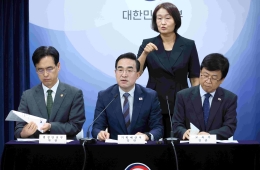
Gwangju Mayor Kwan-Yeol Park is discussing regional win-win measures related to the integrated water supply project for semiconductors in Yongin at the 'Local Win-Win Direct Task Force' meeting held on the 11th at the City Hall Vision Hall. Provided by Gwangju city
View original imageOn August 11, Gwangju City (Mayor Kwan-Yeol Park) held a "Regional Win-Win Direct Task Force" meeting at the City Hall Vision Hall, attended by Mayor Kwan-Yeol Park, senior officials, and relevant department heads. While the city plans to cooperate with the national strategic industry initiative, it aims to link the burden associated with the water pipeline passing through the area to the city’s future growth.
Key strategic initiatives discussed at the meeting included the development of an artificial intelligence (AI) smart city accommodating 30,000 households, the establishment of a national semiconductor and high-tech industry cluster, and the creation of a Physical AI Innovation Cluster. The participants also reviewed ways to align with government policy and measures to secure the necessary support for these projects.
Gwangju City does not intend to remain merely a peripheral city supporting the Yongin National Semiconductor Industrial Complex. The city plans to become a high-tech hub in the southeastern metropolitan area, connecting the AI and ICT industries of Seongnam and Pangyo with semiconductor production functions in Yongin. By expanding R&D, technology demonstration, and business support capabilities, the city aims to strengthen the industrial infrastructure for related sectors.
Regarding the integrated semiconductor water supply project, the city intends to pursue institutional reforms so that areas where the pipeline passes, in addition to those hosting the core infrastructure, will be included as support recipients. To ensure that Gwangju’s requirements are reflected in the relevant laws and government policies, the city will work in cooperation with the National Assembly, Gyeonggi Province, and other stakeholders.
The city will also jointly address anticipated inconveniences for residents, such as traffic congestion, environmental, and safety issues, during the water pipeline construction. The Direct TF will share relevant licensing and regulatory matters and develop response strategies by department.
Gwangju is also pursuing measures to cultivate talent to support the AI and semiconductor industries. The city plans to expand industry-academia partnerships and on-site training programs in collaboration with universities, corporations, and research institutes, as well as to attract related education and research functions, thereby creating a structure that fosters talent development, employment, and industrial advancement.

Park Kwan-yeol, mayor of Gwangju, is discussing regional win-win measures according to the integrated semiconductor water supply project in Yongin during the 'Regional Win-Win Direct TF' meeting held at the City Hall Vision Hall on the 11th. Provided by the City of Gwangju
View original imageThe city will establish a public-private cooperation system involving key organizations, groups, and local communities in various towns, townships, and neighborhoods, and will jointly respond alongside National Assembly members and provincial and city councilors. A separate "Policy Development TF Team" will be formed to oversee policy trend analysis, the discovery of strategic projects, and institutional improvements related to the water supply project and the government’s three major mega projects.
Mayor Kwan-Yeol Park stated, "If Gwangju provides infrastructure for national strategic industries, it is true win-win cooperation when industries, businesses, talent, and jobs come together," and emphasized, "We should not perceive the Yongin National Semiconductor Cluster as merely another regional burden, but rather transform it into a new growth opportunity that redefines Gwangju's industrial landscape."
Hot Picks Today
 "Not Even Daiso, but Prices from 1,000 to 7,000 Won" Crowds Flock... This Place Becomes Millennial & Gen Z Shopping Hotspot
- "Is It Really This Big?" World Number One in Sight... K-Beauty’s Surge Captivates Foreign Consumers with Trusted Korean Products
- A Real-Life Fairytale: 26-Year-Old Car Salesman Revealed to Be a Prince
- "I'm Not Selling, I'm Still Waiting"... Why Jeon Wonju Holds Firm Despite a 9,000% Return on SK hynix
- "Does This Really Work?" Just Add Cold Water... Cup Noodles Sell Out in 68 Years' First Craze
Meanwhile, the city is establishing a "Policy Development TF Team" to build a continuous response system to the Yongin Integrated Semiconductor Water Supply Project and the government’s three major mega projects. Centered around the Policy Development TF Team, the city plans to proactively analyze policy trends, systematically identify strategic projects, implement institutional improvements, and engage in external consultations.
© The Asia Business Daily. All rights reserved. Unauthorized AI training and use prohibited.