Deputy Governor Sangdae Yoo of the Bank of Korea: "Back-to-Back Rate Hikes in August Hinge on This"
Yoo Sangdae to Leave the Bank of Korea This Month
Market Eyes on Possible Back-to-Back Hikes
"GDP and Inflation Trend Continued Since July’s Rate Hike"
Future Path of Growth and Inflation to Be Determined with Economic Outlook
Sangdae Yoo, Deputy Governor of the Bank of Korea, who will be leaving the bank this month, said that the recently confirmed growth and inflation indicators have continued the trend that led to the policy rate increase in July. Regarding the market's focus on inflation, he cautioned that vigilance is needed since the consumer price index may remain above the target level of 2.0% for a prolonged period, rather than just focusing on the magnitude of the increase. He also stressed significant concerns about core inflation persistently rising due to demand-side pressure fueled by the semiconductor-led growth.
This builds a case for an additional rate hike, including a potential back-to-back policy rate increase in August. However, Yoo will step down as Deputy Governor on the 20th of this month, a week before the next rate-setting meeting on the 27th, and therefore will not participate in the decision directly.

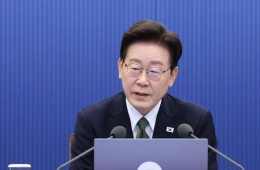
Sangdae Yoo, Deputy Governor of the Bank of Korea, is speaking at a press conference held on the 11th at the Bank of Korea in Jung-gu, Seoul. Bank of Korea
View original imageOn Consecutive Rate Hikes: “Need to Review the August Economic Outlook”
He explained that whether consecutive rate hikes will occur depends on the outcome of the August economic outlook. Previously, Governor Hyun Song Shin of the Bank of Korea had emphasized the need to closely monitor both the second-quarter gross domestic product (GDP) and the July consumer price index following July's rate increase. Deputy Governor Yoo stated, “The decision to raise interest rates in July was made based on growth momentum being stronger than initially expected and the outlook that inflation would remain above the target. This trend was reaffirmed in the most recent second-quarter GDP and July inflation data.”
He continued, “If past data confirms growth and inflation trends, the key now is to use the Bank of Korea’s August economic outlook, which the research bureau is set to prepare in earnest this week, to determine whether the outlook for growth and inflation matches expectations.” Yoo further explained the need to monitor trends through real-time customs export figures and track private consumption—central to demand-driven inflationary pressure—via indicators like credit card spending.
Unprecedented Income Growth: Need to Watch Domestic Spillover Effects
There have been four major policy rate hike cycles by the Bank of Korea since 2000. What sets this latest cycle apart is the unprecedented nominal GDP expansion and current account surplus improvement driven by improved terms of trade. In the first half of this year, the current account posted a surplus of $191 billion, 1.6 times higher than last year’s annual figure of $123.1 billion.
Yoo expects that the unusual increase in income on the growth side will gradually spill over into the domestic market. During periods when export prices drove terms-of-trade improvements, consumption grew significantly more and investment expanded immediately from the outset, compared to periods when import prices played that role. He noted that, above all, the spillover effects of heightened cost pressures due to the Middle East situation—as well as demand-driven pressures stemming from economic recovery—are areas of concern.
“Greater Concern about Prolonged Overshoot than the Size of Price Increases”
When asked if the policy rate ceiling should be kept above the level seen after the Russia-Ukraine war (3.5%, from January 2023 to October 2024), Yoo responded, “Back then, the main shocks were supply-side, triggered by war, and the post-COVID price increases sent inflation much higher. This time, I do not expect inflation to go that high, but the current pressures are largely demand-driven as the economy recovers, meaning there is substantial concern that core inflation could rise gradually but persistently.”
He explained that, although the increase in consumer prices may be smaller than it was when the rate rose to 3.5% during the Russia-Ukraine conflict, there is a risk that high inflation will persist for an extended time, which raises new monetary policy considerations. The longer inflation stays above the target, the stronger the knock-on effects via expectations and wage growth.

Usangdae, Vice Governor of the Bank of Korea, is speaking at a press conference held on the 11th at the Bank of Korea in Jung-gu, Seoul. Bank of Korea
View original imageExchange Rate: Expected to Fall Further… “Fundamentals Will Have Greater Impact”
Yoo projected that the exchange rate, currently hovering around 1,410 won, is likely to decline further. He noted, “From the end of last year into early this year, short-term and temporary factors—including supply-and-demand dynamics and expectations—played a much bigger role in determining the exchange rate than fundamental or longer-term drivers.” In fact, temporary factors, rather than fundamentals such as Korea’s current account surplus, interest rate differentials, or economic growth rate, drove significant and rapid exchange rate movements, according to his assessment.
He continued, “With the impact of supply-and-demand factors waning and the Bank of Korea raising interest rates, the influence of more fundamental factors like the current account and trade surplus is set to increase. Also, growing expectations that the domestic-foreign interest rate gap could narrow further mean that mid- to long-term fundamentals will gain weight compared to temporary factors.” Yoo concluded, “Since supply-and-demand and sentiment effects still linger, I don’t expect a rapid decline. But if I have to pick a direction, I see it heading lower,” signaling his expectation of further depreciation in the exchange rate.
Internationalization of the Won: Preparation Has Begun, Speedy Implementation Needed Amid Change
Yoo views this as the right time to push forward with the internationalization of the won, given Korea’s growing prominence due to the semiconductor-driven boom. “Both foreign investment in Korea and outbound investment by Koreans have surged, yet the market depth is limited, making the foreign exchange market susceptible to supply-and-demand swings and high volatility,” he pointed out. He stressed that building an environment in which market participants can trade comfortably is the starting point. Infrastructure and regulations—such as a 24-hour open market and an offshore won payment system—should be improved first, after which market voices can be reflected in gradual reforms.”Even so, he emphasized that, regardless of the gradual approach, an active and speedy rollout is essential.
He gave positive assessments of the “K dot plot,” introduced in February for the first time in Korea. This tool lets each of the seven monetary policy board members indicate their rate outlook by placing three dots each, allowing for collective forward guidance on rates six months out. “Regardless of the U.S. Federal Reserve’s discontinuation of forward guidance, the K dot plot has proved constructive for communication among the board and its market impact. I expect that will continue to be the case,” he said.
Hot Picks Today
![An Apartment Once Worth 400 Million Won Nears 1 Billion... "Still Worth It" as 1990s-Born Pangyo Workers Flock to Gyeonggi Gwangju [Report]](https://cwcontent.asiae.co.kr/asiaresize/93/2026100211322949134_1790908349.jpg) An Apartment Once Worth 400 Million Won Nears 1 Billion... "Still Worth It" as 1990s-Born Pangyo Workers Flock to Gyeonggi Gwangju [Report]
An Apartment Once Worth 400 Million Won Nears 1 Billion... "Still Worth It" as 1990s-Born Pangyo Workers Flock to Gyeonggi Gwangju [Report]
- [Breaking] Military: "Final assessment confirms our soldiers were injured by North Korean landmines south of the MDL"
- Suddenly Called Out During Class, Awarded $100,000 as Students Cheer in the Gym
- "After a Dream About Feces, Bought a Lottery Ticket and Won 20,000 Won... Scratched Again and Hit a 2 Billion Won Jackpot"
- 'Limp-and-Gold Medal' Controversy Grows... Woojin Choi Apologizes, Says "Absolutely Not Intended to Demean Armed Forces"
Yoo, who first joined the Bank of Korea in 1986, retired in 2021 and rejoined the institution two years later as Deputy Governor. While there were some gaps, he has almost 40 years of experience. Reflecting on his tenure, Yoo recalled, in order: his inauguration on August 21, 2023, during an Eulji exercise; the financial stability risks at the end of that year tied to project financing failures at Taeyoung Construction; his scuttled vacation in August 2024 due to turmoil in the international financial markets from yen carry trades; the state of emergency at the end of that year; U.S. “Liberation Day” tariff announcements in April last year; the focus on stabilizing the FX market amid soaring exchange rates at the end of last year; and the Middle East war that broke out in March this year—just when things seemed to be stabilizing—saying, “Things were so hectic, I barely noticed time passing by.” As for advice for his successor, he simply said, “I am confident an excellent person will take over.”
© The Asia Business Daily. All rights reserved. Unauthorized AI training and use prohibited.